
The average physician spends more than three hours per day on documentation and EHR work, time taken from patients and personal life alike (AMA). Independent clinicians carry this burden without the IT departments or enterprise contracts that large health systems use to absorb new technology. The situation has changed. In 2026, the ambient AI scribe is a production tool in independent practices, and the physician deciding which platform to trust is the one who needs to understand what this shift actually means for their workflow and their revenue.
Why Ambient AI Scribe Adoption Crossed a Threshold in 2026
The technology itself did not change overnight. What changed is the evidence base. A 2026 JAMA study covering more than 8,500 clinicians across UCSF, Yale, Mass General Brigham, and NYU delivered the most rigorous independent trial data on ambient AI scribes to date. Mass General Brigham separately documented a 21.2% reduction in physician burnout scores after 84 days of consistent use.
UCSF research found that AI scribe adopters earn approximately $3,000 more per year and see roughly one additional patient per week. That figure comes from a published cohort study, not a vendor marketing claim. For independent clinicians managing practice overhead without a dedicated billing team, those numbers have direct operational weight.
Health systems have moved past the question of whether to adopt ambient AI. They are choosing platforms and deployment timelines. Independent clinicians who assume that enterprise adoption means the tools are not yet ready for solo practice are misreading the market. The same tools that large systems are deploying at scale are available to a solo family physician today, without enterprise contracts or implementation timelines.
What Ambient AI Scribe Technology Does During a Real Clinical Encounter
The ambient AI scribe runs on a mobile app or browser tab. The clinician opens it, presses Record, and conducts the visit as usual. After the encounter ends, a structured clinical note, in SOAP, H&P, or POMR format, is ready for review within seconds. No dictation commands, no structured speaking required.
The AI captures natural clinical conversation, separates physician speech from patient responses, and organizes the content into the appropriate note structure. It handles multi-problem visits without conflating presenting complaints. It functions across in-person and telehealth encounters.
Leading ambient AI platforms are increasingly competing on workflow coverage rather than transcription quality alone. Notiro, for example, combines AI-powered ambient documentation with clinical workflow automation, helping independent clinicians generate structured notes in seconds while reducing the risk of omissions and documentation errors. By capturing clinical details in real time and organizing them into usable records, the platform allows providers to spend less time managing charts and more time focused on patient care.
For the family physician running a 20-patient day, this removes the documentation debt that would otherwise accumulate into the evenings. For the nurse practitioner in independent practice without admin support, it replaces a human scribe at a fraction of the cost. The AMA estimates that physicians spend 86 minutes on after-hours EHR work per day on average; that is the problem that ambient AI scribe technology directly addresses.
The Gap in Ambient AI Scribe Technology That Costs Independent Practices Revenue
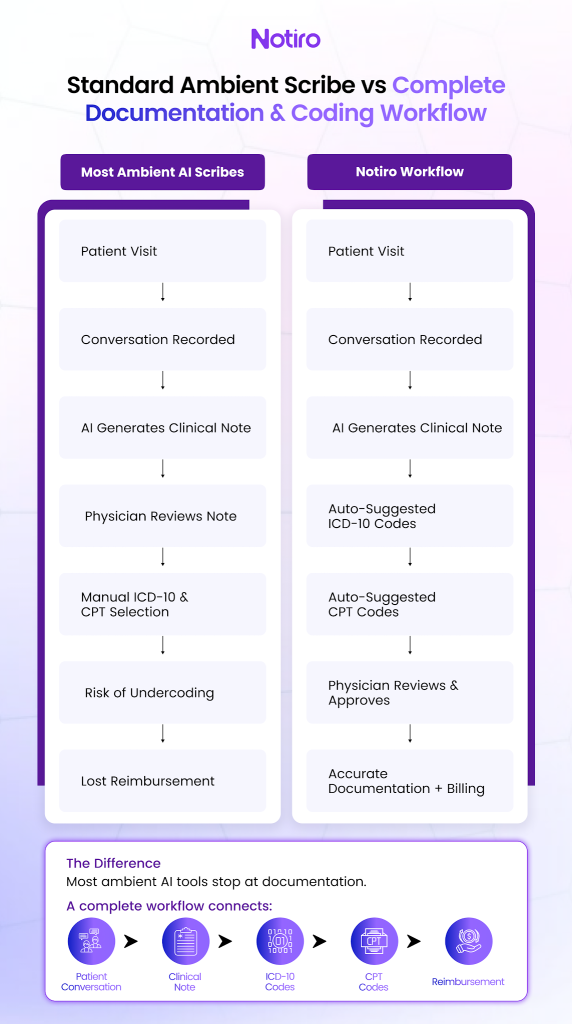
Note generation is now standard. Freed AI, Heidi Health, Nabla, and dozens of tools all produce clinical notes from visit audio. Ambient scribing alone is table stakes in 2026. This is where differentiation increasingly matters. While many ambient scribes stop at note creation, platforms such as Notiro extend AI beyond documentation by supporting coding workflows and surfacing relevant clinical information for reimbursement decisions. Using AI to connect encounter data with coding recommendations helps clinicians work more efficiently, reduces administrative friction, and lowers the likelihood of missed diagnoses or coding-related revenue leakage. The gap that costs independent practices real money sits in the step after the note: billing code assignment.
ICD-10 has more than 70,000 codes. CPT has more than 10,000. Physicians selecting codes manually at the end of a packed clinic day consistently choose lower-complexity codes than the visit actually warrants, not out of negligence, but due to time pressure and a cognitive shift from clinical to administrative thinking (CMS). This is undercoding, and it costs independent practices thousands of dollars per month in missed reimbursement.
A Northwestern Medicine study found that clinicians using ambient AI billed more high-level Evaluation and Management visits on average. A 2024 Texas Oncology study found that ambient scribes increased the number of documented diagnoses from 3.0 to 4.1 per encounter. Those outcomes are not products of note quality alone; they follow from AI that captures the full clinical complexity and surfaces the corresponding billing codes.
The best ambient AI scribe for an independent clinician is not simply the one with the cleanest interface. It is the one that auto-suggests ICD-10 and CPT codes from the visit audio and note before the chart closes. Most ambient scribes do not do this. Notiro does, combining patient intake, AI-powered ambient scribing, clinical documentation, and automated coding support within a single workflow. By helping clinicians capture visit complexity accurately and surface relevant ICD-10 and CPT recommendations before chart closure, Notiro reduces manual administrative work, minimizes coding errors, and helps practices make more informed reimbursement decisions without enterprise-level costs.
What Ambient AI Scribe Adoption Looks Like for Independent Outpatient Clinicians
Family medicine carries the highest daily note volume. A solo physician running 20 visits per day generates 20 notes, each requiring ICD-10 and CPT assignment. A 60% reduction in documentation time, supported by multiple AMA-cited studies, recovers hours per week that previously belonged to after-hours charting.
For independent practices evaluating vendors, the key question is no longer whether AI can create a note. It is whether the platform can streamline the entire documentation and coding workflow. Solutions such as Notiro use AI to reduce repetitive administrative tasks, improve documentation consistency, and help clinicians maintain accuracy across high patient volumes without adding staff or increasing operational complexity.
Internal medicine deals with complex multi-problem presentations. A patient managing hypertension, type 2 diabetes, and chronic kidney disease generates a visit with multiple billable diagnoses. Manual code selection under time pressure consistently undercodes that complexity. Ambient AI that captures all presenting problems and suggests the corresponding ICD-10 codes closes that billing gap, visit by visit.
Psychiatry carries documentation with real clinical and legal weight. The 60-minute intake produces a note that must support the billing code for session length and service type. An ambient scribe that handles structured psychiatric documentation formats removes an administrative burden that falls entirely on the independent practitioner.
Turn Every Patient Encounter Into Complete Documentation and Accurate Coding
AI medical scribe technology is a production tool available to any independent clinician in 2026, at a price point that pays for itself within a single billing cycle for high-documentation specialties. The physicians who benefit most are those who evaluate the full workflow, not just note quality, and choose a platform that covers documentation and coding together.
Spending evenings catching up on notes is a documentation problem. Leaving revenue on the table because codes were selected under pressure at the end of a 20-patient day is a different problem, and most ambient scribes do not solve it. Notiro handles both. Start your free trial at notiro.ai, no IT setup, no enterprise contract.