A Subjective, Objective, Assessment, and Plan(SOAP) note is intended to improve care for the patient. In too many clinics, it does the opposite, because it turns a conversation into a typing marathon and leaves the patient staring at the side of a monitor like it is the main character.
That tension is not imaginary. In a primary care study based on EHR event logs, clinicians spent 355 minutes that is 5.9 hours of an 11.4 hour workday, on the EHR task per weekday, including 86 minutes after clinic hours.
So the goal is not to “write more SOAP notes.” The goal is to write SOAP notes that protect the patient’s story while keeping documentation accurate, defensible, and usable for the next clinician.
Why SOAP Notes Shape The Patient Experience
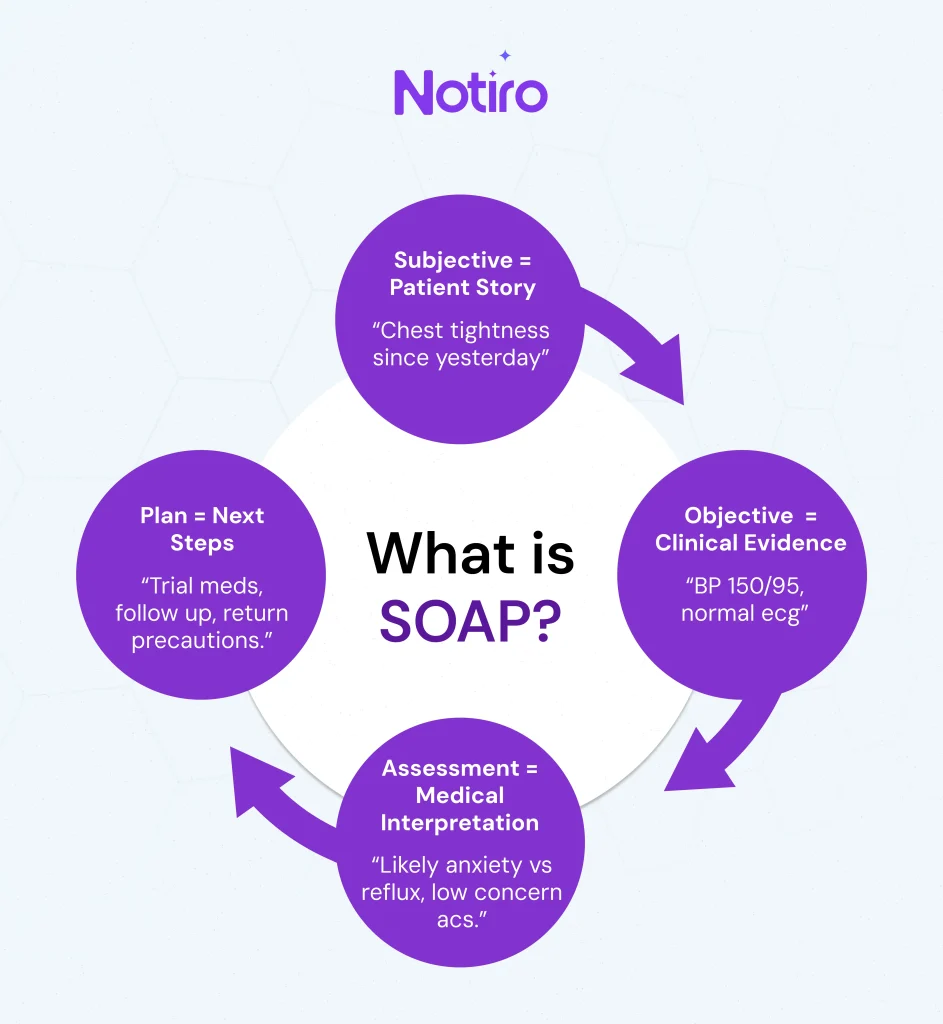
SOAP notes are usually taught as a structure that needs to be implemented. In practice, it is a handoff system. It is how a clinician communicates with the future clinician who will see this patient again, cover an on-call shift, review a chart for a referral, or defend a decision in an audit.
The format traces back to the problem-oriented medical record movement and the work of Lawrence Weed. He is known for developing the SOAP method, which helps organize medical information clearly. This method promotes records that can be easily used for clinical reasoning.
When SOAP is done well, the patient experience improves even if the patient never reads the note, because fewer details are lost and fewer assumptions creep into care. Thus, follow-up steps are clearer, and care feels coordinated.
However, when SOAP is implemented poorly, a few predictable failures occur.
What Goes Wrong When Documentation Takes Over
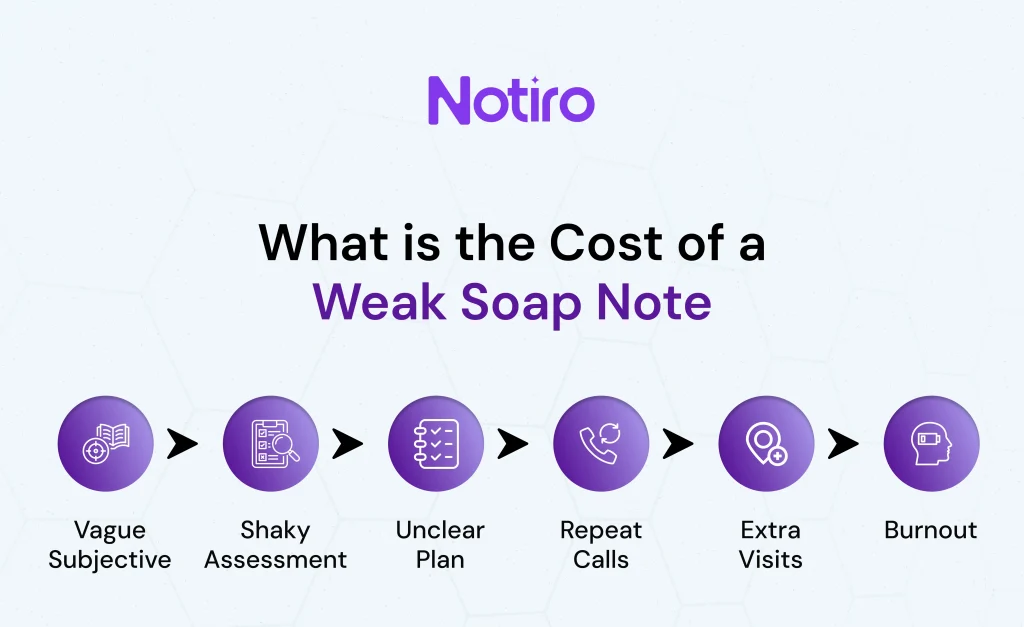
First, the patient’s story gets distorted as important timelines, triggers, and functional impacts are compressed into a single, vague line.
Second, the assessment becomes a copy paste shadow. The note “looks” complete, but does not actually explain why the plan makes sense.
Third, the plan becomes clinician-friendly but confusing for the patient. It might say “RTC PRN” and feel done, but the patient leaves with no concrete steps, no safety net, and no confidence.
The fix is not more words. The fix is a better signal.
How Patient-First SOAP Notes Will Work
A patient’s first SOAP note does not imply an informal note. It simply means the note is anchored in the patient’s lived experience, then translated into clinical reasoning, and finally transformed into a plan that can be followed. Here is how SOAP notes will work in this scenario.
Subjective: That Sounds Like A Human
Subjective is not a transcript. It is the story that matters. Therefore, a strong subjective section includes:
- The patient’s main concern, in their own words, when possible
- A timeline with start point, progression, and what changed
- Context that affects risk, such as travel, exposure, medication changes, or psychosocial stressors
- Functional impact, like what became harder to do or what got interrupted
- Relevant negatives that support the differential rather than a long checklist
An example of a weak subjective is “Headache for 2 weeks.”
However, an example of patient first subjective is “Headache started 14 days ago after a long flight. Dull pressure behind the eyes. Worse in the afternoons. No focal weakness. No vision loss. Sleep has been poor. OTC ibuprofen helps for a few hours.”
The next version may be somewhat more tedious to read. However, in the healthcare industry, it eliminates the guesswork and enhances the care of patients.
Objective: That Is Clean And Defensible
The objective part refers to the part where many notes get messy because everything gets dumped in. Patient first does not mean “include less.” It means including what assists the assessment and plan. Thus, the objective should contain:
- Vitals that matter for the complaint
- Key exam findings, such as ‘what was normal’, assist in ruling out the danger
- Pertinent labs and imaging, not every value
- Procedures performed, plus immediate results
- Documented observation when relevant, such as appearance and distress level, etc.
- Avoid vague phrases like “normal exam” when specific elements matter.
Thus, a clear objective section makes the assessment believable.
Assessment: That Shows Clinical Reasoning
Assessment is the core of SOAP. It is also where patient trust quietly lives, because the plan should feel like it came from real thinking, not from an autopilot. An assessment does three jobs:
- It links subjective symptoms to objective findings
- It prioritizes problems rather than listing everything flat
- It explains the primary diagnosis and lists key alternatives to consider.
For example, a vague assessment will be “Likely viral.” However, a patient’s first assessment will be “Most consistent with viral URI given sore throat, low-grade fever, clear lungs, and no focal exam findings. Low concern for pneumonia given normal O2 saturation and no crackles. Strep less likely given lack of exudate and cough present.”
That short rationale makes the plan make sense. It also protects continuity if another clinician takes over.
Plan: That A Patient Can Actually Follow
Plan is where good clinical care can still fail if the patient leaves confused. Thus, planning is specific, plain language-friendly, and safety net-focused. A practical plan includes:
- Treatment and the reason why it aligns with the assessment
- Medication instructions that are unambiguous
- Tests ordered with a purpose and what will happen with the results
- Follow up timing with a real window
- Red flags with clear instructions
- Referrals with the reason for referral and what the specialist is expected to address
Even small changes help. “Follow up in 2 weeks if symptoms persist” beats “RTC PRN.” A safety net line such as “Go to ER for chest pain, shortness of breath, or fainting” is not fluff. It is risk management and patient reassurance.
A Quick Quality Check of SOAP Notes
Documentation gets better when you check its quality. Using a SOAP checklist helps keep notes clear and consistent, particularly in working clinics. Here are some of the points to do a quick quality check:
- The SOAP notes tell a clear story in the right order
- Objective findings support the diagnosis
- Problems are listed by how serious they are
- The plan is comprehensive with clear instructions, and no assumptions
- Referrals explain why they are needed
- Patient instructions are simple for doctors to read and understand
- Safety instructions are included when there is a risk
- Medication changes are clearly written
- Pending tests and follow-ups are mentioned
Therefore, if a note meets these criteria, the next clinician can easily understand it, and the patient’s care remains smooth between visits.
How Notiro Supports SOAP Notes Format
A patient’s first SOAP note begins before typing starts, and the biggest challenge is staying focused. When attention is divided, the story becomes less clear, and the note loses its strength.
Notiro streamlines the workflow by minimizing active typing during patient encounters. It captures conversations and seamlessly converts them into text for later review. The tool features AI-driven transcription, supports audio recording then uploading, and includes a history function to revisit past consultations.
Moreover, Notiro aligns with that approach by capturing and transcribing conversations, supporting recording and upload, and facilitating review, editing, and revisiting past notes.
Thus, it makes the result simple with better notes, handoffs, and visits. Let Notiro take care of transcription and note drafting. This way, you can focus on the conversation. Afterward, you can review and sign off with confidence.
Frequently Asked Questions
- What Does SOAP Notes Stand for?
SOAP notes stand for subjective, objective, assessment, and plan, which is a standardized documentation used by healthcare providers.
- Is a SOAP Note a Legal Document?
Yes, a SOAP note is a legal document because it is part of a patient’s medical record and can be used as evidence in legal or insurance matters. That’s why it must be accurate and complete.
- Do Doctors Still Use Soap Notes?
Yes, doctors still use SOAP notes every day. Even with modern EHR systems and AI tools, SOAP notes remain the standard way to document patient visits.
- What are SOAP Notes In Healthcare?
SOAP notes are a structured format for documenting patient information. They include what the patient says (Subjective), what the doctor observes or measures (Objective), the diagnosis (Assessment), and the treatment plan (Plan).