
Clinical documentation has become one of the most significant challenges in modern healthcare. Between EHR requirements, compliance standards, coding demands, and patient volume, clinicians often spend hours each day completing notes and administrative tasks.
A 2025 study published in JAMA Network Open found that clinicians using ambient AI documentation tools reported improved workflow efficiency and lower documentation burden.
As healthcare organizations look for ways to reduce administrative workload without compromising care quality, one technology is gaining significant attention: ambient clinical intelligence.
Rather than focusing solely on what the technology is, clinicians are increasingly asking a more practical question: How can ambient clinical intelligence improve daily workflows and reduce time spent documenting care?
This guide explains what ambient clinical intelligence is, how it works during patient encounters, and what clinicians should consider before adopting it.
Ambient Clinical Intelligence Through a Clinician’s Lens
Ambient clinical intelligence refers to AI-powered technology that captures conversations between clinicians and patients and transforms them into structured clinical documentation.
Unlike traditional documentation methods that require providers to type notes manually or dictate information after a visit, ambient AI works quietly in the background during the encounter itself.
Think of it as a digital assistant designed to support documentation rather than clinical decision making.
As conversations occur naturally, the system identifies medically relevant information such as symptoms, medications, treatment plans, and follow-up instructions. It then organizes this information into a draft note that clinicians can review, edit, and approve.
For many providers, the real value is not the technology itself. It is the opportunity to spend less time documenting and more time engaging with patients.
What Happens During an Ambient AI-assisted patient visit?
One reason ambient clinical intelligence is gaining attention is that it fits naturally into existing workflows.
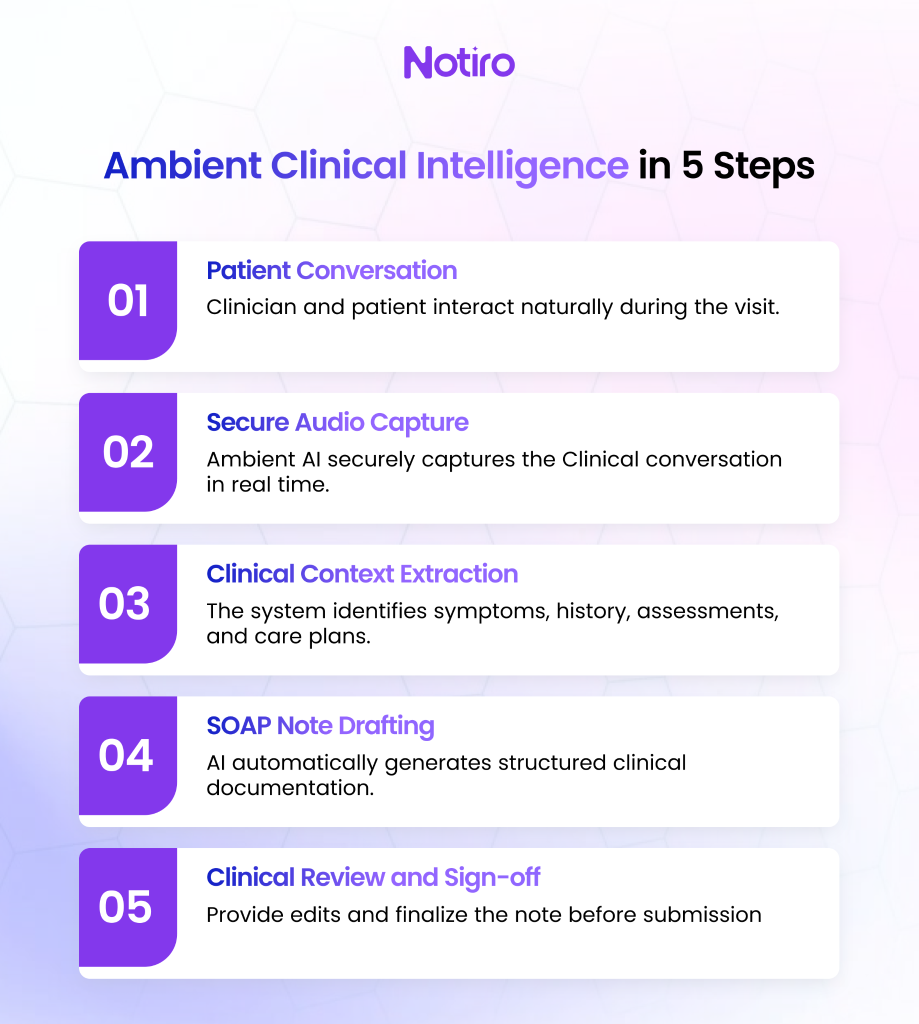
A typical visit may look like this:
- The clinician and patient have a normal conversation.
- The ambient AI system securely captures the interaction.
- Relevant medical information is identified and organized.
- A structured draft note is generated.
- The clinician reviews, edits, and approves the documentation.
Because documentation is created from the conversation itself, clinicians can spend less time switching between patient interactions and data entry tasks.
Why Clinicians Are Paying Attention to Ambient AI
The healthcare industry continues to face increasing documentation demands. Many providers spend hours completing charts after clinic hours, contributing to burnout and reduced job satisfaction.
Ambient AI healthcare solutions are attracting interest because they directly address one of the most common frustrations in clinical practice: documentation overload.
Potential benefits include:
- Reduced documentation time
- Faster chart completion
- Less after-hours charting
- Improved workflow efficiency
- Better patient engagement during visits
- More consistent note quality
- Support for clinical documentation improvement initiatives
When clinicians spend less time focused on screens, they can often devote more attention to patient conversations and clinical decision-making.
Ambient AI vs Traditional Documentation Methods
Healthcare providers have used various documentation tools for years, but not all approaches work the same way.
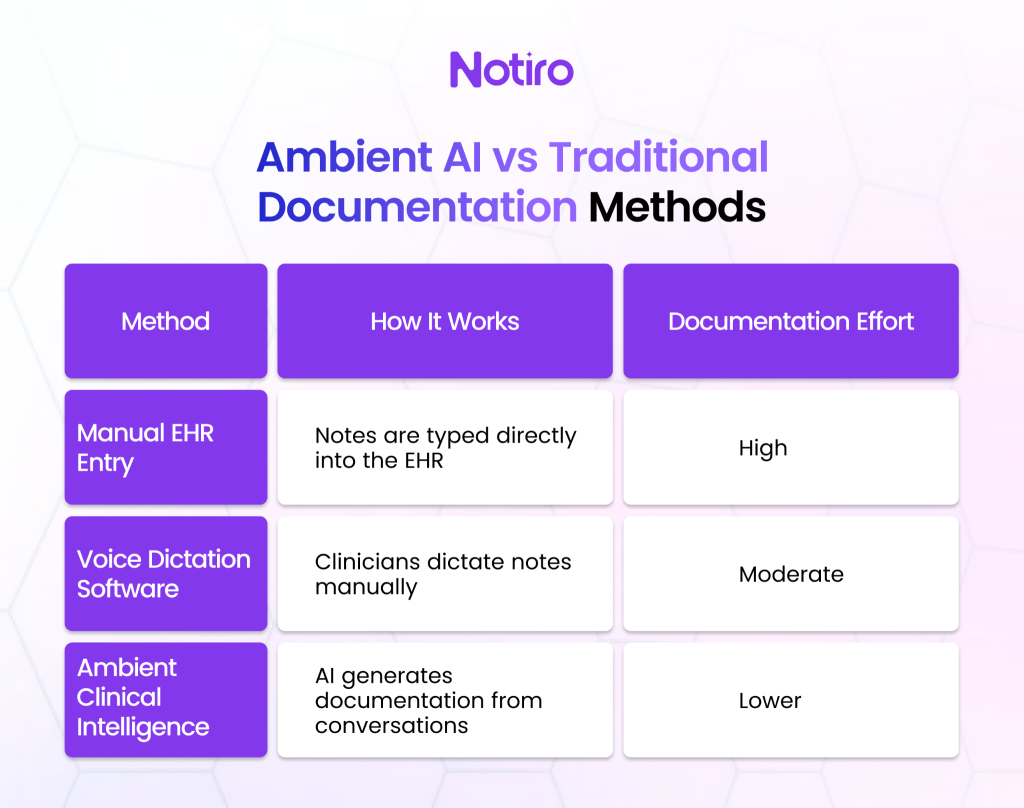
Traditional dictation still requires providers to organize and create notes themselves. Ambient clinical intelligence takes a different approach by helping generate structured documentation from the patient encounter itself.
The objective is not simply faster note-taking. It is reducing documentation workload while maintaining clinician oversight.
Common Misconceptions About Ambient Clinical Intelligence
As AI adoption grows, so do misunderstandings about what ambient clinical intelligence can and cannot do.
- It Replaces Clinicians
It does not.
Ambient AI supports documentation workflows, but clinicians remain responsible for medical decisions, documentation review, and final approval.
- It Creates Perfect Notes Automatically
AI-generated documentation can significantly reduce manual work, but every note still requires clinician review to ensure accuracy and completeness.
- It Is Just a Recording Tool
Modern ambient AI platforms do much more than record conversations. They identify relevant clinical information, organize content, and generate structured notes that support documentation workflows.
How Ambient AI Contributes to Clinical Documentation Improvement
Clinical documentation improvement is about more than compliance and reimbursement.
It also focuses on creating sustainable workflows that support both providers and patients.
Ambient clinical intelligence can contribute in several ways.
- Better Note Consistency
Structured documentation templates can help improve note organization and readability.
- Faster SOAP Note Creation
Many ambient AI systems automatically organize information into SOAP note formats, reducing manual reconstruction after the visit.
- More Structured EHR Documentation
Integrated systems can help reduce repetitive data entry while supporting cleaner documentation within electronic health records.
- Improved Workflow Efficiency
- Documentation that occurs closer to real time often reduces the need for providers to revisit patient encounters later in the day.
How to Evaluate an Ambient AI Solution
Not all ambient AI healthcare platforms offer the same capabilities.
Before adopting a solution, healthcare organizations should consider questions such as:
- Is the platform HIPAA compliant?
- Does it integrate with existing EHR systems?
- Can clinicians easily review and edit notes?
- Does it support specialty-specific workflows?
- Is the documentation accurate and clinically useful?
- Will it simplify existing workflows rather than add complexity?
The most effective solutions should feel like a natural extension of clinical practice rather than another technology that requires extra effort to manage.
The Future of Clinical Documentation
Healthcare technology should support clinicians, not distract them from patient care.
Ambient clinical intelligence represents a shift toward more efficient documentation processes that reduce administrative burden while preserving clinician oversight. As adoption continues to grow, healthcare organizations are increasingly viewing ambient AI as a practical tool for improving workflows, supporting documentation quality, and helping providers spend more time where it matters most: with patients.
How Notiro Streamlines Modern Clinical Workflows
Ambient clinical intelligence delivers the greatest value when it integrates seamlessly into everyday care delivery.
Notiro combines ambient documentation, coding support, clinical order assistance, and EHR integration into a single workflow designed for healthcare providers.
Instead of spending additional time creating notes after appointments, clinicians can focus on patient conversations while documentation is generated in the background. Providers remain in control of every note while benefiting from faster chart completion and reduced administrative workload.
For organizations looking to improve clinical documentation without adding complexity, Notiro helps create a more efficient and patient-focused workflow.