
The average physician spends more than three hours a day on documentation, not care, not diagnosis, just charting. That number is the primary reason 51% of US physicians report burnout. The US Department of Veterans Affairs decided it had seen enough. In October 2025, the VA launched an ambient AI scribe pilot across 10 medical centers. By 2026, that deployment will scale to more than 130 VA facilities nationwide. This is the most closely watched AI scribe hospital deployment in American healthcare history, and every private practice clinician should be paying attention to what it reveals.
What the VA AI Scribe Actually Does
The VA’s ambient AI scribe captures the conversation between a provider and a patient during the clinical visit and automatically generates a draft of the documentation. The provider reviews and signs the note before it is entered into the record. No commands, no dictation prompts, no typing mid-visit.
The VA’s Digital Health Office notes that the technology lets providers have a real conversation rather than talking to someone typing. That shift is not cosmetic. A clinician who makes eye contact and asks follow-up questions consistently produces better visit quality than one who manages two tasks at once.
The workflow runs in four steps: the provider requests consent, a device captures the visit audio, AI processes the conversation into a clinical structure, and the provider reviews it before the chart closes. The system integrates directly with the VA’s existing electronic health record system.
For independent practices, the same principle applies. The value of an ambient AI scribe is not simply that it creates a note, but that it fits naturally into existing clinical workflows. Platforms such as Notiro use AI to automate documentation while integrating with practice operations, helping clinicians spend less time on administrative tasks, reduce manual errors, and focus more attention on patient care.
How the VA Scaled an Ambient AI Scribe to 130+ Hospitals
The VA did not attempt a system-wide launch from day one. The pilot ran at 10 medical centers beginning in October 2025. Early data exceeded initial expectations: providers reported reduced documentation burden, and Veterans reported feeling more connected to their care teams.
In March 2026, Rise8 and Thoughtworks were awarded the federal contract to evolve that pilot into a production-grade platform. The scope covered all 130+ VA medical centers, with plans to expand into additional clinical specialties. VA Providence in Rhode Island went live on March 24, 2026. The rollout model is phased by facility, with structured training for clinical staff at each site before activation.
This phased approach carries a direct lesson for AI scribe hospital deployment in private settings. Large implementations that skip the staged rollout create resistance to adoption. Clinicians who encounter the technology without preparation tend to abandon it within the first week, regardless of the tool’s accuracy.
What the VA Rollout Reveals About Ambient AI Scribe Deployment
Three patterns from the VA implementation are worth examining for any clinician considering a similar transition.
Consent Infrastructure Matters More Than The Technology
The VA built an explicit consent process into every encounter. A research survey of 75 Veterans found that 71% had no concerns about the VA’s ambient AI scribe program, with the remaining concerns focused on privacy. In private practice, the same consent framework applies. Patients who understand what the tool does and that it does not change their care accept it readily.
Training Determines Adoption, Not Accuracy
Published research from JAMIA (2025) found that brief, role-specific prompt examples reduced post-editing burden, and early office-hours sessions improved adoption rates. Clinicians who understood how to work with AI-generated drafts spent less time editing. Those who received no onboarding treated the tool as an extra step rather than a time-recovery mechanism.
Integration Depth Separates Real Deployment From A Demo
A copy-paste workflow that drops AI-generated text into a free-text field is not an integration. The VA system writes structured data back into specific chart fields. For private practice, a genuine ambient AI scribe deployment means choosing a platform that maps note content to the correct EHR sections, not one that adds a paste step after every visit.
This distinction is where modern AI-powered platforms differentiate themselves. Notiro, for example, is designed to streamline the clinical workflow beyond simple transcription by helping providers move from patient conversation to structured documentation with fewer manual steps. By reducing repetitive administrative work and minimizing documentation inconsistencies, AI can improve efficiency while supporting more accurate clinical records and downstream decision-making.
The Documentation Problem the VA Rollout Does Not Solve
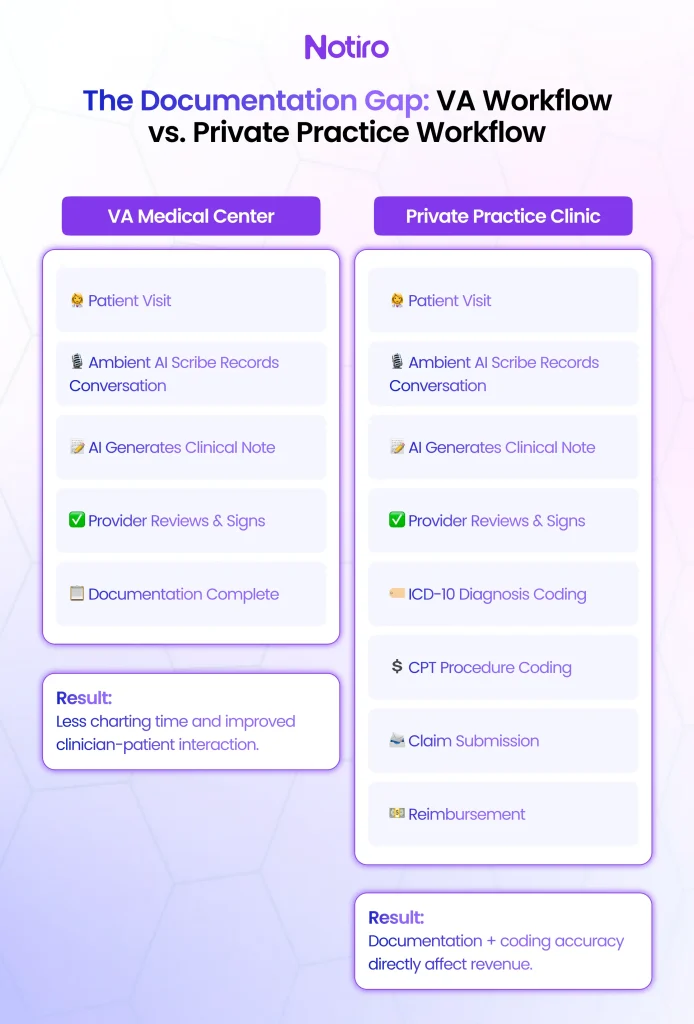
The VA’s ambient AI scribe addresses documentation burden inside a system that already has a billing and coding infrastructure. VA providers do not generate commercial insurance claims. That means the VA deployment, despite its scale, reveals only part of the documentation problem facing the average outpatient physician.
In private practice, note completion is step one. Billing code selection is step two. Undercoding, selecting lower-complexity codes than the visit warrants, costs practices thousands of dollars per month in missed reimbursements. Not from negligence, but from the time pressure of selecting codes manually after a full schedule. CMS reports that ICD-10 contains over 70,000 codes, and CPT contains over 10,000. No provider selects optimally under that pressure without assistance.
The VA rollout validates the ambient scribe as a clinical documentation tool. It does not address the billing layer. For private practice clinicians, that gap is where the revenue conversation lives.
This is where solutions built specifically for independent practices are gaining attention. Notiro extends AI beyond note creation by supporting the workflow before, during, and after the encounter. In addition to ambient documentation, the platform helps clinicians generate ICD-10 and CPT coding recommendations, reducing the time spent on administrative follow-up while helping practices capture appropriate reimbursement opportunities with greater consistency.
What Private Practice Clinicians Should Take From This
The VA deployment is institutional confirmation that ambient AI scribe technology is no longer experimental. A federal health system, bound by strict federal privacy and security standards, has committed to deploying it at scale across the country’s largest healthcare organization. The technology works at volume. The infrastructure questions have been answered at the enterprise level.
For the family physician in a solo or small group practice, the lesson is not that the same technology is now available. It has been available. The lesson is that the documentation threshold question has been answered, and the conversation has shifted to: which platform solves the full clinical day, not just the note?
A clinician still spending evenings charting has already established that ambient scribing alone does not close the loop. What closes the loop is a platform that handles intake before the visit, scribing during it, and ICD-10 and CPT code generation after it , so the chart is billable before the next patient walks in.
Conclusion
The VA is deploying ambient AI scribes at scale across 130+ medical centers with federal-grade infrastructure. That rollout settles the experimental question. The remaining question for private practice clinicians is whether the tool they adopt addresses documentation in its entirety or only the note.
The remaining question for private practice clinicians is whether the tool they adopt addresses documentation in its entirety or only the note. Increasingly, providers are evaluating AI-powered platforms such as Notiro that combine intake, ambient scribing, and coding support into a single workflow designed to reduce administrative burden and help clinicians complete documentation faster.
Still Finishing Charts After Hours?
VA clinicians are getting documentation time back. Private practice physicians who handle after-hours charting and manually select billing codes bear the same burden, with an added revenue layer. Notiro covers the full clinical day: patient intake, ambient scribing, and ICD-10 and CPT code generation after the visit. Start your free trial at notiro, no IT setup, no enterprise contract.