
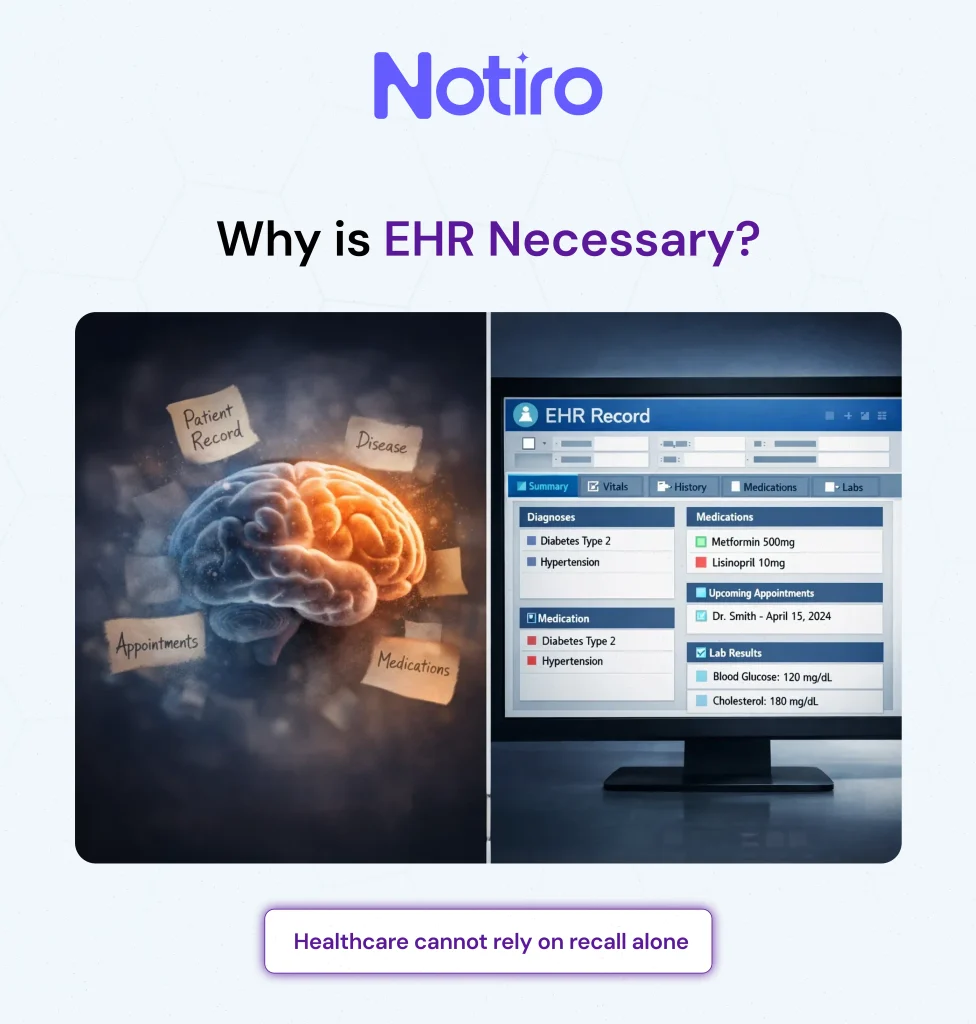
Healthcare does not struggle because clinicians lack the required expertise; it usually fails when critical details are forgotten, misplaced, or never recorded in the first place.
An allergy was missed, a dosage change was not documented, or a lab result is in the wrong system are not skill problems. They are memory problems; therefore, modern healthcare runs on context, accountability, and continuity.
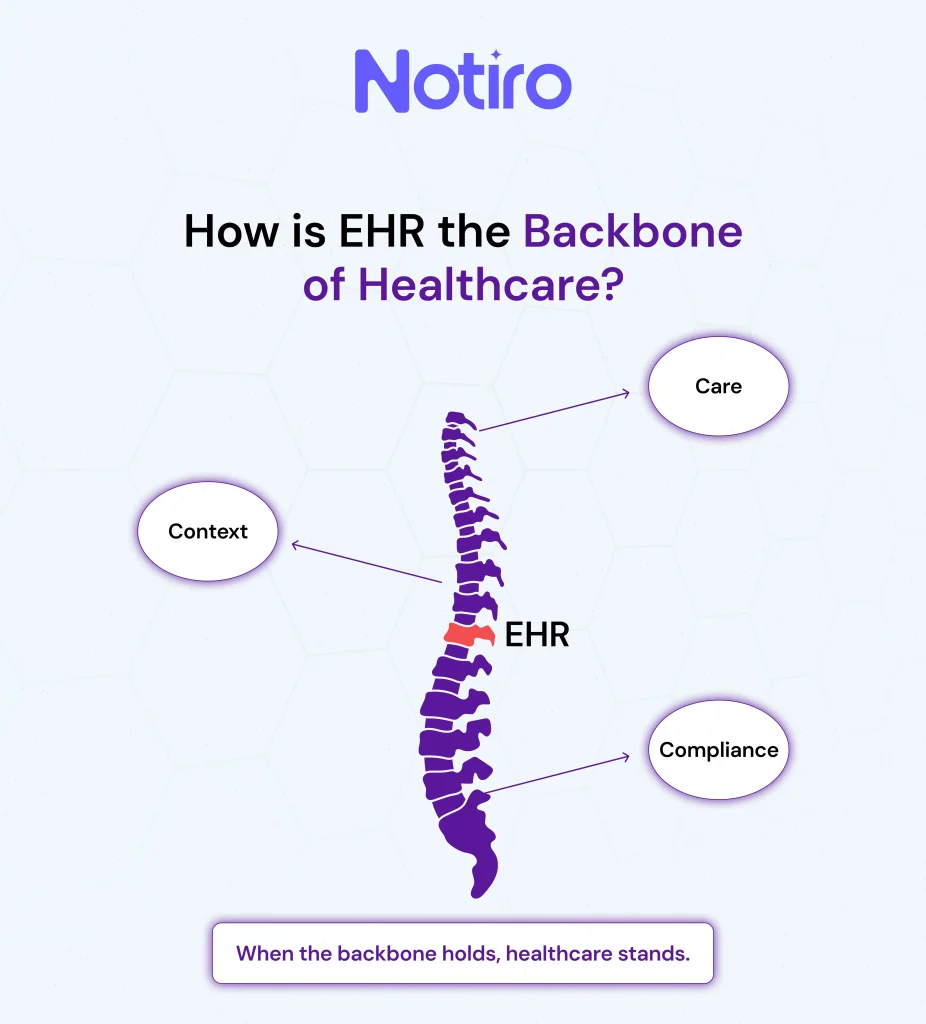
That is exactly why Electronic Health Record(EHR) software exists, not as just another system on a screen, but as the institutional memory and compliance backbone of healthcare.
| FYI In 2024, 95.0% of U.S. office-based physicians had adopted EHRs, and 83.6% used a certified EHR. |
Healthcare Runs on Memory and Not Just Medicine
Every clinical decision depends on what is known at that moment, including which symptoms appeared, which treatments were effective, which didn’t work, and what changed overnight.
Human memory was never designed to manage hundreds of patients across rotating shifts, changing departments, and various locations. The paper charts helped for a while, but they broke down quickly once the field of healthcare expanded.
So, patients no longer see one doctor in one room. They move across clinics, specialists, emergency departments, and laboratories. Each interaction needs a proper record with context, along with the omissions.
Therefore, EHR software was created to solve this exact problem. It helps in the retention of important medical information and supports accurate recollection of the patient encounters.
But wait
What is EHR Software?
An Electronic Health Record(EHR) system is a digital record of a patient’s medical journey that evolves with time. However, describing it as “digital storage” understates its real purpose.
An EHR:
- Maintains a continuous record across encounters
- Structure information so it can be trusted and reused
- Allows authorized clinicians to access the same context
- Creates traceability for every clinical action
Unlike simple files or scanned notes, EHRs are designed to grow with the patient. Therefore, every visit, diagnosis, prescription, and observation becomes part of a living record.
The EHR does not just store the diagnostic history, but also contextualizes why decisions were made, and such differentiation is important as it reveals the whole patient history if reviewed days, months, or years later.
Where Medical EHR Software Is Used in Practice
EHR software is a vital aspect of healthcare, as the medical decisions depend upon the whole medical history of the patient. Below is an illustration of how EHR software is used in real life.
| Hospitals | EHR supports coordination among the departments, which belong to different domains |
| Primary Care | EHR Software tracks the health patterns of a patient in the long term |
| Specialty Clinics | It ensures clinicians have context before acting. |
| Emergency Settings | In emergency conditions, it provides immediate access to life-critical information when time is limited. |
The key point is not where care happens, but the need for accurate memory. Using an EHR tool is essential as there are multiple doctors or incidents in patient’s medical history to consider before moving towards the treatment.
Where is EHR required the Most In the Healthcare Sector
Some healthcare environments depend on EHRs more than others. The fields that encounter more number of patients cannot solely depend on memory. Workers rotating among health wards require clarity in communication, and efficient management of chronic illnesses requires understanding past health data.
Thus, Hospitals, emergency departments, and long-term care facilities sit at the highest end of this spectrum. The decisions in these environments carry high risk and limited margin for error.
Moreover, in regulated systems, the requirement goes even deeper. Care must not only be delivered correctly, but it must also be documented correctly. What is not recorded may as well not have happened.
The EHR systems make the difference between defensible care and exposed care.
How EHR Software Acts as a Compliance Engine
Beyond memory, the EHR software solution plays a second critical role. It turns clinical activity into accountability. Every prescription, order, and note becomes part of an auditable history.
The healthcare system needs to comply with the regulatory requirements, such as the Health Insurance Portability and Accountability Act (HIPAA) of the United States. EHR systems obligate those regulatory requirements under the following standards:
- Documentation standards
- Billing accuracy
- Audit readiness
- Legal defensibility
- Regulatory reporting
So, when questions arise, EHR records provide clarity. They show what was known, when it was known, and how decisions were made. In this sense, EHR software protects institutions and clinicians as much as it protects patients.
Why Clinical Context Matters More Than Data Exchange
Healthcare memory only works if there is context behind every course of action. A diagnosis without supporting history loses meaning, and a treatment plan without prior responses becomes guesswork.
Thus, EHR systems maintain context as patients move across care settings. When that continuity breaks, uncertainty grows.
In the healthcare sector, clinicians often repeat tests, double-check information, or hesitate when confidence is needed.
Therefore, the goal is not technical connectivity for its own sake, but to preserve understanding. So, when systems support continuity of context, care becomes safer, faster, and more consistent.
The Hidden Cost of Broken Memory in the Medical Sector
When healthcare memory fractures, the costs are subtle but significant. As a result, clinicians spend valuable time reconstructing patient stories instead of advancing care. Meanwhile, patients are required to repeat the same information repeatedly.
Over time, records begin to conflict, and notes contradict one another. Ultimately, confidence in the care process erodes. Operationally, the impact appears as:
- Duplicate testing
- Documentation delays
- Claim denials
- Compliance exposure
- Clinician burnout
None of these failures announces itself loudly, instead, they accumulate quietly, draining time, trust, and resources. Thus, the broken memory serves as one of healthcare’s most expensive problems.
EHR Software as the Future of Healthcare Memory
EHR systems will remain the foundation of healthcare documentation, and that will not change. However, what will change is how memory is captured and surfaced. Well, we can see the future favors the following:
- Cleaner records
- Smarter context retrieval
- Fewer interruptions
- Review-first automation
- Tools that support documentation without disrupting care
Since the direction is clear, healthcare does not need less documentation, but better memory management.
Notiro Captures Care With EHR Systems While It Happens
EHR systems are essential because they preserve data and ensure compliance. But they were never designed to capture care as it happens. That burden still falls on clinicians, and this is where Notiro comes in.
Notiro supports EHR workflows by capturing clinical conversations in real time, transforming them into structured documentation that clinicians can review, approve, and sync into the EHR. So, instead of asking clinicians to reconstruct encounters after the fact, it helps preserve context at the moment it matters.
The result is stronger clinical memory, cleaner records, and documentation that stands up to regulatory and billing requirements, without adding friction to care delivery.With EHR remaining the system of record, Notiro helps make sure that the record is accurate, complete, and defensible.