The conversation about AI replacing doctors often overlooks a more immediate healthcare problem.
Doctors are not only treating patients. They are searching through records, preparing notes, updating charts, checking documentation, and completing routine administrative tasks. These responsibilities are important, but they can consume time that would be better spent on clinical judgment and patient care.
This is where artificial intelligence in healthcare offers real value. AI can organize information, automate repetitive tasks, and prepare clinical documentation, while physicians remain responsible for reviewing the information and making decisions.
A large-scale evaluation covering more than 2.5 million patient encounters estimated that ambient AI scribes saved physicians 15,791 hours of documentation time. In a separate prospective study, providers who used an AI scribe in at least 60% of encounters recorded a 21% decrease in daily note time.
As a leading AI-powered clinical workflow solution, Notiro is designed around this practical use of AI. It helps healthcare teams save time, reduce the risk of documentation errors, and streamline everyday clinical processes.
Here are eight ways AI can return valuable time to doctors without replacing them.
1. AI Brings Important Patient Information Forward
Preparing for a consultation can require physicians to search through previous visits, medications, test results, referrals, and specialist notes.
AI can organize the most relevant information into a focused pre-visit view. It may highlight recent changes, active conditions, and issues that still need attention.
The doctor still reviews the original record and decides what matters. The benefit is that they begin the consultation with a clearer clinical picture instead of rebuilding the patient’s history from several different screens.
Notiro supports this type of connected workflow by using AI across clinical documentation and patient information processes. This helps teams find and manage relevant information more efficiently while reducing unnecessary manual work.
2. AI Captures the Conversation Without Distracting the Doctor
During an appointment, a physician may be listening to symptoms while typing notes and selecting fields in the electronic health record.
Constantly switching attention between the patient and the computer can make the conversation feel less natural. It can also leave important details waiting to be documented later.
An ambient AI medical scribe can capture the approved conversation and turn it into a structured clinical note. The doctor can speak naturally with the patient and review the generated content afterward.
Notiro uses medically focused ambient AI to capture patient encounters and generate structured notes in real time. Clinicians can then review, edit, and approve the documentation before it is finalized.
AI handles the first draft. The physician keeps control of the medical record.
3. AI Summarises Complex Clinical Records
A long medical record may contain years of appointments, investigations, treatments and specialist recommendations.
Reading everything from the beginning is rarely the best use of a physician’s time. They may initially need to understand the current problem, recent changes and unresolved decisions.
AI can summarise lengthy information into a clearer clinical overview. It can help doctors identify relevant details before they begin a deeper review.
This is especially valuable for complex cases, referrals, hospital follow-ups and patients receiving care from several specialists.
The summary supports the physician’s work. It does not replace their responsibility to examine the original information when making a clinical decision.
4. AI Creates Clinical Notes While the Details Are Fresh
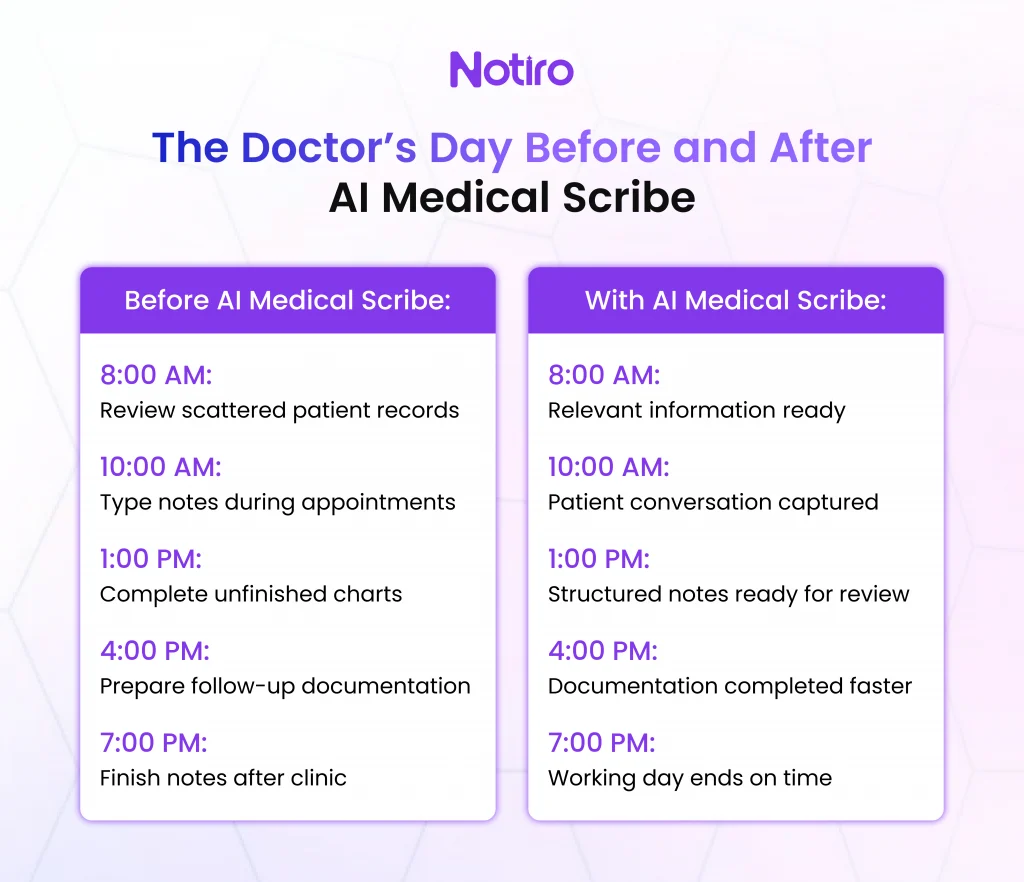
The longer the documentation is delayed, the more difficult it becomes to reconstruct the encounter accurately.
Doctors may need to remember what was discussed, why a treatment was chosen and what follow-up was agreed upon. A short task immediately after an appointment can become a much longer task at the end of the day.
AI can prepare the note shortly after the encounter while the details are still fresh. The physician then reviews the draft, corrects any inaccuracies and adds missing context.
Notiro helps streamline this process by generating structured clinical notes automatically. Its editing tools also allow clinicians to update specific details using short voice or text instructions without rewriting the full note.
This can save time and reduce the chance of errors caused by delayed or incomplete documentation.
5. AI Makes Clinical Handoffs Easier
Patient care often moves between doctors, nurses, specialists and other healthcare professionals.
Each handoff requires a clear explanation of the patient’s current condition, completed actions and next steps. Preparing this information manually can mean rewriting the same case several times.
AI can turn a detailed encounter into a focused handoff draft. The clinician reviews the information and decides what should be shared with the next member of the care team.
Clearer and more consistent documentation also supports better decision-making. Healthcare professionals can understand what has already happened and what still requires attention without searching through the entire record.
6. AI Speeds Up Routine Follow-Up Work
After an appointment, physicians may need to prepare patient instructions, referral summaries, follow-up messages or explanations of the treatment plan.
AI can create an initial draft using information already captured during the visit. The doctor can then check its accuracy, personalize the wording, and approve the final communication.
This saves time without removing human oversight.
Notiro supports an integrated clinical workflow rather than treating documentation as an isolated task. Approved notes can be transferred into connected EHR software, helping teams avoid unnecessary copying, repeated data entry and fragmented processes.
7. AI Helps Identify Documentation Gaps Earlier
Missing medication details, unclear follow-up instructions or incomplete sections can cause a chart to return to the physician later.
Reopening the record interrupts another task and forces the doctor to remember the original encounter again.
AI can help flag possible omissions, inconsistencies or areas requiring review before the chart is closed. It does not decide whether the documentation is clinically complete. It gives the healthcare professional an earlier opportunity to check.
Notiro combines AI-generated documentation with clinician review and approval. This human-led workflow helps teams improve efficiency while reducing the risk of inaccurate or incomplete information entering the final medical record.
8. AI Supports Better Clinical Decisions
AI in medical diagnosis can help physicians manage large amounts of information. It may identify patterns, organize findings and surface clinical considerations that deserve closer attention.
However, recognizing a pattern is not the same as practicing medicine.
A diagnosis may depend on physical examination, medical history, patient circumstances and the consequences of choosing one treatment over another. These decisions require professional judgment and accountability.
Notiro uses AI to improve efficiency and support clinical decision-making within the workflow. It can help healthcare teams organize documentation and surface useful information while leaving the final interpretation and decision with the clinician.
Can AI Replace Physicians?
So, can AI replace physicians? AI can search, summarise, structure, and draft information more quickly than a person completing the same repetitive task manually. It cannot independently understand every patient’s circumstances or accept professional responsibility for the outcomes of clinical decisions.
The AI vs human doctors discussion, therefore, needs a more practical frame.
AI is most useful when work is repetitive, searchable, or suitable for a first draft. Doctors remain essential when care requires interpretation, empathy, accountability, and trust.
Concerns about AI replacing healthcare professionals should not be ignored. Technology must be implemented carefully, reviewed regularly, and kept under appropriate human supervision.
The strongest model is simple: AI prepares and organizes. Healthcare professionals verify and decide.
The Future of Doctors With AI Is More Focused
Concerns about AI replacing healthcare professionals should not simply be dismissed. Poorly designed automation can create more review work or make the responsibility unclear.
Useful healthcare AI does the opposite. The system prepares. The clinician verifies. The final decision remains human.
That is the more realistic future of doctors with AI: fewer minutes lost to rebuilding information and more time available for reasoning, communication, and care.
Where Notiro Fits
Notiro helps clinicians recover time around the patient encounter by capturing conversations and generating structured clinical notes that remain available for physician review, editing, and approval.
The promise is not a clinic without doctors. It is a clinical day with less work that only looks like medicine and more time for the work that truly is.