
A family physician is finishing the eleventh patient visit of the day. The note is incomplete. A few lines have been copied from the previous visit. The billing code is selected from memory instead of the details discussed during the consultation.
The claim is submitted. Three weeks later, it was denied. The physician must then spend more time correcting the note and resubmitting the claim after working hours. This may look like a small billing issue, but it can create much bigger problems.
The same documentation gap remains in the patient’s medical record. Another healthcare professional may use that information to make a clinical decision. It may also create a compliance issue during an audit or become a legal risk during a malpractice case.
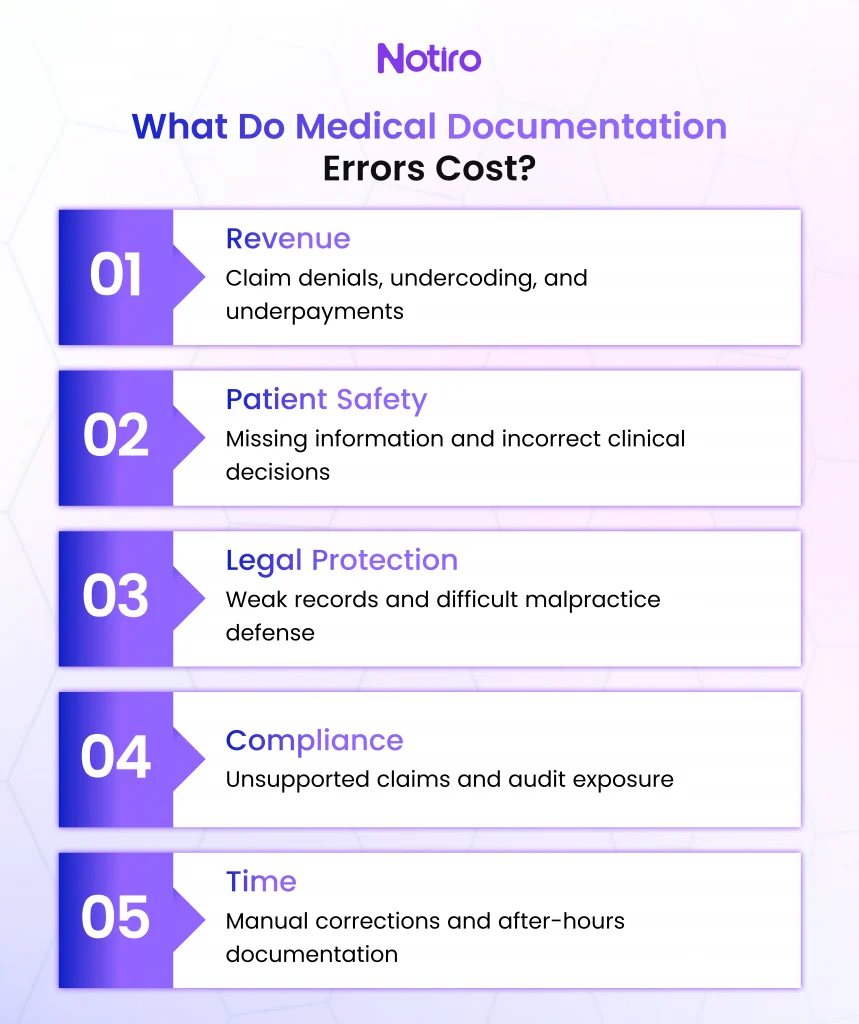
Medical documentation errors cost healthcare providers far more than denied claims. They can affect revenue, patient safety, legal protection, regulatory compliance, and daily clinical operations.
Understanding the full cost of medical documentation errors can help healthcare organizations prevent problems before they spread across the care process.
1. The Financial Impact of Documentation Errors
The financial impact of documentation errors is not always easy to see.
Sometimes a claim is denied immediately. In other cases, the provider receives less money than they should.
For example, a physician may provide a complex service but submit a lower-level code because the medical note does not clearly explain the care provided. The claim may still be approved, but the practice loses revenue through undercoding.
According to Experian Health’s 2025 State of Claims report, 68% of healthcare providers said inaccurate or incomplete patient information collected during patient intake contributes to claim denials.
The same research found that 10% or more of claims are being denied for a growing number of providers. It also reported that only 56% of respondents believed their existing claims technology met their revenue cycle needs.
Medical billing documentation errors can lead to:
- Claim denials
- Delayed payments
- Undercoding
- Underpayments
- Additional administrative work
- Lost revenue
The cost does not stop with the unpaid claim.
A national survey by Premier found that healthcare providers spent more than $25.7 billion on claims adjudication in 2023. This was a 23% increase from the previous year.
Premier also found that the administrative cost of challenging a denied claim increased from $43.84 per claim in 2022 to $57.23 in 2023. Around 70% of denied claims were eventually overturned and paid, but only after expensive rounds of review and rework.
These figures show that the cost of inaccurate medical records includes both lost revenue and the employee time required to correct preventable mistakes.
Notiro helps reduce this risk by generating ICD-10 and CPT codes from the clinical conversation. The suggested codes are based on what was discussed and managed during the visit rather than what the physician remembers at the end of a busy day.
2. Healthcare Documentation Errors Can Affect Patient Safety
Healthcare documentation errors do not remain inside the billing department.
Once incorrect or missing information enters the patient record, it can influence future clinical decisions.
A 2024 cross-sectional hospital study found that 26.8% of primary diagnoses were coded incorrectly. The study also found incorrect secondary diagnosis coding in 9.9% of records.
Overall, around 36.7% of the reviewed records contained an incorrect primary or secondary diagnosis code. The coding problems resulted in lost revenue and also affected how patient conditions were represented in the medical record.
Clinical documentation errors may include:
- A missing diagnosis
- An incorrect diagnosis code
- An incomplete medication history
- Missing symptoms
- An inaccurate patient history
- Clinical reasoning that was not recorded
These medical documentation mistakes can affect the next healthcare professional who treats the patient. A missing or incorrect diagnosis may influence:
- Future diagnostic decisions
- Medication choices
- Specialist referrals
- Treatment plans
- Risk assessments
- Follow-up care
The medical record becomes a major source of information for future care. When that information is wrong, later decisions may also be affected.
An Agency for Healthcare Research and Quality review estimates that 5% of adults in the United States experience a diagnostic error in an outpatient setting each year. It also reports that around 0.7% of hospital patients experience harm linked to diagnostic errors.
Not every diagnostic error is caused by poor documentation. However, incomplete notes, missing results, and incorrect patient histories can make accurate diagnosis and treatment more difficult.
Notiro’s AI Medical Scribe captures the clinical conversation and turns it into a structured note. Its Diagnosis Support feature can also highlight possible diagnoses based on the information discussed during the visit.
3. Medical Charting Errors Increase Legal Risk
Medical records are not only used for patient care and billing.
They are also legal records. During a malpractice case, the medical chart is often one of the first documents reviewed. It shows what the physician observed, what decisions were made, and why a specific treatment was selected.
Medical charting errors can make appropriate clinical care difficult to defend. For example, a physician may have made the correct decision, but the record may not explain the reasoning behind it. During a legal case, missing information can look like missing clinical judgment.
Candello analyzed more than 65,000 medical malpractice cases closed between 2014 and 2023.
The analysis found that 20% of malpractice cases involved at least one documentation failure. It also found that documentation problems more than doubled the likelihood that a case would close with an indemnity payment.
Common problems included:
- Alterations to the medical record
- Missing clinical findings
- Incomplete treatment reasoning
- Poor documentation of informed consent
- Missing follow-up instructions
- Incomplete adverse-event records
A complete and time-stamped note provides a clearer record of what happened during the consultation.
Ambient documentation tools can help physicians capture the actual conversation instead of rebuilding the visit from memory several hours later.
4. Documentation Mistakes Can Trigger Audits and Compliance Issues
Some documentation mistakes are not discovered during billing. They may only appear months later during a regulatory audit.
The Centers for Medicare and Medicaid Services states that the main causes of Medicare Fee-for-Service improper payments include missing documentation and records that do not properly demonstrate medical necessity.
CMS reported $31.46 billion in Medicare Fee-for-Service improper payments for the 2022 reporting year. This represented an improper-payment rate of 7.46%.
CMS also explains that most improper payments do not automatically represent fraud. Many occur because documentation is missing or a reviewer cannot confirm whether the payment met program requirements.
Documentation requirements also continue to change.
The fiscal year 2025 ICD-10-CM update became effective on 1 October 2024. It included:
- 252 new diagnosis codes
- 36 deleted codes
- 13 revised codes
These changes added more detail to areas such as cancer, obesity, eating disorders, hypoglycemia, and digestive conditions.
The American Medical Association’s CPT 2025 code set contained 420 total updates, including:
- 270 new codes
- 112 deleted codes
- 38 revised codes
The changes covered developing areas such as digital medicine, remote therapeutic monitoring, artificial intelligence, and advanced diagnostic testing.
A coding process that was accurate last year may no longer meet the latest requirements. This makes manual coding more difficult, especially for physicians already managing heavy patient workloads.
Copying and pasting information inside electronic health records can create another problem known as note bloat.
Note bloat happens when repeated or outdated information fills the medical record. Important details become harder to find and the note may no longer accurately represent the patient visit.
During an audit, this can create questions about:
- Whether the service was medically necessary
- Whether the correct code was used
- Whether the documentation supports the claim
- Whether the note was updated correctly
- Whether the record accurately reflects the consultation
Reliable documentation and coding support can help healthcare organizations reduce audit risk and maintain clearer medical records.
5. Medical Documentation Mistakes Increase Physician Workload
Medical documentation mistakes are not always caused by carelessness. They are often caused by a system that requires physicians to remember large amounts of information while managing full patient schedules.
Healthcare professionals regularly complete notes after the patient has left or after the working day has ended. A time-and-motion study found that physicians spent 49.2% of their working day on electronic health records and desk work.
Only 27% of the working day was spent on direct clinical time with patients.
Within electronic health record and desk work, 38.5% of physicians’ time was spent on documentation and record-review tasks. Physicians who completed after-hours diaries also reported spending another 1 to 2 hours on EHR work each evening.
This workload creates mental pressure. When physicians are tired or rushed, the risk of clinical documentation errors increases. Common results include:
- Incomplete notes
- Copy-and-paste mistakes
- Incorrect codes
- Missed clinical details
- Late chart completion
- More claim denials
- Additional administrative rework
Every denied claim creates more work. Billing teams must review the claim. Physicians may need to update the note. Codes are corrected, claims are resubmitted, and payments are delayed.
This administrative cycle takes time away from patient care and increases the risk of further healthcare documentation errors.
Notiro captures the clinical conversation, creates the note, recommends ICD-10 and CPT codes, and provides diagnostic support before the physician closes the chart. This helps reduce the documentation workload at the point where many errors begin.
The True Cost of Inaccurate Medical Records
The cost of inaccurate medical records cannot be measured through denied claims alone.
One documentation error can create several problems at the same time. It can cause:
- Lost revenue
- Delayed payments
- Incorrect clinical decisions
- Patient safety risks
- Legal exposure
- Regulatory audits
- Additional administrative work
- Physician burnout
The note that causes a denied claim may also create a malpractice risk, an audit issue and a patient safety concern.
Treating these problems separately only manages the consequences. The better approach is to improve documentation accuracy during the clinical visit. When healthcare providers capture what was discussed, diagnosed, coded and clinically considered at the point of care, they can reduce risk across the healthcare workflow.
Start Where Documentation Errors Begin
Notiro captures the clinical conversation, generates structured medical notes, recommends ICD-10 and CPT codes and highlights diagnostic considerations before the chart is closed.
This helps healthcare providers reduce medical documentation mistakes, improve billing accuracy and create clearer records for future patient care.
See how Notiro works or book a demo to explore the complete clinical documentation workflow.