Voice dictation software has a reputation problem it no longer deserves. A physician who tried it in 2016 and gave up is judging a completely different product from the one available today, yet that outdated impression still shapes buying decisions across practices in 2026.
The disappointment made sense at the time. Early tools struggled with medical terminology, required clunky hardware, and produced raw transcripts that needed just as much manual cleanup as if you typed the note yourself. That experience left a lasting impression that dictation software simply isn’t reliable enough for clinical work.
That impression hasn’t kept pace with reality. Physician AI adoption jumped from 38% in 2023 to 81% in 2026, according to the American Medical Association’s 2026 Physician Survey on Augmented Intelligence. Voice recognition software has moved from rigid, command-based transcription to AI voice dictation that understands clinical context, and in some cases, turns a spoken visit directly into a coded, chart-ready note.
The gap between what physicians assume and what the data shows is wide enough to cost a practice real time and real revenue.
Common Voice Dictation Software Myths in Medical Practice
Most of these assumptions trace back to tools physicians tried years ago and never revisited. The sections below walk through each one, showing how it aligns with current data and product design.
Myth 1: Voice Dictation Software Is Too Inaccurate for Clinical Use
Early speech-to-text software struggled with medical terminology, drug names, and anatomical language, producing transcripts that needed heavy correction. That experience shaped a lasting assumption that dictation accuracy isn’t good enough for a clinical chart.
The data no longer supports that assumption. Modern voice recognition software now performs well ahead of average human typing accuracy, and leading medical dictation tools are built specifically to handle clinical terminology, drug names, and anatomical language with far fewer errors than earlier generations of the technology. A physician evaluating dictation software should still ask how the model was trained and whether it has been tested on multi-problem visits, since accuracy claims vary meaningfully by vendor and recording environment.
Myth 2: You Need Expensive Hardware to Use It
Some physicians associate dictation software with a dedicated microphone, a foot pedal, and a desktop-bound workstation. That was accurate for legacy transcription systems built around fixed clinical stations.
Most current dictation software runs through a standard phone or laptop microphone. Mobile-first AI voice dictation tools let a physician dictate between rooms or during a telehealth visit without carrying separate equipment. A solo physician can adopt dictation software the way they’d adopt any app: download, sign in, start dictating. No procurement cycle, no equipment line item.
Myth 3: Dictation Software Only Produces Raw Transcripts
This myth carries some truth for older tools, which is why it persists. First-generation dictation software converted speech into text and stopped there, leaving the physician to structure it manually into a usable note.
AI voice dictation built for healthcare goes further, organizing a spoken visit into a structured SOAP notes, H&P, or problem-oriented format, sorting subjective complaints, objective findings, assessment, and plan as the physician talks. Notiro’s ambient scribing works this way: it listens to the conversation and generates a structured note in real time, rather than an unformatted transcript. A practice testing dictation software should ask whether the output is chart-ready or still needs manual reorganization.
Myth 4: All Voice Dictation Software Works the Same Way
Dictation software gets talked about as one category, but the underlying approach varies between products, and that variation determines how useful a tool is in practice.
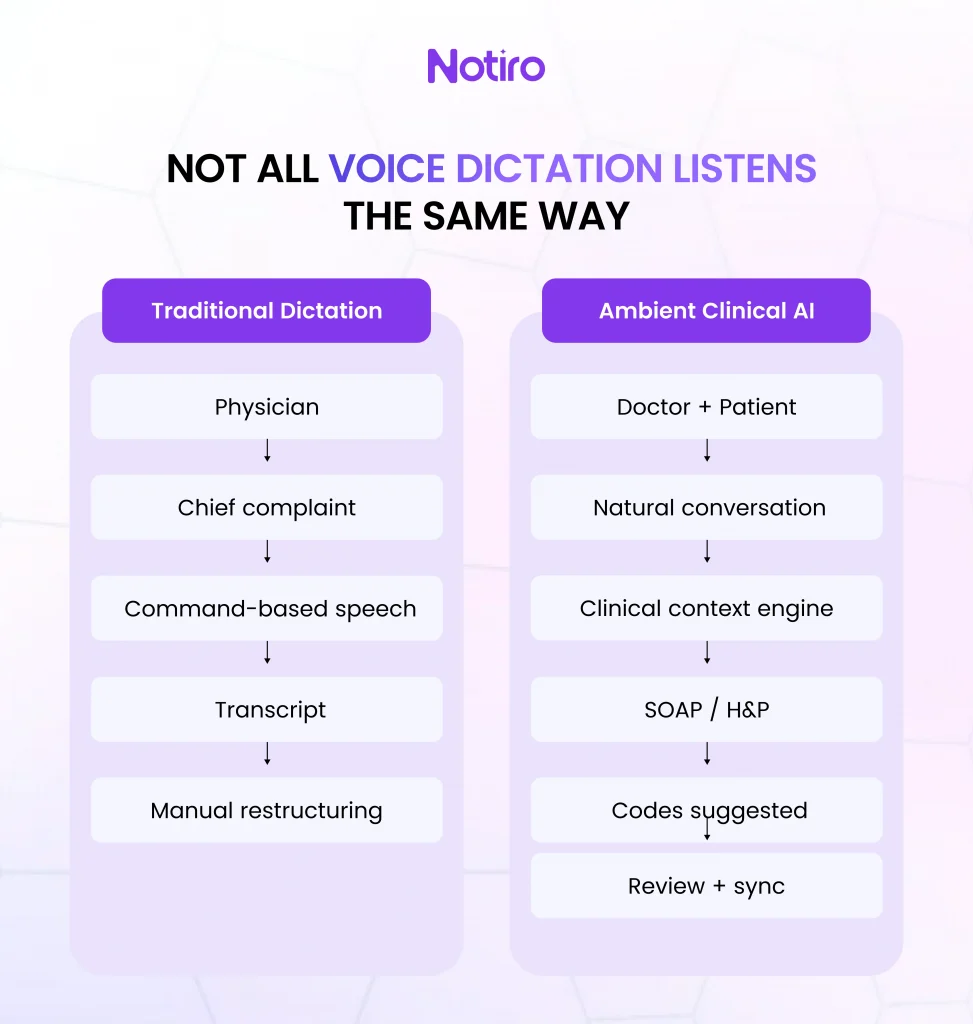
Some platforms are command-based, requiring the physician to speak in a structured format and manually trigger sections. Others are ambient, listening passively to a natural conversation and extracting clinical content without a scripted delivery. A command-based tool asks the physician to dictate directly: “Chief complaint, headache for three days.” An ambient tool listens to the actual visit, including the patient’s own words, and structures the note from that exchange.
Ambient requires less behavior change and captures more of what happened in the room, and research has linked ambient AI scribes specifically, not general AI use, to a meaningful drop in measured physician burnout within 30 days.
The difference becomes clearer when you compare how each approach handles the same clinical encounter.
Myth 5: Dictation Software Can’t Handle Complex, Multi-Problem Visits
A patient managing diabetes, hypertension, and a new GI complaint in one visit is common in internal medicine and family practice, and it’s exactly the kind of encounter early dictation tools handled poorly. Multiple overlapping problems, discussed out of order, tend to confuse simpler transcription systems.
Dictation software trained on real clinical encounters is built to separate multiple presenting problems within a single session without conflating them. This is where the difference between basic speech-to-text software and purpose-built medical voice dictation software shows up most: a general tool captures words, while a clinically-tuned one keeps each problem in its own place in the note. Health systems adopting AI scribes at scale have reported strong physician uptake for handling exactly this kind of complex, high-volume caseload.
Myth 6: Dictation Software Isn’t HIPAA Compliant
Given how much patient information passes through a dictation session, this concern is reasonable on its face. Any tool processing visit audio is handling Protected Health Information, and a physician is right to ask about compliance first.
Reputable medical voice dictation software vendors are HIPAA compliant and provide a signed Business Associate Agreement, the contract required under HIPAA when a vendor handles PHI. Notiro is HIPAA compliant and signs a BAA with every practice, and this compliance page should be one of the first things a physician checks. Data privacy is also the top adoption barrier physicians name, ahead of nearly every other concern in recent surveys.
The myth isn’t that no compliant options exist. It’s the assumption that dictation software as a category is inherently non-compliant, which isn’t true of vendors built specifically for healthcare.
Myth 7: Dictation Software Doesn’t Help With Billing
Most physicians think of dictation software purely as a documentation tool, separate from billing and coding. That separation used to be accurate: dictation created the note, and a separate process, often the physician alone at the end of the day, assigned the ICD-10 and CPT codes.
That gap is exactly where undercoding happens. ICD-10 has more than 70,000 codes, and CPT has more than 10,000, and selecting the right ones under time pressure at the end of a 20-patient day is a real source of missed reimbursement, not physician negligence. Notiro auto-suggests ICD-10 and CPT codes from the visit audio and note, which the physician reviews and syncs to the EHR rather than coding from scratch. Physicians using AI scribes have reported earning more annually and seeing more patients per week, according to UCSF research. Most dictation tools stop at the note and leave coding as a manual step.
Myth 8: Switching to New Dictation Software Requires a Long Setup Process
The assumption that new software means weeks of IT involvement and staff retraining keeps physicians on tools they’ve outgrown. That fear made sense, given legacy enterprise dictation systems that require on-site installation.
Modern dictation software, particularly mobile-first AI voice dictation tools, is built for self-serve setup. A physician can typically sign in and start dictating the same day. EHR sync happens with a single click after the visit, rather than through manual export and import, where most of the old friction used to live.
The Real Question Isn’t Whether Dictation Software Works
The myths above share a common root: accurate descriptions of dictation software as it existed several years ago, applied to a category that has since moved on. Physician AI use has more than doubled since 2023, and voice-based documentation is one of the fastest-growing use cases within it. The real question for a physician or practice manager in 2026 isn’t whether voice dictation software works. It’s whether a specific tool handles clinical complexity, closes the billing loop, and fits an existing EHR workflow.
Undercoding, after-hours charting, and disconnected billing workflows still cost practices real money and physicians real evenings. A dictation tool that only writes the note is solving half the problem.
See What Voice Dictation Software Can Actually Do
Notiro’s AI voice dictation covers the full clinical day, from ambient scribing during the visit to ICD-10 and CPT code suggestions after it. Start a free trial at notiro.ai. No IT setup, no enterprise contract.