
A solo family physician sees 20 patients today. Three hours of documentation and coding wait after the last one leaves, the same three hours that show up night after night once the kids are in bed. The instinct is to hire help: post a listing, interview for a few weeks, add another line to payroll.
The math on AI vs hiring medical staff tells a more complicated story, and it starts with what a $50,000 hire actually costs once benefits, training, and turnover are counted, not just the number on the offer letter.
An AI platform built for the clinical day changes the comparison entirely. It does not need four to six weeks of onboarding, does not call in sick, and does not need replacing when it burns out on repetitive work.
This piece walks through the real cost of each option, where AI genuinely wins, where a human still matters more, and how a practice decides between them without guessing.
The Real Cost of Hiring a $50K Staff Member
Salary, Benefits, and Hidden Overhead
A $50,000 salary rarely stays $50,000. Payroll tax, health benefits, and paid time off push the fully loaded cost toward the mid-$60,000s a year for most practices. Add four to six weeks of onboarding before a new hire works at full speed, and the first year costs more than the offer letter ever suggested.
The cost climbs further once a role sits empty. According to a 2026 MGMA poll on medical practice staffing, front-office and medical assistant roles remain the highest-turnover positions in most practices, and practices that automate the repetitive parts of billing and coding are already shifting those roles toward exception handling rather than eliminating them outright.
The Turnover Problem: AI vs Hiring Medical Staff
Every departure resets the clock. According to Revele’s analysis of medical practice staffing costs, replacing a frontline support staff member typically costs between $25,000 and $30,000, while specialized billing and administrative roles can run even higher once lost productivity and training time are factored in.
The AI vs hiring medical staff comparison starts here: a platform does not resign and does not need replacing every 12 to 18 months.
The bigger version of this problem sits with physicians, not front-desk staff. Documentation remains a leading driver of physician burnout, and 41.9% of physicians still reported at least one symptom of burnout in 2025, according to a report from the American Medical Association. That is progress from the pandemic-era peak, but it is still nearly half the physician workforce.
What a $99 AI Platform Actually Delivers
Scheduling, Intake, and Insurance Verification
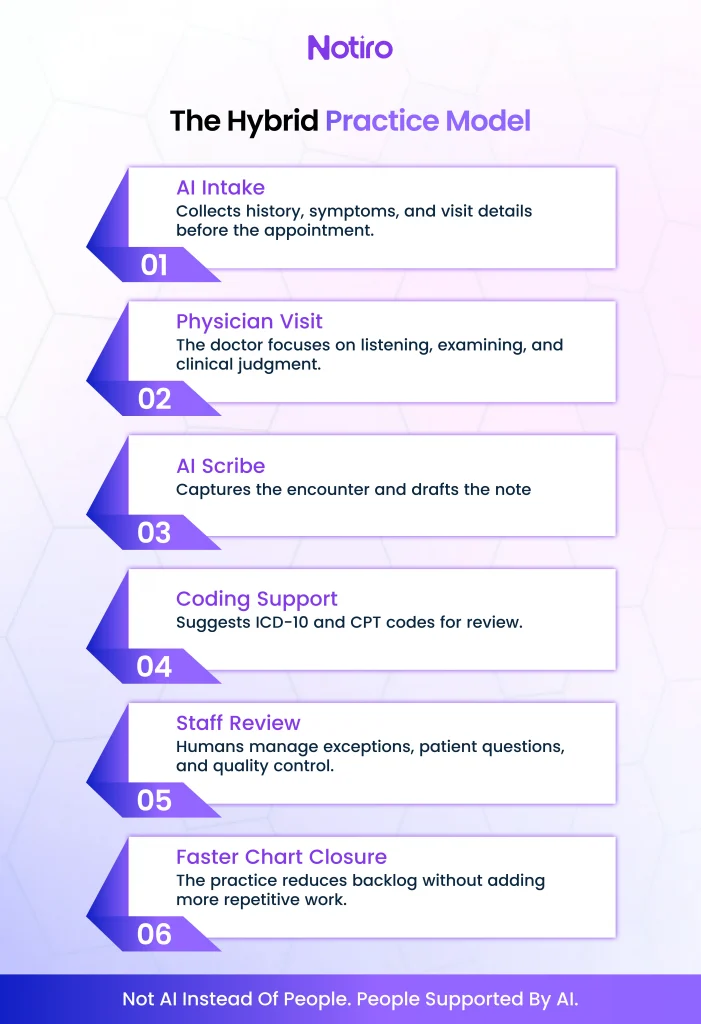
Most administrative hires spend their day on repetitive, rules-based work: collecting patient history before the visit, documenting the encounter, and getting the billing codes right afterward. Notiro’s Patient Intake AI collects history, symptoms, and vitals before the patient walks in, so the physician starts the visit already briefed, rather than starting cold.
The bigger gap sits after the visit, not before it. Notiro auto-suggests ICD-10 and CPT codes from the visit audio and note, the step where undercoding quietly costs practices real reimbursement every month. A 2026 study published in JAMA Network Open by UCSF researchers found that physicians adopting AI scribes generated 1.81 more relative value units per week, worth approximately $3,044 in additional annual revenue per physician, and saw 0.8 more patients per week, with no increase in claim denials. No staff hire fixes a coding gap the way a system trained on the visit itself can.
24/7 Coverage Without Overtime
An administrative employee works roughly 2,000 hours a year. Notiro’s intake and documentation workflow runs on every visit, every day, without an overtime line item. That gap reframes AI healthcare workforce automation around coverage that a single hire cannot physically provide, not just cost per hour.
AI vs Human Staff in Healthcare: Where Each One Wins
Where AI Wins: Consistency, Scale, Predictable Cost
An AI documentation platform does not call in sick or disengage after a hard week. Notiro’s ambient scribe captures multi-problem visits the same way on a busy Monday as on a slow Wednesday, and pricing stays flat regardless of volume.
A multicenter quality improvement study in JAMA Network Open, reported by the AMA, found that burnout among clinicians using an ambient AI scribe dropped from 51.9% to 38.8% within 30 days, alongside measurable improvements in after-hours documentation time. That consistency is the core argument in any AI vs human staff in healthcare comparison built around predictability.
Where Humans Win: Judgment, Empathy, Complex Situations
A distressed patient navigating a new diagnosis needs a person who can read tone and respond in the moment. Notiro’s Diagnosis Support feature is built as an augmentation tool, not a replacement for clinical judgment, and that boundary matters. AI vs administrative staff comparisons work best when they stay honest about which tasks still need a human in the room, whether that is de-escalating a billing dispute or explaining a diagnosis a patient did not expect to hear.
The same honesty applies to the specialty context. A psychiatry visit built on long narrative notes and a family medicine visit built on a fast-moving mix of wellness and acute complaints need different things from a documentation tool, and neither replaces the clinician’s read of the room.
It’s Not Either/Or: The Case for Augmentation
One Employee + AI vs Two Employees Without It
A single administrative employee, supported by an AI platform handling patient intake and coding, tends to outperform two employees working without that support. The person manages patient relationships and exceptions. The platform absorbs the repetitive volume behind the scenes, which is the practical shape of AI-driven medical practice efficiency that most practices end up adopting.
This mirrors what MGMA’s 2026 staffing data describes: automation absorbing repetitive billing and coding tasks while staff shifts toward quality control and exception management, as reported in MGMA’s staffing outlook.
In practice, the strongest model looks less like a replacement and more like a redesigned workflow.
A Simple Framework for Deciding
Four Questions to Ask About Your Practice
Four questions arise about how AI fits into a specific practice.
- What tasks are repetitive and rules-based, like intake collection or code selection?
- What has staff turnover actually cost in the last two years, recruiting fees included?
- Where do patients feel the most friction today, whether that is wait times or slow chart closure?
- What is the growth trajectory for patient volume over the next year, since a hire caps out where an AI platform can keep scaling?
A solo physician practice, a small group, and a multi-location clinic will answer these differently, but the exercise applies to any of them. The answers usually point toward the same conclusion: automate the repetitive layer first, then decide whether the remaining work still needs another hire.
The Future of AI Medical Practice Efficiency Is Hybrid
The honest answer to AI vs hiring staff for medical practice is not a single winner. AI platforms handle volume, consistency, and the coding accuracy that most staffing solutions never touch, backed now by peer-reviewed data from UCSF and multicenter research published in JAMA Network Open. Human staff still carry the judgment and relationship work that no platform replicates, and the practices that do best combine both rather than choosing a side.
Ready to See the Difference
Undercoding and documentation backlog cost more than most practices realize, often more than a full-time hire would. Notiro’s AI Scribe captures the visit, auto-suggests ICD-10 and CPT codes, and syncs to the chart before the next patient sits down. Start a free trial at notiro, no IT setup and no enterprise contract required.