A family physician finishes a twelve-patient day, opens a blank note, and pastes the visit transcript into ChatGPT to save twenty minutes. This habit is common enough now to raise a real question: why not use ChatGPT for medical notes if it writes a clean paragraph in seconds? The honest answer sits in what that note does not carry.
There is no signed Business Associate Agreement, no verification of the accuracy of a multi-problem visit, and no automatic path to the ICD-10 or CPT code the visit earned. 51% of US physicians report burnout, and clinical documentation is consistently identified as the top driver.
A faster note that fails compliance or invents a detail is not a solution. It is a new risk sitting inside the chart. Notiro exists because closing the clinical day takes more than a chatbot that happens to write well.
Quick takeaways:
- Consumer ChatGPT, Claude, and Gemini accounts are typically not covered by a signed BAA, creating direct HIPAA exposure when patient details are entered.
- General-purpose AI models can produce fluent but factually wrong clinical details, a pattern known as hallucination.
- None of the three generates the ICD-10 or CPT code tied to the visit, leaving the billing gap exactly where it was.
- A medically-tuned AI Medical Scribe handles clinical language, real exam-room noise, and Protected Health Information from the first draft, not as an afterthought.
Why Not Use ChatGPT for Medical Notes in a Real Exam Room
ChatGPT, Claude, and Gemini are general-purpose language models designed to hold conversations about nearly any topic. None of the three was designed around the structure of a SOAP note, the acronym-heavy shorthand of a chart, or the requirement to turn a visit into a billable code. A purpose-built AI Medical Scribe listens to the visit itself and converts speech into structured documentation without a manual copy-paste step in between.
The gap shows up first in structure. Notiro automatically generates SOAP, H&P, or POMR notes from the consultation audio, formatted the way a chart is actually reviewed. Feeding a rough transcript into a general chat window still leaves the physician editing structure, not just content, after the AI has already done its part.
The Risks of Using ChatGPT for Medical Documentation Start With Privacy
The first risk is not accuracy. It is where the data goes.
Under HIPAA, any AI tool that touches Protected Health Information needs a signed Business Associate Agreement between the practice and the vendor. Personal ChatGPT, Claude, and Gemini accounts do not come with one by default.
This is the center of ChatGPT healthcare privacy concerns raised by compliance teams and physicians alike. Pasting a patient’s name, history, or exam findings into a consumer AI account without a BAA is a plausible HIPAA violation, not a hypothetical one. Notiro is HIPAA-compliant and signs a BAA with every practice, closing that exposure before the first session begins.
ChatGPT for Medical Notes Limitations Show Up After the Note Is Written
Consider an internal medicine visit covering three chronic conditions and a new medication. A physician who pastes the recording transcript into a general chatbot gets a note back in seconds, written in confident clinical language.
The dosage may be wrong. The differential may include a condition never discussed in the room.
This is the practical shape of AI-generated hallucinations in healthcare: fluent, well-formatted text that is not anchored to what was actually said during the visit. Medical note accuracy issues compound because a general model has no reference point for what the physician actually observed. It generates the statistically likely next word, not a verified clinical fact.
These are not abstract AI medical documentation risks. They show up directly in the chart, in the codes, and in the audit trail. ChatGPT for medical notes limitations extend past hallucination, too, including no specialty tuning for psychiatry’s narrative-heavy notes and no handling for the acoustic reality of a real exam room.
Clinical Documentation Compliance Needs a Signed Agreement, Not a Terms of Service
Clinical documentation compliance is not a checkbox to be checked after launch. It is the signed agreement, the audit trail, and the confirmation that patient audio is never used to train a public model. A terms-of-service box checked once at signup is not the same as a Business Associate Agreement negotiated with a healthcare vendor.
Physicians already hesitate before asking a patient for permission to use an AI scribe during the visit. That question gets harder to answer honestly when the tool behind it is a consumer chatbot with no healthcare-specific agreement in place. Notiro’s compliance status is built for that exact conversation, not retrofitted onto it after complaints.
ChatGPT vs Medical AI Scribe: What Changes at the Point of Care
The comparison is not close once the full clinical day is considered. ChatGPT vs AI medical scribe: the moment coding enters the conversation, it’s no longer a fair fight, because a general chatbot has no path from conversation to billable code.
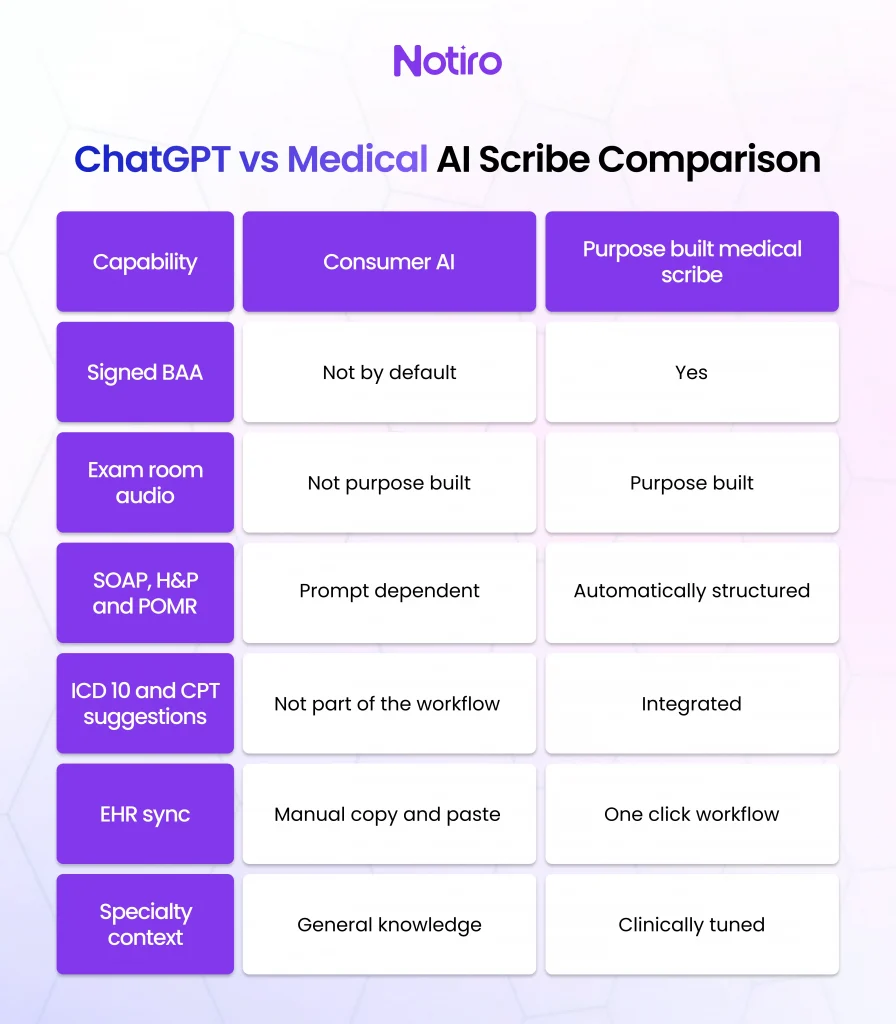
Ambient scribing alone is close to a commodity now, offered by more than thirty dedicated tools. The differentiator most practices actually pay for is what happens after the note. It is whether the visit closes with the ICD-10 and CPT code it earned, or waits for someone to fix it manually next week.
What Secure AI Medical Scribe Solutions Actually Look Like
Secure AI medical scribe solutions start before the visit, not after a transcript is already sitting in a chat window. Notiro’s Patient Intake AI gathers history and symptoms before the physician enters the room. Ambient scribing then captures the visit in SOAP, H&P, or POMR format, and ICD-10 and CPT coding is suggested directly from the audio and note.
That is the full clinical day, from patient hello to chart closure, not a note handed back with the coding still undone. Undercoding already costs practices real revenue.
Physicians face pressure to manually select from more than 70,000 ICD-10 codes and 10,000 CPT codes at the end of a long day (source: CMS). A general chatbot cannot close that gap. A scribe built around the clinical day can.
The physician who once asked why not use ChatGPT for medical notes usually is not looking for a chatbot. They are looking for the twenty minutes back at the end of the day, without trading it for a compliance question nobody wants to answer later.
Chart With a Secure AI Medical Scribe, Not a Chat Window
Charting with a consumer chatbot: 20 minutes today for a privacy and coding problem later. Notiro signs a BAA with every practice, listens to the visit itself, and suggests the ICD-10 and CPT codes it actually earned. Start a free trial at notiro, no IT setup and no enterprise contract required.