An emergency physician sees a new patient every fifteen minutes during a busy shift. Then come ten or more charts to close before signing out. The average physician already spends 3 or more hours daily on documentation, according to the American Medical Association.
Search “AI scribe emergency medicine” and most results list general ambient note tools. Few were built for trauma bays, multiple voices, or unscheduled high-acuity visits. Notiro approaches emergency department documentation differently, covering intake, charting, and coding in one workflow.
This page breaks down what emergency department documentation software actually needs to handle. It also covers where Notiro fits into a fast-moving emergency department shift. The goal is fewer minutes lost to charting and more revenue captured correctly. That includes speed, noise tolerance, and what happens after signing.
Why Emergency Department Documentation Software Breaks Down Under ED Pace
Emergency department visits move faster than almost any other clinical encounter. A single visit can include trauma evaluation, multiple specialists, and a worried family member. Capturing all of that without losing the clinical thread is the first real test.
Most ambient scribes were designed for one quiet exam room, not a trauma bay. Background noise, overlapping voices, and constant interruptions push transcription accuracy down fast. A scribe who loses detail during a code blue is worse than no scribe at all.
Ambient note generation alone is now a commodity feature across the AI scribe market. Dozens of tools can turn a recorded conversation into a passable draft note. Speed alone does not make a tool fit for emergency department documentation software standards.
Emergency medicine also carries higher medicolegal stakes than many outpatient specialties. Thin documentation can become a liability if a diagnosis is missed later. Complete, structured notes protect the patient record and the physician afterward. That risk grows when several problems are documented under serious time pressure.
The real test starts after the note gets drafted and reviewed. That is where most tools marketed to emergency medicine still fall short. Few connect the note to coding, billing, or the EHR record. That gap leaves the heaviest administrative work for the physician to finish alone.
What an AI Medical Scribe for Emergency Physicians Needs to Capture
An effective AI medical scribe for emergency physicians has to separate overlapping problems cleanly. A single ED visit often includes chest pain, a fall, and a medication question together. Conflating those threads into one note creates real risk at sign-out.
Notiro’s ambient scribe is medically tuned to recognize clinical terminology, not general speech. It is built to handle real exam-room and trauma-bay acoustics, not studio-quality audio. Multiple presenting problems get captured separately, without merging one complaint into another. It also keeps trauma team chatter separate from the physician-patient conversation.
Emergency settings carry the highest multi-problem complexity of any clinical environment in medicine. Notiro’s Diagnosis Support feature can surface differential considerations worth documenting in these visits. It is built to augment clinical judgment in the room, never to replace it.
A nurse practitioner running an urgent care overflow shift faces the same layered complaints. The same scribe needs to work for any clinician seeing patients, not physicians only. Scope of practice differences should not mean a worse documentation tool.
How an Emergency Medicine AI Scribe Should Work, Start to Finish
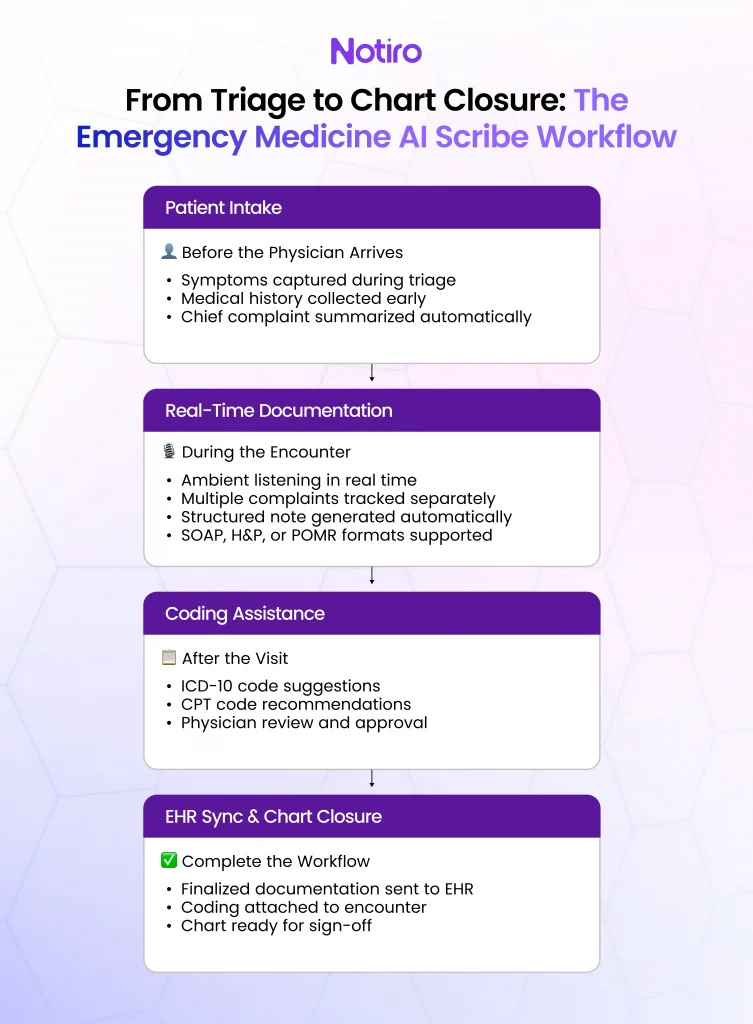
Most AI scribes only start listening once the physician walks into the room. Notiro’s Patient Intake AI captures symptoms and history earlier, during triage and check-in. The physician reaches the bedside already briefed on the chief complaint. That head start matters most during a multi-patient surge.
During the encounter, Notiro listens and drafts a structured clinical note in real time. Notes generate in SOAP, H&P, or POMR format, depending on the visit type and complexity. The entire workflow runs from a mobile phone, with no extra hardware in the bay.
After the visit, Notiro suggests ICD-10 and CPT codes drawn from the note and audio. The physician reviews and confirms the codes before the chart syncs to the EHR. One workflow now covers intake, charting, and coding across an entire shift.
That full-day coverage is the actual difference between an emergency medicine AI scribe and a transcription app. A transcription app stops at the note and leaves coding and EHR entry to the physician. Notiro carries the same encounter from patient hello to chart closure.
AI Scribe for Emergency Medicine, Built for Round-the-Clock Shifts
Emergency departments never close, which means documentation cannot depend on regular office hours. A night shift at 3 AM needs the same charting support as a Tuesday afternoon. Most AI scribes were built around scheduled outpatient visits, not continuous coverage.
Shift changes also create gaps, where one physician hands off a patient mid-workup to another. A consistent AI scribe for emergency medicine keeps the documentation trail intact across that handoff. The incoming physician reads one continuous note instead of piecing together two different styles.
Notiro runs the same way at 3 AM as it does at noon on a Tuesday. There is no separate night-shift configuration or reduced functionality after hours. That consistency matters most exactly when staffing and attention are stretched thinnest.
AI Charting for Emergency Medicine: Closing the Coding Gap After the Shift
Emergency department visits generate complex codes, often across several presenting problems at once. Selecting the right ICD-10 and CPT codes under time pressure is where charts lose money. Undercoding is a documented, recurring cause of missed reimbursement in high-volume practices.
Most AI scribes built for emergency medicine stop at the note and skip coding entirely. Freed, Heidi Health, and Nabla all generate solid notes, but none auto-suggest billing codes. Notiro’s AI charting for emergency medicine carries the coding step through to the EHR.
UCSF research found AI scribe adopters earn approximately $3,000 more per year on average. They also see about one additional patient per week, according to the same research. In a high-volume emergency department, that margin compounds across a busy schedule.
DeepScribe offers similar coding automation, priced at $350 to $500 per provider monthly. Notiro brings that same coding depth to practices and departments of any size. The coding step should not stay a luxury reserved for the largest health systems.
HIPAA and Trust: What an AI Scribe Emergency Medicine Team Needs
Emergency department visits are unscheduled, which makes patient consent harder to standardize than clinic visits. Any AI scribe processing visit audio needs a signed Business Associate Agreement under HIPAA. Notiro is HIPAA compliant and signs a BAA with every practice it works with.
Hospital systems also need clarity on who approves AI documentation tools for clinical use. That governance question matters as much as the technology itself in many institutions. Notiro’s HIPAA compliance and signed BAA give compliance officers a clear starting point.
The right AI scribe for emergency medicine needs to offer more than fast transcription. It needs noise tolerance, multi-problem accuracy, coding support, and a working EHR connection. Notiro’s EHR sync currently covers Athenahealth and Epic, with more integrations underway.
Losing one emergency physician to burnout can cost a hospital system $500,000 or more. That figure comes from AMA data on physician recruitment and turnover costs. AI scribe emergency medicine adoption now functions less like a perk and more like a retention strategy.
Emergency department documentation eats into patient care time and after-shift hours alike. Notiro covers intake, ambient charting, and ICD-10 and CPT coding in one connected workflow. Start a free trial at notiro.ai, no IT setup and no enterprise contract required.