
Healthcare’s relationship with artificial intelligence has changed dramatically over the past few years. In 2023, many healthcare organizations were still experimenting with AI documentation tools through small pilot programs. By 2026, AI clinical documentation will have become one of the most widely adopted and practical applications of healthcare AI.
The shift is reflected in physician adoption. According to the latest survey from the American Medical Association, more than 80% of physicians now use AI professionally, more than double the rate reported in 2023. The report also found that physicians are increasingly optimistic about AI’s ability to automate tasks that contribute to burnout and improve efficiency across healthcare workflows.
For healthcare leaders, the question is no longer whether AI belongs in clinical documentation. The real question is how AI can improve documentation quality, reduce administrative burden, support better decision-making, and create more efficient clinical workflows.
What Is AI Clinical Documentation?
AI clinical documentation refers to the use of artificial intelligence to capture, generate, organize, and improve clinical records throughout the patient journey.
Early solutions focused primarily on speech-to-text transcription and digital dictation. Today’s AI-powered systems can listen to clinician-patient conversations, generate structured notes, summarize encounters, support coding workflows, and assist with documentation review.
The scope of AI is also expanding beyond documentation itself. Healthcare organizations increasingly want solutions that automate multiple stages of the clinical workflow rather than simply generating notes. This shift is creating demand for platforms that can support documentation before, during, and after patient encounters.
How does this workflow actually operate in practice?
Modern AI documentation platforms do far more than convert speech into text. They capture patient conversations, generate structured clinical notes, support medical coding, synchronize information with EHR systems, and surface insights that help clinicians make faster decisions. The workflow below illustrates how AI now supports the entire documentation journey from patient interaction to clinical action.
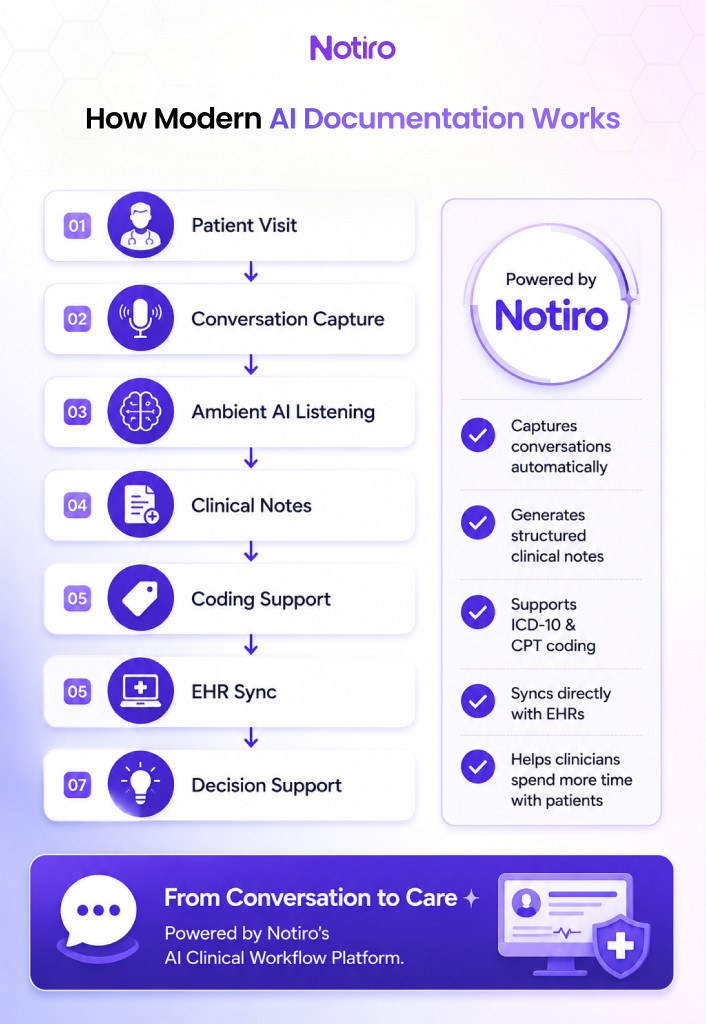
Solutions such as Notiro are helping drive this evolution. By combining AI-powered documentation with broader workflow automation, Notiro helps healthcare teams reduce manual work, improve documentation consistency, and save valuable administrative time.
AI Clinical Documentation Adoption in 2026
AI clinical documentation adoption has reached a turning point.
According to the AMA’s 2026 physician AI survey, physician awareness and use of AI increased to 81%, while the average number of AI use cases per physician more than doubled compared to 2023. Clinical documentation remains one of the most common applications because it directly addresses one of healthcare’s most persistent operational challenges.
Physicians spend significant time documenting encounters, reviewing records, updating EHRs, and completing administrative tasks. These responsibilities often extend beyond clinic hours, contributing to burnout and reducing time available for patient care.
Healthcare organizations are increasingly investing in AI for clinical documentation because the return on investment is easier to measure than many other AI initiatives. Time savings, improved efficiency, reduced administrative burden, and better documentation quality all contribute to measurable outcomes.
This is also where workflow-focused platforms are gaining momentum. Rather than treating documentation as a standalone process, Notiro helps connect documentation with patient intake, coding support, and EHR workflows, creating efficiencies across the clinical day.
Top AI Clinical Documentation Trends Shaping Healthcare in 2026
- Ambient AI Documentation Is Becoming Mainstream
Ambient AI documentation has emerged as one of the fastest-growing categories in healthcare technology.
These systems automatically listen to clinician-patient conversations and generate structured clinical notes. Instead of spending valuable appointment time typing documentation, clinicians can focus on patient interactions while AI handles much of the note creation process.
Major healthcare organizations are already scaling these technologies. Cleveland Clinic reported rapid adoption of ambient AI documentation, with more than 4,000 clinicians voluntarily using the system within 15 weeks and over one million patient encounters documented during deployment.
The success of these deployments demonstrates that ambient AI is no longer an emerging technology. It is becoming part of everyday clinical practice.
- Generative AI Is Moving Beyond Medical Scribes
The next generation of AI documentation tools does much more than transcribe conversations.
Generative AI can summarize encounters, identify relevant clinical details, structure information into preferred note formats, and support downstream workflows. Rather than functioning as digital dictation tools, these systems increasingly act as intelligent documentation assistants.
This evolution is creating opportunities for broader workflow automation. Notiro, for example, uses AI not only for documentation but also to streamline coding preparation, workflow management, and information sharing across healthcare systems. This allows healthcare teams to reduce repetitive administrative tasks while improving overall operational efficiency.
- Burnout Reduction Is Driving Investment
Burnout remains one of the strongest drivers of AI clinical documentation adoption.
A multicenter study published in JAMA Network Open found that clinician burnout decreased from 51.9% to 38.8% after implementing ambient AI scribe technology. Researchers also observed improvements in cognitive workload and reductions in after-hours documentation.
These findings reinforce a growing belief among healthcare leaders: AI documentation tools are not simply productivity technologies. They are also workforce support technologies.
By reducing time spent on documentation, clinicians can spend more time focusing on patient care and less time completing administrative work.
- Governance and Trust Are Becoming Strategic Priorities
As AI adoption accelerates, healthcare organizations are paying closer attention to governance, privacy, transparency, and physician oversight.
The AMA’s research found that physicians want stronger safeguards around AI implementation, including validation, privacy protections, and accountability frameworks. Healthcare organizations increasingly recognize that successful AI deployment depends on trust as much as automation.
Organizations that implement AI responsibly are more likely to achieve long-term adoption and clinician confidence.
How Generative AI Is Transforming Clinical Documentation
Generative AI is fundamentally changing how clinical information moves through healthcare organizations.
Traditionally, clinicians document patient encounters manually, review records, update EHRs, prepare coding information, and complete administrative follow-up tasks. These processes require substantial time and attention.
Generative AI reduces this burden by transforming conversations into structured documentation. It can identify key clinical details, generate draft notes, organize information into preferred formats, and assist with documentation review.
The most significant transformation occurs when AI supports the entire workflow rather than a single task.
Notiro represents this broader approach. By combining AI-powered patient intake, ambient documentation, coding support, and EHR synchronization, Notiro helps healthcare organizations streamline processes across the entire clinical journey. The result is fewer manual handoffs, improved efficiency, reduced documentation errors, and better access to structured clinical information that supports decision-making.
Benefits of AI Clinical Documentation Software
The rapid growth of AI clinical documentation software is driven by measurable benefits.
- Reduced Documentation Time
AI-generated documentation reduces the need for manual note-taking and repetitive data entry. Clinicians spend less time documenting encounters and more time interacting with patients.
- Improved Clinical Efficiency
By automating administrative tasks, AI helps healthcare teams streamline workflows and improve productivity throughout the organization.
- Better Documentation Consistency
Standardized AI-assisted documentation helps improve record quality and reduce variability across providers and departments.
- Reduced Errors and Administrative Burden
Manual documentation processes often create duplicate entries, inconsistencies, and missing information.
Platforms like Notiro help reduce these challenges by automating workflow steps and improving information flow between systems. This reduces administrative burden while supporting cleaner and more accurate documentation.
- Better Clinical Decision Support
One of the most promising benefits of AI is its ability to transform unstructured conversations into organized clinical information.
When documentation is more structured and accessible, clinicians can make better-informed decisions while reducing the cognitive burden associated with locating and reviewing patient information.
Challenges Facing AI Clinical Documentation in 2026
Despite rapid progress, important challenges remain.
Accuracy continues to be a primary concern. AI-generated documentation must be reviewed carefully to ensure completeness and clinical correctness. Large language models can occasionally produce inaccuracies or omit important details.
Privacy and compliance also remain significant considerations. As AI systems process sensitive patient information, healthcare organizations must ensure proper governance, consent management, and regulatory compliance.
These realities reinforce an important principle: AI should support clinicians rather than replace their oversight.
Why Notiro Reflects Where AI Clinical Documentation Is Heading
The state of AI clinical documentation in 2026 is clear. Healthcare organizations are moving beyond standalone AI scribes and note-generation tools toward platforms that support the entire clinical workflow. The focus is no longer limited to documenting patient encounters faster. It is about reducing administrative burden, improving documentation quality, supporting better decision-making, and giving clinicians more time to focus on care.
As adoption continues to grow, the solutions creating the greatest impact will be those that connect every stage of the clinical day. Notiro is helping lead this shift by bringing together patient intake, ambient documentation, ICD-10 and CPT coding support, and EHR synchronization within a single AI-powered workflow. By helping healthcare teams save time, reduce documentation errors, streamline operations, and improve information accuracy, Notiro represents the next generation of AI clinical documentation software.
Ready to see how AI can simplify your clinical workflow? Discover how Notiro helps healthcare teams move from conversation to care.