Clinical documentation has always been a balancing act. Physicians need detailed, accurate records, but creating them often comes at the expense of patient interaction, work-life balance, and productivity. This challenge has driven the rapid adoption of AI medical scribes across healthcare organizations.
AI-powered documentation tools promise to reduce charting time, automate note creation, and streamline workflows. Yet one question continues to dominate conversations among physicians and healthcare leaders:
Can AI-generated notes be trusted? Understanding AI scribe accuracy is essential before integrating these tools into clinical workflows. While modern AI scribes have made remarkable progress, accuracy is not simply about transcribing conversations.
It involves capturing clinical context, documenting key details, maintaining compliance, and producing notes that physicians can confidently rely on.
This article explores what physicians should know about AI scribe reliability, common accuracy concerns, and the factors that separate high-performing solutions from those that introduce unnecessary risk.
What is AI Scribe Accuracy?
AI scribe accuracy refers to how effectively an AI-powered system captures patient encounters and converts them into clinically useful documentation.
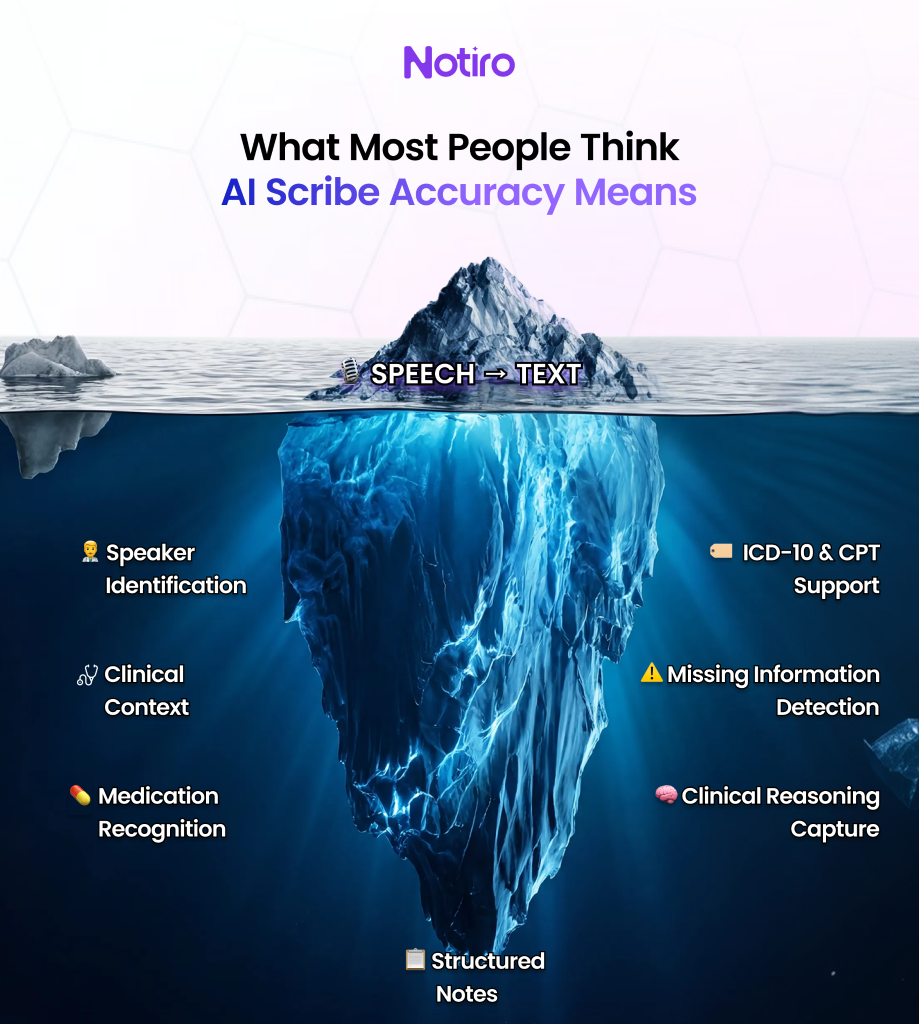
Many people assume accuracy means converting speech into text without mistakes. In reality, AI scribe note quality depends on several factors:
- Correctly identifying speakers
- Capturing relevant clinical information
- Maintaining context throughout the encounter
- Generating structured documentation
- Supporting accurate coding and billing
- Minimizing omissions and inaccuracies
An AI medical scribe may achieve excellent transcription accuracy while still missing critical clinical details. For physicians, the true measure of success is whether the generated note accurately reflects the encounter and requires minimal editing before approval.
Why AI Scribe Reliability Matters
Healthcare documentation directly influences patient care, reimbursement, compliance, and clinical decision-making.
A missing symptom, incorrect medication dosage, or omitted diagnosis can create downstream consequences that affect both providers and patients. Even small documentation errors can lead to coding issues, claim denials, or incomplete patient records.
This is why AI scribe reliability has become a major consideration for healthcare organizations evaluating documentation technologies.
Reliable AI scribes help physicians:
- Reduce documentation burden
- Spend more time with patients
- Improve note consistency
- Accelerate chart completion
- Support coding accuracy
However, unreliable systems may increase review time, create workflow disruptions, and reduce clinician trust.
The goal is not simply automation. The goal is dependable automation that enhances clinical workflows without sacrificing accuracy.
Common Factors That Affect AI Scribe Accuracy
Not all AI scribes perform equally. Several variables influence the quality of generated notes.
- Audio Quality
Clinical environments are rarely quiet. Background conversations, medical equipment, interruptions, and multiple speakers can affect audio capture.
Advanced AI systems are designed to filter noise and distinguish between speakers, helping improve documentation accuracy in real-world clinical settings.
- Clinical Context Understanding
Medical conversations often contain abbreviations, specialized terminology, and complex clinical reasoning.
An AI scribe must understand healthcare language rather than simply convert speech into text. Systems designed specifically for healthcare generally outperform generic transcription tools because they are trained on medical workflows and terminology.
- Patient Communication Variations
Different accents, speaking styles, and communication patterns can influence transcription performance.
Modern AI models continue to improve in handling diverse patient populations, but physician review remains an essential safeguard.
- Documentation Structure
A high-quality note is more than a transcript. Effective AI scribes organize information into structured formats such as SOAP notes, HPI sections, assessments, and treatment plans. This improves usability and reduces documentation cleanup.
What Physicians Should Look for in an AI Scribe
When evaluating AI medical scribe accuracy, healthcare organizations should look beyond marketing claims. Several practical questions can help determine whether a solution will support clinical workflows effectively.
Does the System Require Physician Review?
No AI scribe should finalize documentation without clinician oversight. The most reliable solutions position physicians as the final decision-makers while reducing the amount of manual work required to complete notes.
Can It Understand Clinical Context?
Healthcare conversations are highly specialized. An AI scribe should recognize medical terminology, clinical reasoning, and treatment discussions rather than simply transcribe spoken words.
Does It Support Coding and Documentation Standards?
Documentation quality affects both patient care and reimbursement. AI-generated notes should support coding workflows and maintain consistency across encounters.
Does It Integrate With Existing Systems?
Documentation tools should simplify workflows rather than create additional administrative steps. Solutions that integrate directly with EHR systems can significantly reduce duplicate work and improve efficiency.
How Modern AI Scribes Are Improving Accuracy
Recent advances in artificial intelligence have transformed what AI scribes can accomplish.
Today’s leading platforms use large language models, contextual understanding, ambient listening technology, and workflow automation to generate more complete and clinically relevant documentation.
Rather than acting as simple transcription tools, modern AI scribes function as documentation assistants that understand clinical conversations and convert them into structured records.
This evolution has helped improve AI scribe note quality while reducing the amount of editing required from physicians.
Many healthcare organizations now report faster chart completion and reduced administrative workload after implementing advanced AI documentation solutions.
How Notiro Supports Accurate Clinical Documentation
Accuracy remains one of the most important factors when selecting an AI scribe platform.
Notiro is designed specifically to address the challenges physicians face with clinical documentation. Instead of functioning as a basic transcription tool, Notiro serves as a comprehensive AI clinical workflow platform that supports the entire documentation process.
Using ambient AI technology, Notiro captures patient conversations in real time and transforms them into structured clinical notes that physicians can review and approve before they become part of the medical record.
Beyond note creation, Notiro helps healthcare teams improve efficiency through:
- AI-generated clinical documentation
- Coding support for ICD-10 and CPT workflows
- Seamless EHR integration
- Context-aware documentation assistance
- Streamlined review and approval processes
By combining clinical context understanding with workflow automation, Notiro helps reduce administrative burden while supporting higher-quality documentation.
This allows healthcare professionals to spend less time charting and more time focusing on patient care.
Can Physicians Fully Trust AI-Generated Notes?
The short answer is no, and they shouldn’t. AI scribes should be viewed as clinical support tools rather than replacements for physician judgment.
The most effective approach combines AI efficiency with clinician oversight. AI can dramatically reduce documentation workload, but physicians remain responsible for reviewing and approving notes before they become part of the official medical record.
This human-in-the-loop model helps balance productivity gains with clinical accountability.
As AI technology continues to advance, accuracy will improve further. However, trust should be built through consistent performance, rigorous review processes, and solutions that prioritize patient safety.
Accuracy Should Be the Standard, Not the Selling Point
As healthcare organizations increasingly adopt AI-powered documentation tools, understanding AI scribe accuracy becomes more important than ever. Physicians need solutions that do more than automate note creation. They need systems that reliably capture clinical information, support compliance, and fit naturally into existing workflows.
The most successful AI scribes combine advanced automation with physician oversight, ensuring that documentation remains both efficient and clinically sound.
As a leading AI clinical workflow platform, Notiro helps healthcare organizations improve documentation accuracy, reduce administrative burden, support coding workflows, and streamline EHR integration.
By combining AI-powered efficiency with clinician control, Notiro enables healthcare teams to spend less time documenting and more time delivering exceptional patient care.
Ready to see how AI-powered clinical documentation can improve note quality and workflow efficiency? Explore how Notiro helps healthcare teams move from conversation to care.