For every clinician who has genuinely changed how they chart with an AI scribe, there is another who tried one once and returned to manual documentation. AI medical scribe adoption is not stalling because the tools do not work.
It is stalling because rollout strategies routinely ignore how physicians make decisions about new tools in clinical practice.
Platforms like Notiro are built with those objections in mind. Notiro’s AI Medical Scribe captures each visit in real time, generates structured notes across SOAP, H&P, and POMR formats, and connects to ICD-10 and CPT billing code automation that no Tier 1 competitor offers at comparable depth.
A physician trialing it across a real 12-patient day is not testing a transcription tool. They are testing a full workflow replacement.
The Documentation Burden That Makes AI Medical Scribe Adoption Urgent
Physicians now spend an estimated 4.5 hours daily on EHR documentation, according to a study compiled across 10 published articles using direct observation and computer-based EHR tracking methods.
For primary care physicians specifically, documentation accounts for roughly 35% of total clinical time, a proportion that compounds across dozens of patient encounters each day. The EHR did not reduce that burden. In many documented settings, it increased it.
The downstream impact on physician well-being is measurable. Tebra’s 2025 Physician Burnout Survey found documentation and charting ranked as the top burnout driver, cited by 26% of primary care physicians and 23% of mental health providers.
A 2025 multi-site study of 263 physicians across six health systems found that burnout prevalence dropped from 51.9% to 38.8% after just 30 days of consistent ambient AI scribe use. The documentation gap is both a well-being problem and a solvable one.
Why Physician AI Adoption Stalls: Four Barriers Leaders Must Address
- Workflow Disruption Before Workflow Improvement
The first objection physicians raise is not accuracy. It is process. Platforms without direct EHR integration force physicians to copy notes manually into Athenahealth or Epic, losing five to ten minutes per visit.
The time gain disappears before it is felt. Notiro closes this with one-click EHR sync to confirmed integrations, delivering chart-ready notes before the next patient walks in.
- Accuracy In Complex, Multi-Problem Visits
A three-problem visit in 15 minutes is the real test case. Notiro’s AI Medical Scribe is trained on clinical language and handles multi-problem presentations without conflating them. Its noise-robust processing accounts for real exam room acoustics.
Notiro’s Diagnosis Support feature surfaces differential diagnoses and clinical considerations during documentation, helping physicians manage visit complexity without missing documentation that affects coding or continuity of care.
- HIPPA Compliance And Patient Consent
Any AI scribe processing visit audio handles Protected Health Information (PHI). Under HIPAA, the vendor must sign a Business Associate Agreement (BAA). Without one, the physician carries liability regardless of the tool’s technical security.
Notiro is HIPAA compliant and signs a BAA with every practice. Resolving this at procurement removes the most emotionally weighted objection before the first patient visit.
- The Billing Code Gap Most Platforms Leave Open
Most AI scribes stop at the note. The physician adopting a note-only tool still faces post-visit coding under cognitive load. ICD-10 has over 70,000 codes; CPT has over 10,000.
Manual selection under time pressure produces systematic undercoding, costing practices thousands per month in missed reimbursement. Notiro auto-suggests ICD-10 and CPT codes from each visit’s audio and note.
Freed AI, Heidi Health, and Nabla do not offer this. DeepScribe does, but at an enterprise price point that excludes solo and small-group practices. Notiro makes billing code automation accessible at any practice size.
An AI Scribe Rollout Strategy That Builds Durable Physician Adoption
- Start With One Physician Champion
Physician AI adoption moves through peer demonstration, not mandates. A skeptical physician who trials Notiro for 14 days and documents the outcome becomes the practice’s most credible internal advocate. Their specific objections and how the platform resolved them answer exactly what every hesitant colleague is already asking.
- Choose A Platform Covering The Full Clinical Day
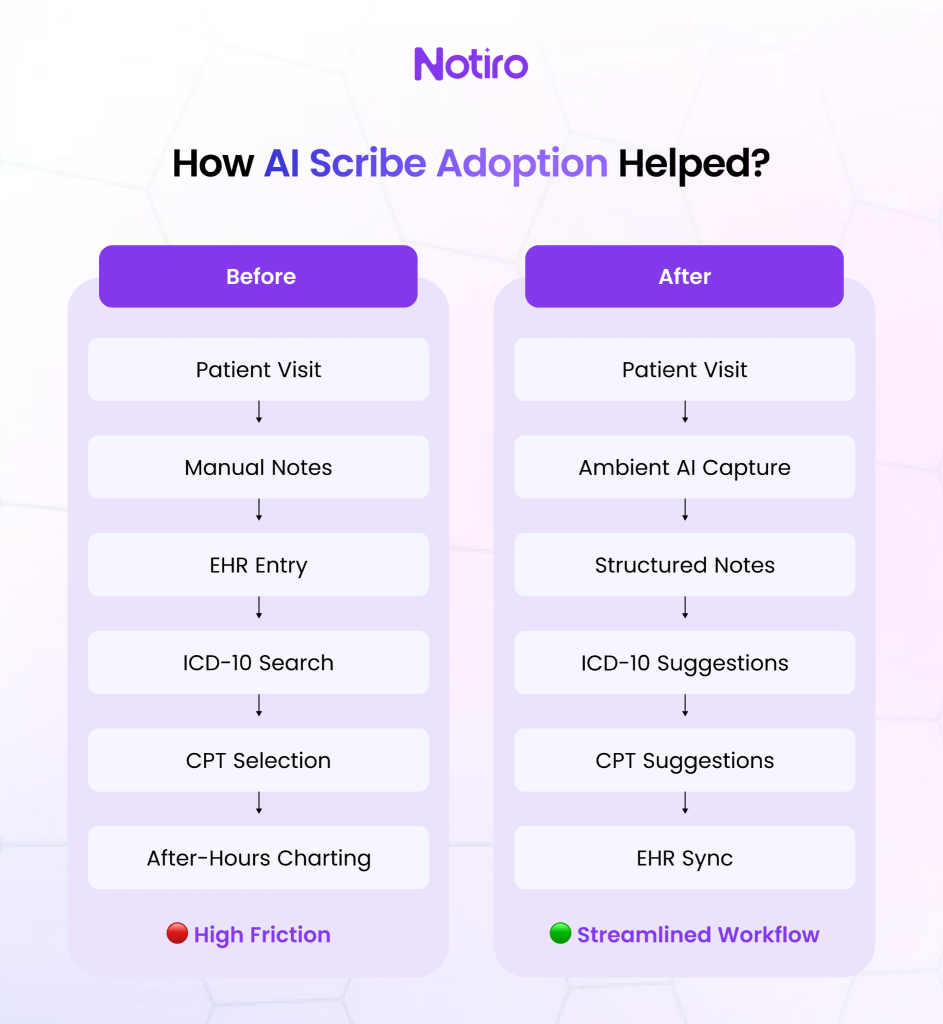
A note-only scribe removes one bottleneck and leaves the billing gap open. Notiro automates the complete workflow: Patient Intake AI briefs the physician before the visit, the ambient scribe captures the note during it, and ICD-10 plus CPT code suggestions close the billing loop after.
No other Tier 1 competitor offers all three stages. This is the difference between a documentation aid and a full workflow replacement.
- Measure Documentation Time, Not License Activation
A 2026 study of 1,800 clinicians across five academic medical centers found that consistent AI scribe use saved 16 minutes of documentation time per eight hours of patient care. That figure is modest in isolation, but across a 20-patient day it represents a meaningful shift in when the chart closes and whether the physician leaves on time. Practice managers should track this at the individual level, not through aggregate license data.
Physician reluctance to adopt AI scribes will not resolve as the technology matures. The tools are already capable. What is missing in most stalled practices is a rollout strategy that takes objections seriously and selects a platform that covers the full documentation workflow.
Notiro automates intake, note generation, billing code suggestion, and EHR sync in one platform. When a physician experiences that full-cycle workflow for 14 days, the adoption decision becomes straightforward. The rollout strategy is the variable.
Ready to Close the Adoption Gap?
Documentation burden, undercoding, and after-hours charting are each large enough to justify the transition to an AI scribe platform. Notiro automates the entire clinical day, from patient intake through ambient scribing to ICD-10 and CPT code generation, in a single workflow. Start your free trial at notiro, no IT setup, no enterprise contract.
Frequently Asked Questions
- What Is The Main Reason Physicians Resist AI Medical Scribe Adoption?
Workflow disruption anxiety is the primary barrier. Physicians with established charting routines resist tools that add friction before removing it. Poor EHR integration, unresolved HIPAA questions, and note-only platforms that leave billing untouched all reinforce this resistance. An AI scribe rollout strategy that addresses these objections at procurement produces materially higher adoption rates.
- What Happens to Billing Codes When A Physician Uses An AI Scribe?
Most AI scribes generate the clinical note but leave ICD-10 and CPT coding entirely to the physician. Manual code selection under post-visit time pressure is a documented source of undercoding. ICD-10 contains over 70,000 codes and CPT over 10,000, and cognitive load after a full patient day consistently pushes physicians toward lower-complexity code selections than the visit actually warrants. Platforms that automate code suggestions from visit audio close this gap and improve revenue capture without adding physician time.