Do you know that more than 80% of US physicians now use AI professionally, more than double the adoption rate recorded in 2023, according to the AMA Physician Survey on Augmented Intelligence (2026)? The physicians who have not yet trialed one are not uninformed.
They have specific, reasonable concerns about accuracy, data privacy, billing gaps, EHR friction, and liability. Each concern is worth examining against what the evidence actually shows.
Concern 1: The AI Will Generate Inaccurate Notes
A 2025 UCLA Health study found that physicians reported AI-generated notes “occasionally” contained clinically significant inaccuracies, most commonly omissions. Columbia Nursing researchers also found that speech recognition systems show lower transcription accuracy for patients with non-standard accents or limited English proficiency.
No AI scribe is error-free. The safeguard is physician review before anything enters the chart. A 2025 JMIR AI study found that ambient AI scribes improve note structure and completeness compared with dictation or manual entry when physician review protocols are in place.
Notiro’s AI Medical Scribe uses medically-tuned AI trained on clinical terminology and multi-problem visit structures, not general-purpose speech models.
Concern 2: The Tool Is Not Genuinely HIPAA Compliant
Under HIPAA, any tool that handles Protected Health Information must enter into a Business Associate Agreement (BAA) with the practice. A compliance badge without a BAA is not compliant for clinical deployment.
Foley and Lardner identified a common failure: vendors claiming compliance via “de-identified” data while not following either permissible de-identification method under 45 C.F.R. section 164.514.
Before signing with any vendor, the practice should confirm: whether audio is deleted after note generation, whether PHI is used for model training, and whether the platform is SOC 2 certified. State consent laws also vary; many require all-party consent before recording begins. Notiro is HIPAA compliant and signs a BAA with every practice.
Concern 3: AI Scribes Don’t Handle Billing Codes
This is a real market gap, not a perception problem. Most AI scribes generate notes and stop there. The physician still manually selects ICD-10 and CPT codes post-visit, under time pressure, which is exactly the condition that leads to undercoding.
ICD-10 has over 70,000 codes, and CPT has over 10,000, making accurate manual selection at the end of a busy clinic day structurally unreliable.
Freed AI, Heidi Health, and Nabla do not offer auto-coding. DeepScribe does, at $350–$500 per provider per month, offer enterprise-tier pricing that excludes most independent practices.
UCSF research found AI scribe adopters earn approximately $3,000 more per year and see one more patient per week, but that figure reflects time recovered, not billing optimization.
Notiro’s ICD-10 + CPT Coding Automation surfaces billing codes directly from visit audio, available to solo and small group practices at the standard pricing tier.
Concern 4: The AI Won’t Integrate with My EHR
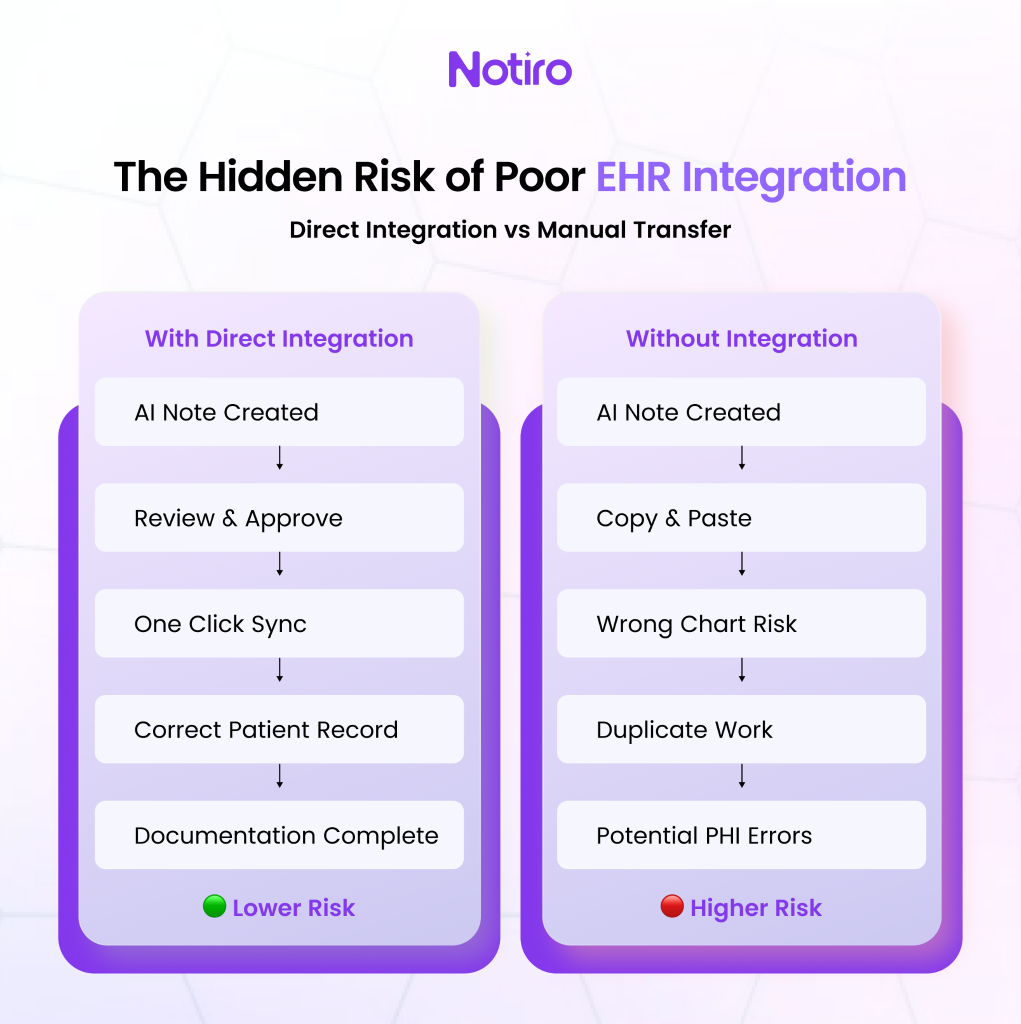
Without direct EHR integration, the physician finishes the visit, reviews the AI note, and manually transfers it into the chart.
That copy-paste step reintroduces time loss and error risk. Foley and Lardner specifically flagged misattribution errors: PHI was inserted into the wrong patient chart due to manual transfer or poor EHR matching. That is a documented failure mode, not a hypothetical.
The practice manager should confirm a direct, verified integration with the specific EHR in use, not just stated compatibility. Notiro has confirmed integrations with Athenahealth and Epic, with notes, ICD-10/CPT codes, and prescription data syncing in one click after each visit.
Concern 5: The AI Only Solves Part of the Problem
A physician’s documentation burden spans three stages: pre-visit preparation, the encounter itself, and post-visit coding and chart closure. Most AI scribes address only the middle stage. A 2025 Peterson Health Technology Institute assessment found that AI scribes reduce clinicians’ cognitive load, but demonstrating financial ROI remains difficult, partly because single-stage tools leave two-thirds of the workflow unchanged.
Notiro covers all three stages. Patient Intake AI briefs the physician before the visit begins. The AI Medical Scribe generates the clinical note during the visit. ICD-10 + CPT Coding Automation closes the billing loop before the chart is filed.
No Tier 1 competitor, including Freed, Heidi Health, or Nabla, covers all three stages. That is the full clinical day, from patient hello to chart closure.
Get Started With Notiro
Physician burnout from documentation is costing the US healthcare system $4.6 billion annually, according to a Stanford analysis published in the Annals of Internal Medicine. Notiro automates the entire clinical day: patient intake before the visit, ambient scribing during the visit, and ICD-10 and CPT code generation before the chart closes. Start your free trial at notiro.ai, no IT setup, no enterprise contract.
Frequently Asked Questions
- Are AI Scribes Accurate Enough For Clinical Use?
Yes, when built on medically-tuned models and used with a physician review step before chart entry. The key variable is whether the AI was trained on clinical language or adapted from a general-purpose model. General-purpose tools tend to produce higher omission and terminology error rates in clinical exam room conditions. As long as the physician reviews and approves the draft before it enters the chart, AI scribes are accurate enough for routine clinical use.
- Do AI Scribes Need To Be HIPAA Compliant?
Yes. Any tool handling patient visit audio, transcripts, or clinical notes is handling Protected Health Information (PHI) and must comply with HIPAA. This requires the vendor to sign a Business Associate Agreement (BAA) with the practice before deployment. Beyond the BAA, a genuinely compliant tool will also disclose whether visit audio is stored or deleted after note generation, whether PHI is used to train its models, and whether the platform holds SOC 2 certification. Practices should verify each of these points directly with the vendor rather than relying on a compliance badge alone.
- Can AI Scribes Reduce Physician Burnout?
Yes, particularly when the tool covers more than note-writing alone. Documentation is widely recognized as the leading driver of physician burnout, and AI scribes reduce the time and cognitive load that charting demands each day. Tools that address only the encounter note still leave pre-visit preparation and post-visit coding to the physician manually. Tools that cover all three stages, intake, scribing, and coding, tend to produce larger and more sustained relief from documentation-related burnout.