
Choosing an EHR is a very different decision for a solo physician than it is for a large health system. Small practices need technology that is easy to learn, reasonably priced, and capable of supporting charting, prescriptions, scheduling, billing, and patient communication without adding unnecessary administrative work.
EHR adoption is now widespread, but practice size still matters. According to the ONC’s June 2026 EHR adoption report, 95% of U.S. office-based physicians used some form of EHR in 2024, while 91% used a certified EHR. Among solo physicians, adoption was lower: 86.1% used any EHR and 79.9% used a certified EHR.
That gap shows why choosing the best EHR systems for small practices requires more than comparing feature lists. The right platform should fit your speciality, budget, staffing model, and daily workflow while leaving room for AI tools that can further reduce documentation burden and improve efficiency as the practice grows too.
What Should a Small Practice Look for in an EHR?
An EHR for small practice use should reduce friction rather than force a small team to operate like a hospital IT department. The most important considerations include:
- Fast, customizable documentation
- E-prescribing and patient portal capabilities
- Scheduling and billing integration
- Interoperability with other healthcare systems
- Transparent pricing and dependable support
It is also worth considering how easily the system works with AI documentation technology. For solo providers, the tools surrounding the EHR can be just as important as the EHR itself.
8 Best EHR Systems and Workflow Solutions for Small Practices in 2026
1. Notiro AI: Best AI Documentation and EHR Workflow Companion
Notiro AI takes the first spot for small and solo practices looking to reduce one of the biggest frustrations surrounding EHR use: clinical documentation.
Notiro is not designed to replace your existing EHR. Instead, it works alongside it, using ambient AI to capture patient conversations and transform them into structured, review-ready clinical documentation.
Notiro also supports EHR integration, allowing approved documentation to move into existing clinical workflows. This means practices can improve how information reaches the EHR without undergoing another disruptive software migration.
For physicians who already have an EHR but still spend too much time completing charts, Notiro is one of the most valuable technology upgrades because it makes the existing workflow smarter.
2. Practice Fusion: Best for Simplicity and Predictable Pricing
Practice Fusion is a practical cloud-based EHR for independent medical practices that want essential functionality without enterprise-level complexity.
Its official pricing starts at $199 per provider per month with an annual commitment. The platform includes charting, customizable templates, e-prescribing, patient engagement capabilities, and billing options.
For budget-conscious outpatient practices, its straightforward pricing makes it easier to estimate EHR costs for small-practice operations.
3. Tebra: Best for Clinical and Business Operations
Tebra combines EHR functionality with billing, telehealth, practice management, and patient experience tools. This makes it attractive to practices that want to reduce the number of disconnected platforms they use.
According to Tebra’s current pricing, its EHR Starter for an eligible low-volume physician begins at $199 per provider per month, while Practice Essentials for a standard-volume physician is listed at $599 per month.
Tebra is particularly useful when a practice wants clinical and administrative functions within the same ecosystem.
4. SimplePractice: Best for Behavioural Health and Wellness
SimplePractice is well suited to therapists, counsellors, psychologists, and other behavioural health or wellness professionals.
It combines documentation, scheduling, telehealth, billing, payments, and a client portal. Its current standard plans start at $49 per month for Starter, $79 for Essential, and $99 for Plus.
For a solo behavioural health provider looking for the best EHR for small private practice use, its speciality-focused approach can be more practical than a general medical EHR.
5. Elation Health: Best for Independent Primary Care
Elation Health is designed around independent primary care, including family medicine, internal medicine, paediatrics, geriatrics, and women’s health.
Its focus on longitudinal patient care makes it particularly relevant for primary care and direct primary care practices. Elation does not offer a single standard monthly subscription; its official pricing is tailored to practice requirements and selected services.
For smaller primary care practices, its clinical-first approach makes it worth including in the demo process.
6. DrChrono: Best for Flexible Clinical Workflows
DrChrono combines EHR, patient engagement, practice management, and medical billing in one platform.
Its plans are organised into Foundation, Growth, and Premium tiers, although practices currently need to request a customised quote for pricing.
DrChrono can be a good option for smaller speciality practices that want customizable workflows and the flexibility to expand functionality as the practice grows.
7. athenaOne: Best for Integrated Clinical and Financial Workflows
athenaOne brings together EHR, practice management, billing, patient engagement, and interoperability.
In August 2026, athenahealth reported that its AI-native athenaOne experience was available across a network of more than 170,000 clinicians. The company also reported up to a 30% increase in same-day chart completion and nearly six fewer minutes of chart preparation and documentation per encounter among early adopters.
For practices expecting to grow or needing stronger financial and data-exchange capabilities, athenaOne is worth considering.
8. AdvancedMD: Best for a Configurable All-in-One Platform
AdvancedMD combines EHR, practice management, billing, patient engagement, and optional AI capabilities within a configurable platform.
Its modular approach can work well for private practices that want more functionality than a basic EHR but still want control over the services they purchase. It is especially worth exploring for growing practices that want clinical and financial workflows integrated into a single ecosystem.
What Is the EHR Cost for a Small Practice?
The EHR cost for small practice operations varies significantly. Speciality-focused software can start below $100 per month, while comprehensive medical platforms that include billing and practice management can cost several hundred dollars per provider.
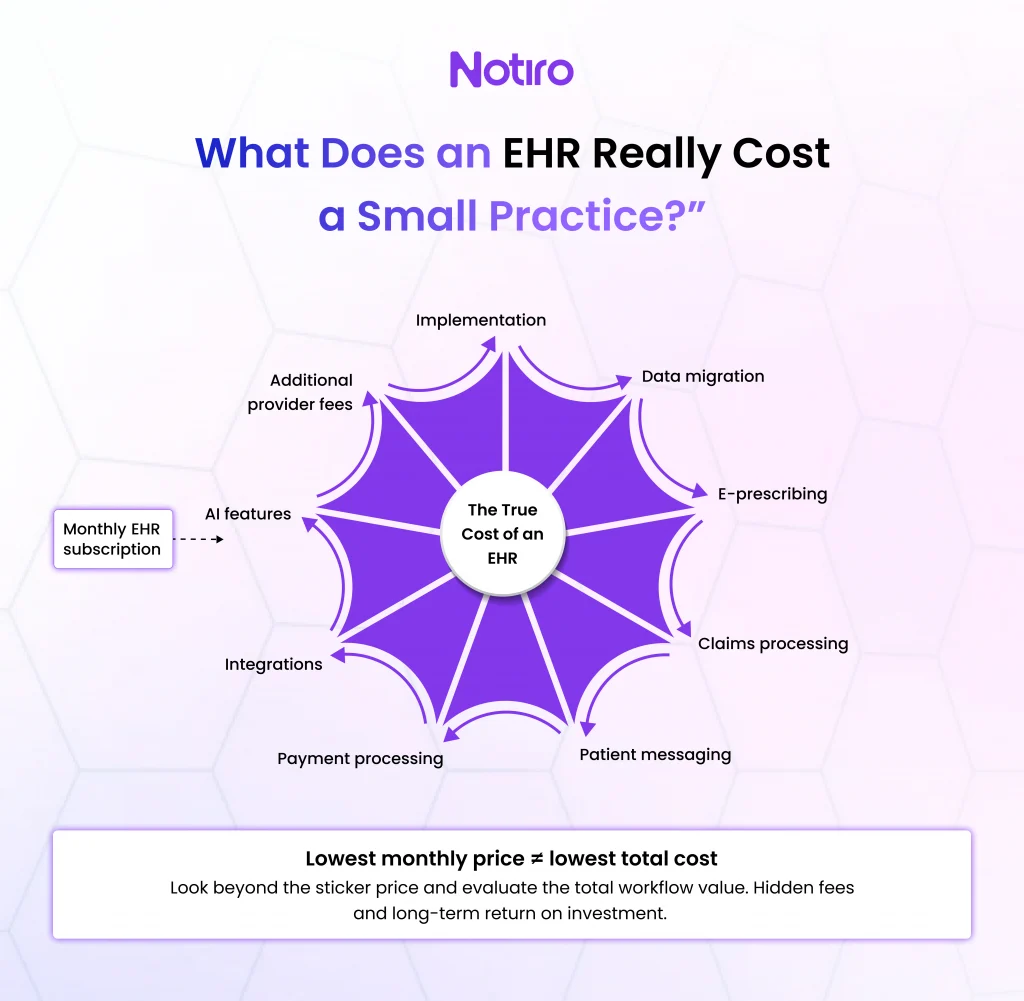
The advertised subscription should not be the only consideration. Practices should also check implementation costs, data migration, e-prescribing, claims processing, patient messaging, payment processing, integrations, AI features, and fees for additional providers.
The cheapest option is not automatically the best EHR software for small practice use. A more expensive platform may provide better overall value if it replaces several subscriptions or reduces significant administrative work.
How to Choose the Right EHR
Ask vendors to demonstrate a normal patient encounter from check-in through chart closure rather than simply showing their dashboard.
Pay attention to how easily you can review history, document the visit, prescribe medications, place orders, bill the encounter, and communicate with the patient.
For solo physicians, small inefficiencies recur at every appointment. The right EHR should fit your speciality, remain financially sustainable, and reduce administrative work rather than shift it elsewhere.
Why Notiro AI Is the Best Technology to Make Your EHR Work Smarter
Choosing the right EHR provides a small practice with a strong foundation, but an EHR alone does not eliminate the documentation burden associated with patient care.
This is where Notiro AI stands out as the best technology for small and solo practices looking to make their existing EHR workflows more efficient.
Instead of requiring providers to replace a system they already use, Notiro adds an intelligent documentation layer on top of it. Patient conversations can be captured and transformed into structured clinical documentation for clinician review, helping providers spend less time typing and more time focused on patients.
For practices that already have an EHR but want faster documentation, smarter workflows, and less administrative work, Notiro bridges the gap between the patient conversation and the completed clinical record.
Ready to make your EHR work smarter? Explore Notiro AI and discover how AI-powered clinical documentation can reduce charting time, simplify workflows, and give more time back to your practice.