Voice dictation is supposed to make clinical documentation faster. Yet many clinicians still end up with notes that feel stiff, repetitive, overly formal, or unlike the way they would normally document a patient encounter.
In many cases, the problem is not the technology itself. It comes down to common dictation mistakes, how information is spoken, and how the final note is processed after the encounter.
Traditional medical dictation software mainly focuses on converting speech into text. Newer tools powered by AI medical dictation go further by understanding context, organizing clinical information, and helping healthcare professionals produce cleaner documentation.
For teams trying to reduce administrative workload without sacrificing note quality, avoiding the most common dictation mistakes can make a significant difference.
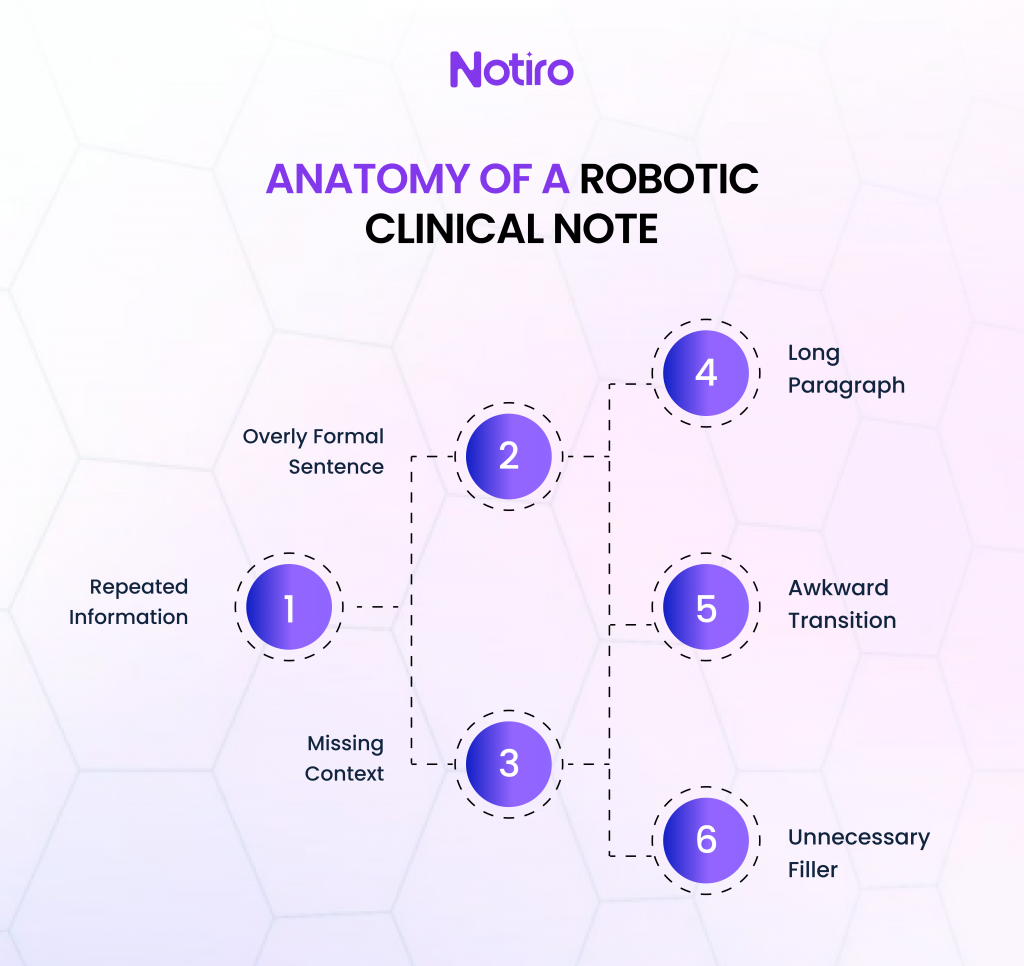
Here are seven mistakes that can make clinical notes sound robotic and what clinicians can do instead.
1. Dictating Every Sentence Word for Word
One of the most common dictation mistakes is treating voice documentation like manual typing. Instead of communicating clinical information naturally, clinicians begin constructing every sentence before saying it.
For example: “The patient is a 48-year-old male who presents today with a three-day history of moderate lower back pain that is worse with movement.”
The sentence is technically fine. However, when an entire note follows this pattern, the documentation can quickly become stiff and overly formal.
Older speech to text software often encouraged this style because clinicians had to dictate exactly what they wanted to appear on screen.
Modern AI dictation software can reduce that burden by interpreting natural clinical language and helping structure the information afterward.
Notiro uses AI to help healthcare teams transform naturally spoken clinical information into more usable documentation. This means clinicians can spend less time mentally constructing every sentence and more time focusing on the patient.
2. Speaking in One Long Stream
Another major mistake is dictating the entire patient encounter as one continuous block of information.
Symptoms blend into examination findings. Assessment mixes with treatment plans. Important information becomes difficult to locate.
The result often reads more like a transcript than a clinical note. A better approach is to think in simple clinical sections such as:
- Chief complaint
- History
- Examination
- Assessment
- Plan
This does not mean clinicians need to speak unnaturally. It simply gives the documentation a logical flow.
Basic voice recognition software may accurately capture everything a clinician says but still produce an unstructured block of text.
AI-powered systems can do more. Notiro uses AI to help organize clinical information into clearer documentation workflows. By reducing the amount of manual restructuring required after dictation, healthcare teams can save time and spend less effort fixing notes before they are ready for review.
3. Using Too Much Formal Medical Language
Clinical documentation should be professional, but professional does not have to mean complicated.
A frequent dictation mistake is becoming noticeably more formal once the microphone turns on.
A simple sentence such as “Patient reports dizziness when standing” can become “The patient endorses episodic sensations of lightheadedness occurring primarily upon transitioning from a seated to an upright position.”
Both may communicate similar information, but the second version is harder to scan and sounds far less natural.
Overly formal language can make notes longer, less readable, and more repetitive. Modern medical dictation software should support clinical clarity rather than encourage unnecessary complexity.
With AI medical dictation, clinicians can speak more naturally while AI helps organize the information into appropriate clinical language.
Notiro supports this approach by using AI to make documentation more efficient and easier to review. The goal is not to make every note sound sophisticated. It is to make clinical information clear, structured, and useful.
4. Repeating the Same Information
People repeat information naturally during conversations. A clinician might mention that a patient has experienced headaches for three weeks while discussing the history, revisit the symptom during examination, and mention it again during assessment.
That repetition is normal during a patient encounter. In a clinical note, however, it can create unnecessary duplication.
This is one of the dictation mistakes that contributes to note bloat and makes documentation harder to review.
Traditional speech to text software may simply capture every repeated statement because it is designed to transcribe what it hears.
AI can help introduce more context. Advanced AI dictation software can support workflows where information is processed and organized more intelligently rather than treated as isolated sentences.
Notiro uses AI to help healthcare teams streamline clinical documentation and reduce repetitive manual work. Cleaner notes make it easier for clinicians to identify important information and support better decision-making without searching through duplicated content.
5. Dictating Every Comma and Period
“Patient reports chest pain, comma beginning yesterday period new paragraph.” This style of dictation will sound familiar to anyone who has used traditional voice recognition software.
For years, clinicians were trained to announce punctuation because the software needed explicit instructions.
The problem is that constantly saying “comma,” “period,” and “new paragraph” interrupts natural thought patterns.
It can turn a supposedly faster documentation process into another highly controlled administrative task.
Modern AI medical dictation is changing that experience. Instead of asking clinicians to manage every punctuation mark, AI-powered tools can interpret speech patterns, sentence boundaries, and context.
That allows clinicians to focus on communicating the clinical information rather than controlling formatting.
Notiro is designed around this more intelligent approach. By using AI to streamline documentation processes, healthcare teams can reduce unnecessary interaction with formatting and spend more time reviewing the actual clinical content.
6. Giving the Software Too Little Context
Consider the statement: “Continue medication and follow up in two weeks.” A clinician may understand exactly what this means because they were present throughout the encounter. Software only has the information it receives.
When clinicians dictate isolated fragments without enough background, notes can become vague, generic, or incomplete.
Useful context may include:
- Symptoms
- Duration
- Previous treatment
- Examination findings
- Medication changes
- Clinical reasoning
- Follow-up instructions
This is where AI dictation software has an advantage over traditional transcription systems.
Instead of simply converting speech into written words, AI can work with broader clinical context to help organize information.
Notiro uses AI to help healthcare teams process documentation more efficiently. When relevant information is clearly captured and structured, clinicians can review patient records more quickly and make better-informed decisions.
AI does not replace clinical judgment. It helps make the information supporting that judgment easier to access and understand.
7. Accepting the First Draft Without Reviewing It
One of the most important dictation mistakes to avoid is assuming that the first generated note is automatically ready to sign.
Even advanced medical dictation software, speech to text software, and AI-based systems can occasionally misunderstand terminology, medication names, numbers, or context.
A small error can significantly change the clinical meaning.
For example, “No history of hypertension” and “History of hypertension” communicate very different information.
That is why clinicians should always review generated documentation before finalizing it.
The real value of AI medical dictation is not removing the clinician from the documentation process. It is reducing the amount of work required before review.
A clean, structured draft is much faster to check than a long, raw transcript.
Notiro helps healthcare teams save time by using AI to streamline documentation before that final review. This can reduce manual typing, formatting, restructuring, and other repetitive tasks that often contribute to documentation errors.
The clinician remains responsible for confirming that the final record accurately reflects the patient encounter.
How to Make Dictated Notes Sound More Natural
Most robotic clinical notes are not caused by one major problem. They usually come from several small dictation mistakes working together.
Clinicians may dictate complete sentences word for word, speak in long blocks, repeat information, use unnecessarily formal language, announce every punctuation mark, provide limited context, or skip the final review.
Improving these habits can immediately make documentation clearer. Technology also matters. Traditional voice recognition software and speech to text software were primarily built to capture words accurately.
The next generation of AI dictation software is focused on understanding those words in context.
That difference matters because clinical documentation is not simply a transcript of a conversation. It is a structured record that healthcare professionals use to communicate, coordinate care, and make decisions.
Why Notiro Goes Beyond Traditional Medical Dictation Software
Notiro is a leading AI-powered solution designed to help healthcare teams create more efficient documentation workflows.
Rather than operating only as traditional medical dictation software, Notiro uses AI to help capture, process, and organize clinical information more effectively.
This approach can help healthcare professionals spend less time typing, formatting, reorganizing, and correcting documentation.
For busy clinical teams, those small time savings can add up quickly across multiple appointments.
Notiro also helps reduce opportunities for manual errors by decreasing repetitive documentation tasks and supporting more structured workflows.
Its AI capabilities are designed to improve efficiency throughout the documentation process so clinicians can review important information faster and focus their attention where it matters most.
As AI medical dictation continues to evolve, the biggest benefit will not simply be faster transcription.
It will be smarter documentation. Healthcare teams need tools that can help them turn natural clinical communication into notes that are clear, structured, and useful.
By combining AI with streamlined documentation workflows, Notiro helps healthcare organizations reduce administrative effort, improve efficiency, and support better clinical decision-making.
The future of dictation is not about speaking faster. It is about making every spoken word easier to turn into useful clinical information.