A patient describes chest tightness, mild, comes and goes, worse with movement. An AI tool flags it low priority based on pattern matching. The physician, reading the patient’s face and hearing how they describe the pain, orders an EKG anyway.
The AI wasn’t wrong to flag what it flagged. The physician wasn’t wrong to override it. This is what balancing automation and clinical judgment looks like in practice, not a philosophical debate, but a decision made in real time by someone accountable for the outcome either way.
This isn’t about who signs the note or who’s liable if something goes wrong. Those are real concerns, but they’re downstream of a more basic one: whether the physician trusts their own judgment enough to override the tool when it matters. That’s a cognitive habit, shaped by how the tool is designed long before any note gets reviewed.
What Clinical Judgment Responsible Use Actually Requires
Most conversations about AI in healthcare split into two extremes: automate everything, or trust nothing. Neither reflects how care gets delivered.
Clinical judgment responsible use starts from a simpler premise: AI is good at pattern recognition across large amounts of information, and physicians are good at reading a specific patient in a specific room. Those are different skills, and neither substitutes for the other.
The problem shows up when AI automation gets treated as a verdict instead of an input. A flagged risk score, a suggested code, a drafted note, all of these are useful because they’re fast and consistent. None of them know the patient the way the physician in the room does.
Where Physician Judgment Balance Breaks Down
Automation bias is documented, not hypothetical. A 2025 study from Technische Hochschule Ingolstadt tested this directly: trained pathology experts using an AI decision-support tool saw overall accuracy improve, but in 7% of cases, a correct initial judgment was overturned by incorrect AI advice. The tool helped on average and still introduced new errors in the moments a clinician deferred when they shouldn’t have. That’s the risk under every AI tool that hands over a confident-looking answer: a habit of mind that forms quietly, well before anyone signs a note or files a claim.
This is why physician judgment balance has to be designed into a tool, not assumed. A system that only confirms what the physician already suspected doesn’t help; it adds noise and trains the physician to stop checking. A system that quietly makes the final call removes the physician from a decision they’re still responsible for.
Notiro is built around a narrower role: support the decision, don’t make it. During a visit, Notiro’s ambient AI listens and produces a structured clinical note in SOAP, H&P, or POMR format, freeing the physician from typing so they stay focused on the patient.
That’s AI automation doing what it’s good at, capturing detail accurately, without asking the physician to hand over anything they shouldn’t. This is what responsible AI healthcare tools look like in practice, not a disclaimer added after the fact, but a boundary built into the product from the start.
Clinical Decision-Making Needs AI Oversight, Not AI Replacement
The instinct to treat every AI suggestion as fully trusted or fully ignored misses the middle ground where most clinical decision-making happens. A physician doesn’t need a tool that diagnoses them. They need one that surfaces what might get missed in a fifteen-minute visit covering three unrelated problems.
Notiro’s Diagnosis Support feature works there. It surfaces clinical considerations worth documenting when a visit is dense enough that details are easy to lose track of. It prompts. It does not diagnose.
That boundary is the design principle behind clinical AI responsible use: the tool’s job is making sure nothing gets missed under time pressure, and the physician’s job is deciding what it means. Every clinical AI responsible for surfacing information, rather than acting on it, has to draw that line clearly.
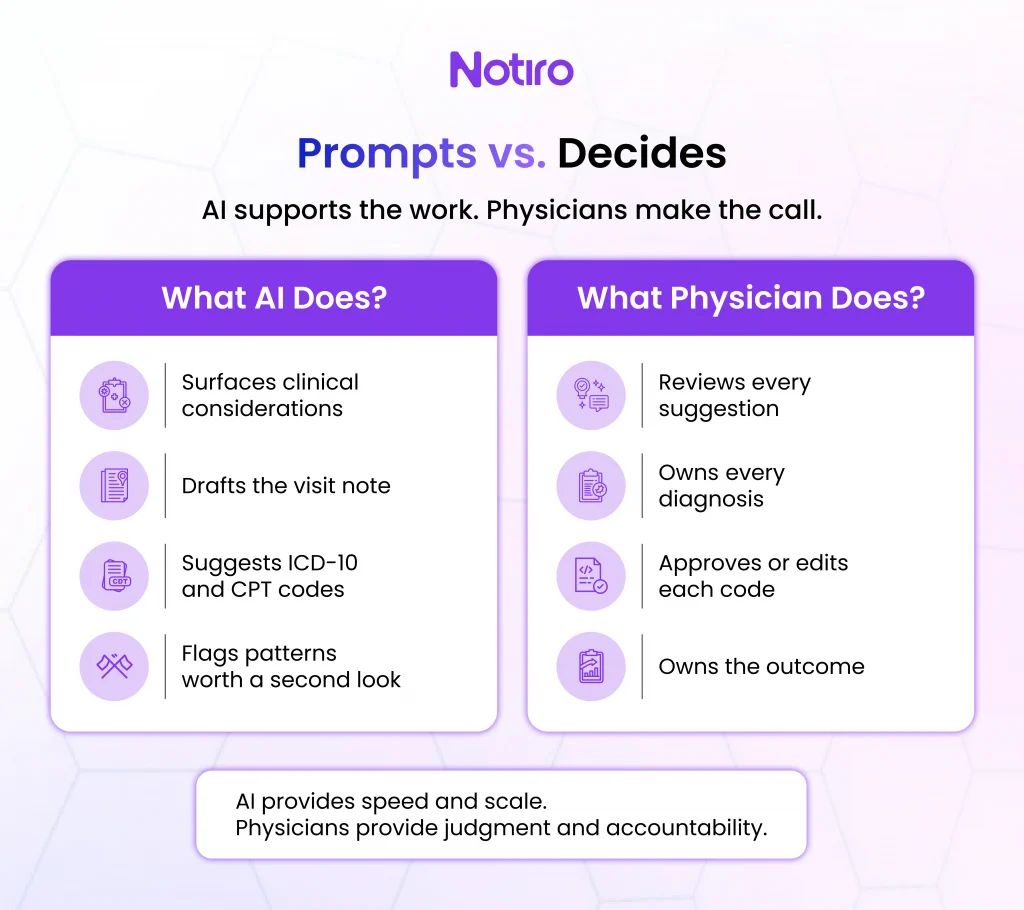
AI oversight works the same way administratively. Notiro suggests ICD-10 and CPT codes from the visit audio and note, and the physician reviews, adjusts, and approves them before anything is finalized. Nothing gets billed or filed without a person confirming it’s accurate.
Use Guidelines Automation Should Follow, Not Set
A tool that sets its own rules for how it gets used isn’t practising responsible AI, no matter how accurate it is. Use guidelines automation should support the clinician’s existing workflow, not redefine it.
That’s part of why Notiro is positioned as a leading AI medical scribe, not a diagnostic authority. A diagnostic tool that’s occasionally wrong is a liability. A documentation and workflow tool that’s occasionally imperfect, and reviewed by the person responsible for the patient, is a normal part of clinical practice with a safety net built in.
This is also where AI earns the “efficiency” claim instead of just gesturing at it. Reducing manual documentation and coding doesn’t just save time; it reduces the small, avoidable errors that happen when a tired physician handles admin work at day’s end instead of when the visit was fresh. Notiro’s model is tuned for real exam-room conditions, overlapping speech, multiple problems in one visit, so the support holds up where clinical decision-making actually happens.
What Responsible AI Healthcare Looks Like Day to Day
Go back to the chest tightness scenario. A well-designed AI tool didn’t try to make the call. It surfaced a pattern, gave the physician more information faster than they could gather alone, and got out of the way. The physician made the decision that mattered, informed by the tool, not directed by it.
That’s the shape automation clinical practice judgment should follow: AI doing the fast, pattern-heavy work, and physicians doing the part that requires being in the room. Every clinical practice judgment still belongs to the person who examined the patient, not the system that prepared for the visit.
Where Notiro Fits
Notiro is built around that same division of labor. It captures the visit, drafts the note, and suggests the codes, so physicians spend less time on admin work and more on the calls only they can make. The AI handles what’s fast and repeatable. The physician still reviews every note, approves every code, and makes every clinical call.
Start a free trial at notiro. No IT setup, no enterprise contract.
FAQ
Does AI replace clinical judgment?
No. Responsible tools surface information faster and more consistently than a physician working alone; they don’t make the call. Notiro’s Diagnosis Support prompts, it doesn’t diagnose, and every suggested code needs review first.
How do you avoid over-relying on automation?
By limiting what the tool is allowed to decide. Automation bias happens when an output gets trusted by default instead of reviewed, so keeping the physician in that review step keeps the balance intact.