Clinical documentation is essential to quality healthcare, but completing it should not feel like a second shift after appointments are over.
Yet many healthcare professionals still rely heavily on manual documentation. A consultation ends, the keyboard comes out, and more time disappears into recording histories, assessments, treatment plans, referrals, and follow-up notes.
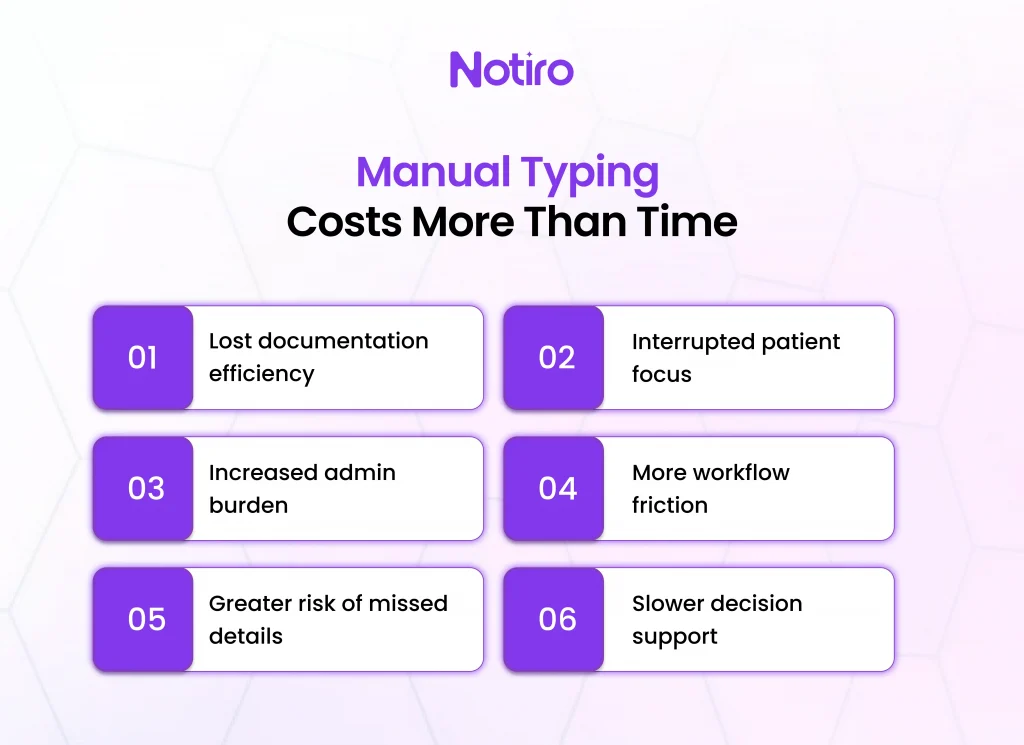
One note may only take a few extra minutes. Over an entire clinic day, those minutes can add up to hours of administrative work. Manual typing can also increase the risk of incomplete information, inconsistencies, and errors when clinicians work quickly or try to recall details later.
This is why healthcare teams are increasingly looking for ways to improve documentation efficiency with tools such as AI documentation software, medical dictation software, and voice dictation software.
As a leading AI powered documentation solution, Notiro helps healthcare teams reduce repetitive work, save time, minimize errors, streamline clinical workflows, and make better use of the information captured during patient care.
But how do you know when your current process has become a bottleneck? Here are six signs that manual documentation may be slowing down your workflow.
1. Your Notes Keep Following You Home
A few unfinished notes at the end of the day may not seem serious.
Then it becomes routine. You finish seeing patients but still have several charts waiting. Documentation moves into lunch breaks, evenings, or time that should have been spent away from work.
This is one of the clearest signs that your manual documentation process cannot keep pace with your clinical workload.
Manual typing creates a simple limitation: documentation speed depends heavily on how quickly information can be physically entered.
Even when you already know what needs to go into the note, you still have to turn every clinical thought into typed sentences.
That friction adds up. Across 15, 20, or more patient encounters, small delays can create a significant backlog and reduce overall documentation efficiency.
AI powered solutions can help remove some of this repetitive work. Notiro helps healthcare teams capture and process clinical information more efficiently so documentation can move alongside the clinical day rather than building up after it.
The goal is simple. When the clinical day ends, documentation should be much closer to finished too.
2. You Finish the Appointment Before You Finish the Chart
The conversation with the patient is complete. Your assessment is clear. The treatment decision has been made. But the documentation is still waiting.
This gap between clinical thinking and clinical recording is one of the biggest problems with manual typing.
Clinicians can often process and communicate information much faster than they can type it. You may already know the symptoms, findings, diagnosis, and next steps while still spending several additional minutes entering them into the record.
When that happens repeatedly, a documentation backlog develops. You either stay behind to finish the record or move to the next patient and return to the note later.
Returning later creates another problem, which is context. You have to remember the encounter, reopen the record, reconstruct your thinking, and finish the note.
This additional step can create more opportunities for missing details and avoidable errors. Modern AI documentation software can reduce this gap by helping clinical information move more quickly from the encounter into the documentation workflow.
Notiro uses AI to streamline documentation, reduce repetitive manual work, and help healthcare teams process information while it is still fresh. The result is greater efficiency and better support for accurate clinical decision-making.
3. Your Attention Keeps Moving Between the Patient and the Keyboard
A good consultation requires attention. Manual documentation often divides it. You listen to the patient, look at the screen, type a sentence, return to the conversation, check another field, and start typing again.
This constant switching may feel normal because it has become part of everyday healthcare workflows. But the clinician is effectively trying to perform two demanding tasks at once:
- Understand the patient.
- Document the patient.
When manual typing dominates the encounter, the screen can begin competing with the person sitting in front of it.
Some clinicians respond by typing less during appointments and documenting afterward. Others attempt to complete everything while the patient is still there.Both approaches involve a compromise.
Document everything immediately, and attention can become fragmented. Wait until later and unfinished documentation begins accumulating.
This is one reason medical dictation software and voice dictation software are becoming increasingly relevant to healthcare teams. Voice based documentation can help clinicians capture information more naturally instead of relying exclusively on a keyboard.
With AI helping organize and process that information, platforms such as Notiro can improve documentation efficiency while reducing unnecessary workflow interruptions.
4. You Are Leaving Out Useful Details to Save Time
Concise clinical documentation can be valuable. Rushed documentation is different.
If you regularly leave out useful context simply because entering it takes too long, your manual documentation process may be affecting the quality of your records.
You know another detail could make the note clearer. You know additional context would help explain the clinical decision.
But another patient is waiting, and the chart has already taken too long. So the detail disappears. This does not always mean the documentation becomes clinically inadequate. It does mean the information captured may be shaped by the inconvenience of typing rather than by what would make the record most useful.
Manual data entry can also create small but important errors through rushed typing, missing information, or inconsistent phrasing.
This is where AI documentation software can provide meaningful support.
Notiro helps healthcare professionals capture and organize clinical information more efficiently. By reducing repetitive manual input, healthcare teams can save time while minimizing avoidable documentation errors.
The goal is not to make notes longer. It is to make accurate documentation easier.
5. Small Documentation Tasks Keep Interrupting Your Day
Documentation delays are not always dramatic. Often they arrive in small pieces.
- A note needs finishing.
- A referral needs additional information.
- A treatment change needs recording.
- A follow-up plan needs updating.
- A previous chart needs reopening.
Each task may take only a few minutes. The problem is how frequently those small tasks interrupt everything else.
This fragmentation can quietly reduce documentation efficiency across the entire working day.
You are not spending one uninterrupted hour documenting. You are repeatedly switching between clinical work and administrative tasks.
Every transition requires you to regain context.
- Open the chart.
- Remember where you stopped.
- Review what has already been entered.
- Continue typing.
- Move to the next task.
Better documentation technology can reduce this friction.
Notiro uses AI to help streamline clinical documentation workflows and reduce repetitive processes that consume time throughout the day.
Instead of depending completely on manual typing, healthcare teams can use AI powered workflows to capture information faster, reduce backlogs, and keep important documentation tasks from repeatedly interrupting patient care.
6. Your Documentation Speed Depends on Your Typing Speed
This may sound obvious, but it is one of the biggest limitations of manual documentation. Typing creates a physical ceiling.
- You may think quickly.
- You may make clinical decisions quickly.
- You may explain your reasoning clearly.
But the record still has to wait for your fingers. Imagine verbally summarizing a case:
“The patient has experienced intermittent lower back pain for three weeks with no neurological symptoms. Symptoms worsen after prolonged sitting. Conservative management was discussed with follow-up recommended if symptoms persist.”
Speaking that information can take seconds. Typing and formatting the same information usually takes longer.
Multiply that difference across an entire clinic day and it becomes easy to understand why healthcare organizations are exploring medical dictation software and voice dictation software.
Voice based documentation allows clinicians to capture information in a way that is closer to how they naturally communicate.
AI can take this further. Instead of simply creating a raw transcript, modern AI documentation software can help process, organize, and structure information so healthcare teams spend less time handling routine documentation tasks.
That is where solutions like Notiro can make a meaningful difference.
Manual Documentation Is Familiar. That Does Not Make It Efficient.
Manual documentation remains common because it is familiar and deeply embedded in healthcare workflows.
But familiar does not automatically mean efficient. If documentation regularly continues after working hours, interrupts patient interactions, creates unfinished charts, or causes useful information to be missed, the process itself deserves another look.
Improving documentation efficiency does not simply mean asking clinicians to type faster.
Healthcare teams need tools that reduce the amount of repetitive administrative work involved in turning clinical information into usable documentation.
This is where AI is changing the category. AI documentation software can help healthcare organizations streamline workflows, reduce unnecessary manual input, minimize errors, and make clinical information easier to capture and use.
Tools such as voice dictation software can also reduce dependence on keyboards and create a more natural way for clinicians to record information.
The value extends beyond speed. Clearer and more accessible information can support better clinical and operational decision-making across healthcare teams.
How Notiro Improves Documentation Efficiency
Notiro is a leading AI powered documentation solution designed to help healthcare teams move beyond slow and repetitive manual documentation.
Instead of relying entirely on manual typing, Notiro uses AI to streamline how clinical information is captured, processed, and used.
It can help healthcare teams:
- Save time by reducing repetitive manual documentation
- Improve documentation efficiency across everyday workflows
- Minimize errors associated with rushed or repetitive data entry
- Reduce documentation backlogs
- Streamline clinical information processing
- Support better decision-making with clearer information
- Reduce dependence on manual typing during busy clinical workflows
By combining the convenience associated with medical dictation software and voice dictation software with AI powered workflow support, Notiro helps healthcare professionals complete documentation more efficiently.
AI should not create another complicated step in a clinician’s day. It should remove unnecessary ones. That is the approach behind Notiro: helping healthcare teams document faster, work more efficiently, reduce avoidable errors, and make better use of clinical information.
Because the problem is not that clinicians have information to document. The problem starts when manual documentation takes longer than it should.
With Notiro, healthcare teams can spend less time typing and more time moving care forward.