
A note generated in ninety seconds that misreads a follow-up visit as a new complaint costs a physician more time than it saved. That is the trade every practice makes when it picks an AI scribe on speed alone. The family physician does not need a note fast. The family physician needs a note that reflects what actually happened in the room, is coded correctly, and is ready for the chart the first time.
Documentation is the leading driver of physician burnout, and it is not close. The American Medical Association’s 2024 workforce data shows that physicians spend 13 hours of a 57.8-hour workweek on indirect patient care tasks such as order entry and documentation, in addition to direct patient time. Speed promises to shrink that number. But speed measures how fast a transcript becomes a paragraph. It says nothing about whether that paragraph is right.
AI-powered clinical documentation tools now compete almost entirely on turnaround time. Every vendor pitch starts with the number of seconds saved per note. What gets left out of the demo is what happens when the visit is not simple. A patient with three chronic conditions mentions a new symptom halfway through discussing medication refills. A telehealth call has cross-talk between a caregiver and the patient. A follow-up visit references a diagnosis from six months ago that is not included in this transcript. Fast transcription doesn’t handle any of this reliably. Contextual AI in healthcare does.
What Context Actually Means in a Clinical Note
Context is not a marketing word here. Context accuracy is the measure of whether the AI-powered clinical documentation tool understands three things at once: what the patient is describing right now, what already exists in the chart, and how clinical language connects the two. A multi-problem visit is the clearest test. When a patient brings up hypertension, a medication question, and a new joint pain in the same fifteen minutes, a scribe without contextual awareness either merges the three into one muddled assessment or drops one entirely. Consider what happens when a routine follow-up turns into a multi-problem visit within minutes.
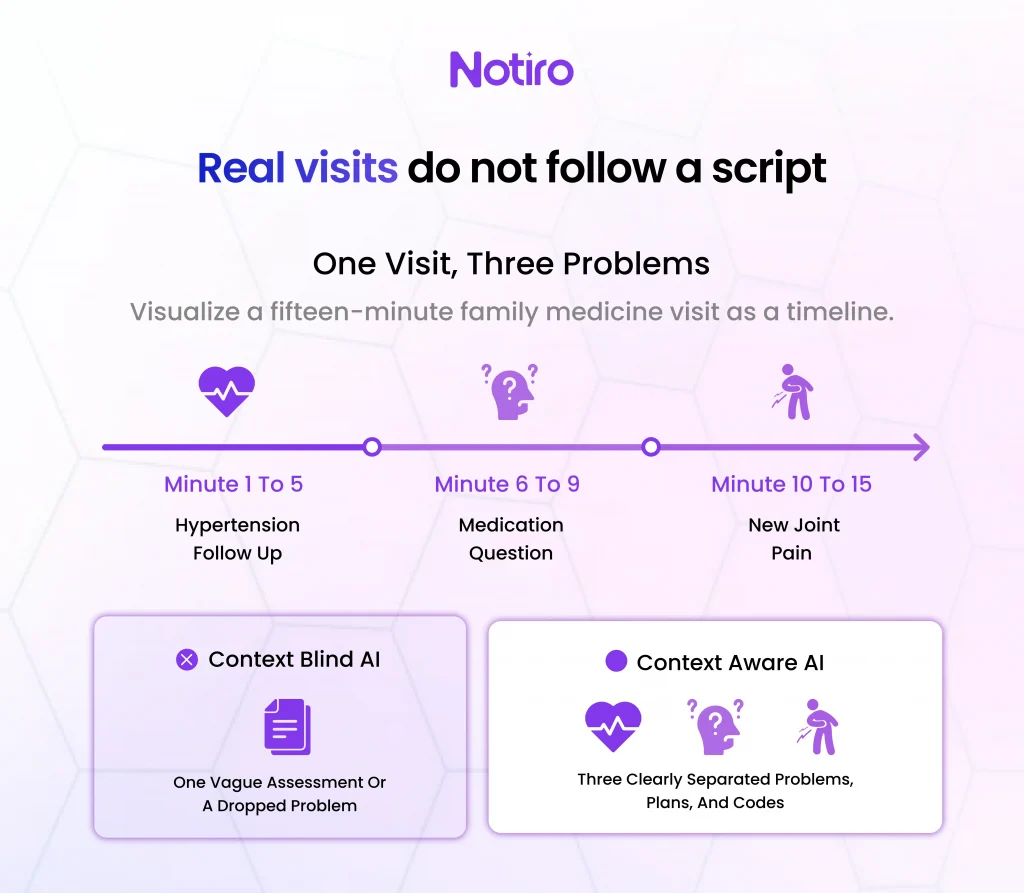
DeepScribe built its entire specialty positioning around this exact problem. The company earned a 98.8 out of 100 performance score in a KLAS Research Emerging Company Spotlight report, with evaluators specifically citing DeepScribe’s context awareness in oncology visits, noting that a note must reflect a patient’s full illness history, not just today’s conversation. That score was not based on transcription speed. It came from clinicians confirming that the notes matched the actual complexity of a longitudinal cancer case. DeepScribe proved something the rest of the category has been slow to admit: physicians will trade a few extra seconds of processing time for a note they do not have to rewrite.
Suki AI took a different path to the same conclusion. Suki markets a 9X return on investment in year one, driven by more accurate documentation that captures a higher level of evaluation and management coding, along with additional encounters clinicians can now fit into a day. That number is not about how quickly a note appears. It is about whether the note, once generated, actually supports the coding level the visit deserves. A note that is fast but generic under-documents complexity, and under-documentation is what drains revenue before a claim ever reaches a payer.
Why Speed-First Tools Break Down in Real Visits
Ambient scribing that only listens and transcribes has become table stakes. Freed, Heidi Health, Nabla, and more than thirty other tools now generate a structured note from audio. Speed no longer differentiates any of them, because it is now assumed. What separates a usable AI medical scribe from one the physician abandons after two weeks is what the tool does when the visit does not follow a script.
Clinical note accuracy depends on the model recognizing when a patient’s statement modifies an existing problem versus introducing a new one. It depends on separating a caregiver’s commentary from the patient’s own report. It depends on carrying forward relevant history without inventing details that were never said. None of this is solved by processing audio faster. It is solved by training the model on clinical language and a multi-problem visit structure, rather than shaving seconds off a transcript.
The gap shows up hardest in coding. ICD-10 contains more than 70,000 codes, and CPT contains more than 10,000, and selecting the right ones under time pressure at the end of a twenty-patient day is a well-documented source of coding errors. A fast note that a physician has to manually recode after the fact does not save time. It just moves the burden from the exam room to the desk at 9 p.m. Medical documentation AI that gets the codes right the first time, because it understands the clinical context of the visit, is the tool that actually closes the loop.
The Cost of Getting Speed Without Context
Undercoding from a rushed or context-blind note costs practices real reimbursement every month, a pattern well known to any practice manager who has reviewed a denied claims report. The physician documented the visit correctly in conversation. The AI simply did not capture the clinical weight of what was said, because it was optimized to produce a note quickly rather than one that reflects the encounter’s true complexity.
This is where healthcare documentation accuracy and financial performance stop being separate conversations. A note that is 90% accurate but missing the one detail that supports a higher-complexity code is not a minor gap. Across a full patient panel, it is the difference between a practice that captures what it earns and one that quietly leaves revenue on the table every single day.
AI medical scribe accuracy also carries a trust cost that is harder to quantify but just as real. A physician who has to re-read and correct every note stops trusting the tool, then stops using it efficiently, and then reverts to writing notes manually after hours. Speed that requires a full manual review afterward was never speed at all.
What This Means for Choosing a Documentation Tool
The family physician evaluating AI clinical documentation tools should ask a different question than “how fast is the transcription?” The better question is what happens when a patient describes three problems in one visit, what happens when a follow-up references history from a prior encounter, and what happens after the note is generated, specifically, whether the tool also gets the ICD-10 and CPT codes right without a manual pass.
Ambient scribing alone answers only the first third of the clinical day. Notiro automates the full sequence, patient intake before the visit, ambient scribing during it, and ICD-10 and CPT coding after it, so context carried from the pre-visit intake informs the note, and the note in turn informs the coding. DeepScribe validated that context-aware documentation earns the highest satisfaction scores in the category. Suki AI validated that accurate, context-rich notes drive real financial return. Notiro delivers that same contextual depth without the enterprise price tag or the sales-call-only onboarding that both require.
A note generated in two seconds that a physician has to fix is not efficient. A note that understands the visit, captures every problem discussed, and hands off a defensible code the first time is the one that actually gives a physician their evening back.
Start Documenting With Context, Not Just Speed
Undercoding and rushed documentation cost practices real revenue every month, not from negligence but from the impossible task of manually reviewing AI-generated notes at the end of a full patient day. Notiro auto-suggests ICD-10 and CPT codes from the same contextual understanding that builds the clinical note, so nothing gets lost between the visit and the chart. Start a free trial at Notiro AI. No IT setup, no enterprise contract.