A family physician opens the exam room door, already running behind schedule. The patient’s chart holds three years of visits and an outdated medication list. Nobody has time to figure out why this particular visit was booked.
Three or more hours of every clinical day are devoted to documentation and EHR work, according to the American Medical Association. Some of that burden starts before the first patient even arrives. A physician walking in without preparation spends the visit time catching up instead of treating.
AI pre-visit preparation exists to close that gap before the physician walks in. Instead of a static chart, the physician receives a summary built from what the patient reports today. Notiro’s Patient Intake AI collects that information directly from the patient before the appointment starts.
What AI Pre-Visit Preparation Actually Looks Like
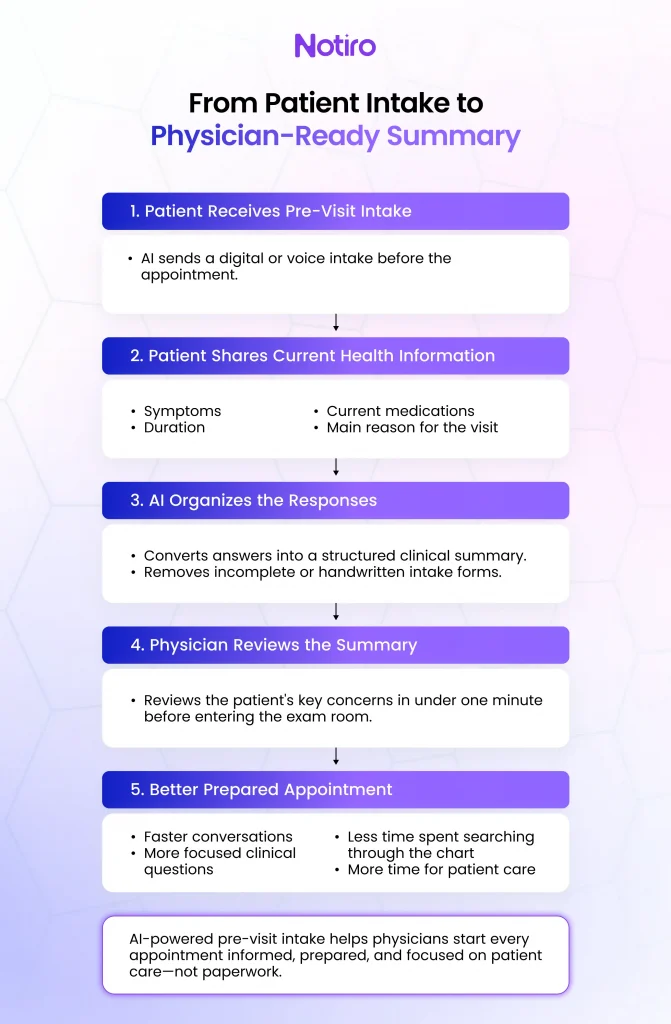
Most practices still hand patients a clipboard ten minutes before the visit. The physician then works from whatever the front desk managed to transcribe. AI pre-visit preparation replaces that clipboard with a structured, conversational intake.
Notiro’s Patient Intake AI asks the patient about symptoms, duration, and current medications before the appointment. The system organizes those answers into a summary that the physician can scan in under a minute. This is not a form filed away and forgotten.
A voice or digital intake takes the patient two or three minutes to complete at home. That single step replaces a decade-old habit of guessing from a paper form. The physician arrives at the visit already holding a usable clinical summary.
AI Patient Intake vs Chart Summarization: A Real Difference
Ambient AI vendors like Suki and DeepScribe summarize what already sits inside the EHR. That is useful when records are complete and current. It says nothing new about how the patient feels today.
AI patient intake works differently because it asks the patient directly, before the visit begins. Notiro gathers today’s symptoms and concerns instead of yesterday’s paperwork. No other major AI scribe platform automates this step of the clinical day.
DeepScribe’s pre-charting tools, for example, pull labs, imaging, and prior notes from oncology records. That depth matters, but it depends entirely on what already exists in the chart. A new complaint the patient has not yet reported anywhere will not appear.
That gap is not just a minor feature difference. It determines whether the physician learns about a new symptom before the visit or only during it. Automated patient intake closes that gap by asking the question nobody else asks in advance.
How Automated Patient Intake Reduces Errors Before They Happen
A rushed intake conversation is often where errors start, not where they get caught. A missed medication or an unmentioned allergy can shape the entire visit. Automated patient intake catches these details before the physician even sits down.
Notiro’s intake structures each answer into the same fields the physician already trusts. That structure reduces the guesswork of trying to reconstruct history from memory. Fewer gaps in the history mean fewer errors carried into the note and the chart.
Documentation is already the top driver of physician burnout, according to the American Medical Association. Incomplete intake only adds to that load once the visit starts.
Physicians using AI scribe tools report earning roughly three thousand dollars more per year, per UCSF research. They also see about one additional patient each week. Fewer intake errors and less rework make that extra capacity possible.
AI Patient Preparation Tools and Better Clinical Decision-Making
Preparation is not only about saving minutes at the front of the visit. A physician who already knows the patient’s chief complaint can ask sharper follow-up questions. That extra context changes how quickly a diagnosis takes shape.
Notiro’s Patient Intake AI feeds the same information into the ambient scribe session that follows. The physician is not starting from a blank note or a vague chief complaint. Decisions get made with more context, not less, from the very first question.
AI Pre-Visit Planning for Complex and Multi-Problem Visits
A fifteen-minute visit rarely covers only one problem. Patients raise a new symptom, a medication question, and a chronic condition update in the same appointment. Without preparation, the physician spends the first few minutes just sorting priorities.
AI pre-visit planning gives the physician the sorting done in advance. Notiro highlights the most pressing concern based on the patient’s prior description. The physician walks in already knowing where the conversation needs to start.
Family medicine physicians juggle wellness checks, medication refills, and new complaints in a single short slot. Internal medicine physicians manage chronic disease follow-ups, where a single new symptom can signal something serious. AI pre-visit planning adapts to both, flagging what matters most for the specialty and the visit type.
Consider a patient booked for a routine follow-up who also wants to discuss new knee pain. Without warning, the physician learns about the knee only after the visit is already underway. AI pre-visit planning surfaces that second concern before the appointment starts, so nothing arrives as a surprise.
Healthcare Pre-Visit Automation and the EHR Connection
Healthcare pre-visit automation only helps if the information reaches the record. A summary trapped in a separate app just becomes one more login to check. Notiro syncs intake data into the visit note and then into the EHR.
Notiro’s intake data syncs with confirmed EHR integrations, including Athenahealth and Epic. That connection means the summary appears within the physician’s existing workflow, not in a separate portal. No extra login, no extra tab, no extra step to remember.
That same visit later feeds Notiro’s ambient scribing and ICD-10 coding automation. One continuous thread runs from the patient’s own words to a coded, chart-ready note. The practice manager sees fewer manual handoffs and fewer places for information to get lost.
Copy-paste workflows between separate tools can cost a physician five to ten minutes per visit. Multiplied across a full patient day, that time adds up fast. One-click sync removes that tax entirely, visit after visit.
Choosing AI Patient Preparation Tools for Any Practice Size
Enterprise platforms like Suki and DeepScribe price patient preparation as an add-on for large health systems. Solo physicians and small groups rarely see that kind of budget. AI patient preparation tools should not require a hospital-sized contract to access.
DeepScribe’s coding-capable plans cost $350 to $500 per provider per month, according to third-party estimates. Suki’s enterprise plans start at nearly $300 per user and require a sales call. Neither model fits a two-physician family practice with a tight budget.
Notiro brings pre-visit intake, ambient scribing, and coding automation into a single platform built for practices of any size. The physician gets the same head start on every visit, without the enterprise price tag. That combination is what makes Notiro a leading option in AI-driven pre-visit preparation.
Every physician deserves to start each visit already informed, not scrambling to catch up on missing history. Notiro’s Patient Intake AI turns that idea into the first few minutes of every single appointment. See how it fits into the clinical day for a specific practice at notiro.