Most physicians adopt an AI medical scribe to solve one obvious problem: documentation time. Ambient scribing helps by turning the patient conversation into a structured note, often before the visit ends. Yet complex visits create another burden that a clean SOAP note cannot fully solve. Physicians must listen, document, assess risk, connect symptoms, remember active diagnoses, and decide what deserves follow-up in the same short encounter.
That is where clinical decision support becomes more than a software feature. It becomes a safeguard for clinical focus. When CDSS is built into an AI scribe, the system can review the evolving note, recognize relevant clinical patterns, and surface considerations while the physician is still with the patient.
Most AI scribes stop at documentation. They record what was said. A scribe with clinical decision support goes further. It helps physicians manage complexity in real time, so important findings are less likely to be missed before the chart closes.
What Is Clinical Decision Support in Healthcare?
Clinical decision support is healthcare technology that processes patient data and delivers targeted clinical information to the physician at the point of care. The goal is not to replace clinical judgment; it is to reduce the probability that something relevant goes unaddressed.
Clinical decision support systems (CDSS) have existed for decades. What has changed is where they operate. The most relevant development for outpatient physicians is CDSS embedded directly inside the AI medical scribe workflow.
How CDSS Works at the Point of Care
A CDSS embedded in a scribe platform reads the clinical note in real time and cross-references the presenting complaint and history against a clinical knowledge base. When findings warrant attention, the system surfaces a flag. The physician reviews it, documents further, or dismisses it. The clinical decision stays with the physician; the system removes the demand that every thread be held in working memory simultaneously.
The Difference Between an Alert System and Decision Support
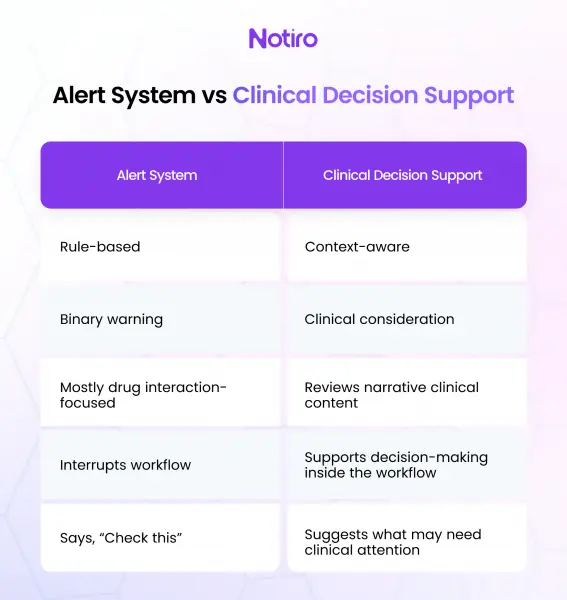
Drug interaction alerts are rule-based and binary. AI clinical decision support inside a scribe platform processes narrative clinical content and surfaces probabilistic considerations , closer to a second clinical opinion on the note than a contraindication checker.
To understand the difference clearly, it helps to separate basic alerts from true clinical decision support. The comparison below shows why CDSS is not just another pop-up warning inside the physician workflow.
Why Most AI Medical Scribes Don’t Include Clinical Decision Support
What Freed AI and Other Scribes Actually Do
Freed AI is the most widely benchmarked consumer AI scribe among solo and small group physicians, a clean, ambient transcription engine producing SOAP notes in real time. What Freed does not include: clinical decision support, patient intake AI before the visit, or ICD-10 CPT coding automation after it. A physician using Freed walks out of a complex encounter with a well-formatted note and no prompt to confirm that the clinical picture was complete. Heidi Health and Nabla sit in the same position. The category today is almost entirely note-writing tools with limited clinical reasoning capability.
The Gap Between Note-Writing and Clinical Reasoning Support
A SOAP note documents the chief complaint, history, assessment, and plan as the physician articulated them. It does not evaluate whether the assessment addressed all documented findings. Healthcare decision support embedded in the workflow closes this gap, surfacing what may be worth addressing before the encounter concludes.
What Clinical Decision Support Systems (CDSS) Do Inside a Visit
Multi-Problem Visits Are Where CDSS Earns Its Place
A 10-minute wellness visit for a healthy 35-year-old does not require CDSS. A 12-minute appointment with a 67-year-old presenting with fatigue, suboptimal A1C, hypertension, and new peripheral tingling is a different visit. The physician is tracking four clinical threads simultaneously while managing the conversation and the note.
Notiro’s Diagnosis Support surfaces differential diagnoses and clinical considerations based on the presenting complaint and documented history. AMA surveys identify documentation as the number one driver of physician burnout, much of which is managing visit complexity, not the writing itself.
What the Physician Sees, and What They Don’t Have to Hold in Memory
A Mass General Brigham study found a 21.2% drop in physician burnout scores after 84 days of AI scribe use (source: Mass General Brigham study). That result came from tools reducing documentation time. A platform that also reduces cognitive load during the visit addresses an additional layer of the same burden; the physician sees the note already written and the clinical flags ready for review, not a list of threads to carry into the next appointment.
How an AI Clinical Decision Support Scribe Changes the Visit Workflow
Before the Visit: Patient Intake AI
Before the patient sees the physician, Notiro’s Patient Intake AI collects the presenting complaint, symptoms, and history. The physician walks in already briefed. No Tier 1 competitor offers this.
During the Visit: Ambient Scribing and Decision Support Together
Notiro’s ambient scribe generates the clinical note in SOAP, H&P, or POMR format in real time. Diagnosis Support runs alongside it in the same workflow. The note is produced, and clinical flags surface together, both available for review before the chart closes.
After the Visit: ICD-10 and CPT Coding from the Same Encounter
Notiro auto-suggests ICD-10 and CPT codes from the visit audio and completed note. Manual post-visit code selection under time pressure is a systematic source of undercoding (source: CMS). A more complete note surfaces more accurate codes downstream. ICD-10 CPT coding automation and CDSS compound each other in the same encounter. Freed covers the note. Notiro covers the clinical day.
What “Intelligent Medical Scribe” Should Actually Mean
Transcription vs. Clinical Augmentation
The term intelligent medical scribe describes nearly every ambient tool on the market. A more precise definition: a system that processes what is documented, cross-references it against clinical knowledge, and surfaces outputs the physician can act on. Clinical augmentation means the system flags peripheral neuropathy as a differential for a fatigued diabetic patient, not just records that the complaint was documented.
How CDSS and Billing Code Automation Work Together
A physician who reviews CDSS flags produces a more complete note, and a more complete note supports more accurate billing codes when the auto-coding layer runs. ICD-10-CPT automation and CDSS produce a compounding value in the same encounter. DeepScribe offers comparable billing depth at $350–$500 per provider per month, inaccessible to solo practices. Notiro delivers both at a price any practice can access.
Which Physicians Benefit Most from AI-Powered Clinical Documentation with CDSS
Internal Medicine and Family Medicine
Internal medicine and family medicine physicians carry the highest multiproblem visit volume in outpatient settings, routinely covering three or more active issues in 15 minutes. AI-powered clinical documentation with embedded CDSS reduces cognitive overhead without adding steps to the workflow.
Nurse Practitioners and Physician Assistants
NPs and PAs share the same documentation burden and visit complexity. Most AI medical scribe tools are marketed to MDs. Notiro is built for any clinician managing a patient panel. Multi-problem visit complexity is a clinical workflow problem, not a physician-specific one.
Why the Note Alone Is No Longer Enough, And What Notiro Does Differently
What most AI scribes leave untouched is the clinical reasoning load inside the visit, the flags that should prompt further documentation, and the differentials that belong in a complete record. A note-writing tool records what the physician said. It does not evaluate whether anything that should have been addressed was left out.
Notiro addresses both layers. The ambient scribe writes the note. The clinical decision support layer cross-references it. The coding automation closes the billing loop. Most AI scribes write what happened. Notiro helps ensure nothing is missed before the chart closes.
Most AI scribes stop at the note. Complex visits require more. Notiro’s Diagnosis Support surfaces clinical considerations in real time, alongside ambient scribing, patient intake AI, and ICD-10/CPT coding automation. Start your free trial at notiro, no IT setup, no enterprise contract.