
The phone at a medical practice does not stop at 5 PM. A parent calls at 8:30 PM about a child’s fever. A post-surgical patient calls Saturday morning about a prescription. A new patient tries to book an appointment at 11 PM and gets voicemail. According to research published by ACC Solutions in 2026, the average medical practice receives 30-50 after-hours calls per week, and more than half of those callers hang up without leaving a message.
The practice does not get a second chance with those patients. Most of them call another provider.
Hiring an answering service or rotating on-call staff through evenings and weekends costs money, generates physician fatigue, and still misses calls. The conversation in practice management has shifted toward a different option: an AI front desk for medical practice that handles appointment requests, patient inquiries, and scheduling without requiring a human to pick up the phone.
Why After-Hours Calls Are a Practice Management Problem, Not Just a Patient Inconvenience
When the front desk closes, the load shifts to on-call staff, voicemail boxes, and Monday morning backlogs.
Research cited by PatientBond in 2025 found that 62% of callers who reach voicemail hang up without leaving a message. That loss is rarely tracked because the patient simply never returns. On-call physicians fielding prescription refill requests or scheduling questions at 10 PM are handling interruptions that a well-configured AI patient scheduling system could have resolved entirely. According to the AMA, documentation and administrative burden are the number one drivers of physician burnout, with more than 51% of US physicians reporting burnout symptoms.
MGMA DataDive reported in 2025 that primary care practices receive approximately 53 inbound calls per physician per day, with 23% going unanswered. Solo practices miss more than 30% , over 15 missed patient contacts daily during business hours alone.
What an AI Front Desk for Medical Practice Actually Does
A virtual medical receptionist handles the administrative layer of patient contact: answering inbound calls, collecting patient information, booking or rescheduling appointments, confirming insurance details, and routing clinical questions to the right staff member, at any hour, without hold times.
AI appointment booking addresses the most common after-hours scenarios: scheduling, rescheduling, prescription refill routing, and new patient intake collection. None of these requires a physician. They require a consistent, HIPAA-compliant communication channel available when the front desk is not.
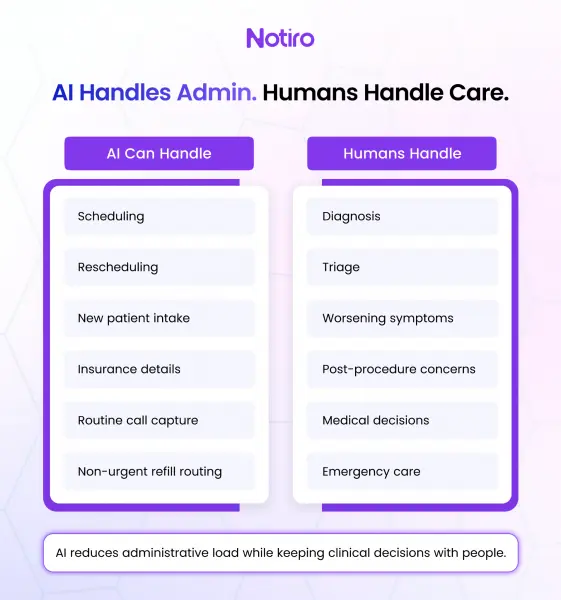
The clearest way to understand the value of an AI front desk is to look at where each after-hours call should go.
According to AInora’s 2025 analysis, most callers begin considering hanging up after 20 seconds on hold. A virtual medical receptionist answers immediately.
Where AI Patient Scheduling Has the Most Impact
In family medicine and primary care, the majority of after-hours contacts are related to appointments. New patients who cannot call during working hours, parents managing sick children, and existing patients needing urgent slots: AI appointment booking handles all of them without escalation.
In psychiatry and mental health practices, a virtual medical receptionist can collect initial intake information and confirm a future appointment without the patient speaking to a clinician first. The administrative step that generated phone tag cycles gets resolved overnight.
For small group practices with 2–10 physicians, the problem is staffing math. A group that cannot justify overnight coverage can configure an AI medical receptionist to fill the gap and route anything clinical to the on-call physician, who no longer handles scheduling at midnight.
The Gap That AI Front Desk Tools Do Not Fill
Healthcare front desk automation handles the administrative surface of patient contact. It does not replace clinical judgment. The two categories of after-hours contact are fundamentally different.
Administrative calls, scheduling, non-urgent refills, and new patient intake account for the majority of after-hours volume. An AI front desk for medical practice handles those. Clinical calls, worsening symptoms, post-procedure questions, situations requiring triage, need a human. A well-configured AI medical receptionist recognizes that threshold and routes accordingly. The goal is to stop sending administrative calls through the same channel as clinical ones.
When those two categories are correctly separated, on-call physicians stop receiving appointment requests. The calls they do receive are the ones that actually require them.
What to Evaluate Before Implementing AI Appointment Booking
Call categorization comes first. Pulling 30 days of after-hours data and separating administrative from clinical contacts shows whether automation solves the majority of the problem or a fraction of it.
HIPAA compliance is non-negotiable. Any AI system handling protected health information must be covered by a Business Associate Agreement, a legal requirement, not an option.
EHR integration determines whether the tool saves time or creates new tasks. Booked appointments need to appear in the practice management system automatically.
Escalation logic defines real value. A virtual medical receptionist is only as effective as its ability to reliably route clinical questions to the right human, which must be configured and tested before launch.
How Notiro Fits Into a Practice That Already Has After-Hours Challenges
Most practices looking at AI patient scheduling for after-hours coverage are dealing with a separate but related problem: the documentation burden in the clinic.
Notiro is not an answering service. It is an AI medical scribe that automates the clinical documentation workflow from before the visit through to chart closure, including Patient Intake AI that collects presenting complaints, symptoms, and relevant history before the physician walks in. No Tier 1 competitor, including Freed AI, offers pre-visit patient intake automation.
A significant portion of same-day appointment calls happen because practices still use phone-based pre-visit data collection. When that step moves into an automated workflow, some of that inbound contact never needs to happen.
Freed AI handles the note. Notiro handles intake, the note, and ICD-10 and CPT coding for the entire clinical day. Three hours of daily documentation overhead compound every administrative inefficiency upstream of it.
The Practice That Cannot Afford to Keep Missing Calls
Research published by PatientPrism in 2025 found that 30–40% of new patient leads are lost due to poor call handling. At an average lifetime value of $10,000 per patient, five lost patients per month is $600,000 annually, which never enters the billing cycle.
Patients who cannot reach a practice after hours do not wait. They find a practice that answers. An AI front desk for medical practice, configured with HIPAA compliance, clear escalation paths, and EHR integration, addresses the administrative half of the problem. The clinical half, documentation, coding, and chart closure, is a separate workflow.
The Answer Is Not More Staff, It Is Smarter Routing
After-hours calls will not stop on their own. The question is whether they keep routing through the same phone, or whether the administrative ones get handled before they reach that point. Practices that make that separation stop losing patients to voicemail and stop burning out physicians on calls that never needed to reach them.
The front desk problem and the documentation problem are connected. Solving one without the other leaves the practice at half capacity on both.
See What Notiro Does for the Clinical Day Your Front Desk Cannot Touch
After-hours call volume is an access problem. What happens inside the clinic, the notes, the codes, the chart that never closes, is a documentation problem. Notiro handles the second half: intake before the visit, ambient scribing during the visit, and automated ICD-10 and CPT coding after it. Start your free trial at notiro.ai, no IT setup, no enterprise contract.