
A typical internal medicine visit does not follow a single complaint. The 68-year-old with Type 2 diabetes also brings poorly controlled hypertension, a new complaint of leg swelling, and a medication question. That is four clinical threads the internist must track, document, and code simultaneously while staying present with the patient.
Most AI medical scribe tools are designed for single-complaint visits. They listen, transcribe, and populate a SOAP note. That is useful. But in internal medicine, where multi-comorbid patients are the rule rather than the exception, a scribe who handles one thread well and drops the others creates more work, not less.
Internal medicine clinical documentation sits in its own category of complexity. The specialty consistently ranks among the highest for physician burnout, with 49% of internists reporting burnout symptoms, a rate that tracks directly with documentation volume and visit complexity. This article covers what separates functional AI charting for internal medicine from tools that look capable in a demo and fall apart in a 20-minute complex visit.
Why Internal Medicine Documentation Is Different
The documentation challenge in internal medicine is structural. A family medicine visit might revolve around a single presenting complaint. An internal medicine visit routinely involves multiple active diagnoses, medication reconciliation across several drug classes, and a plan that touches each problem separately.
The note format reflects this. Where a general SOAP note is sufficient for an acute visit, a Problem-Oriented Medical Record (POMR) with a separate Assessment and Plan entry for each active problem is the clinical standard for complex, multi-comorbid patients. Many AI scribe software for physicians do not generate POMR format natively. They produce a single unified SOAP note, forcing the internist to manually reorganize the content before the chart is accurate.
Understanding the distinction between SOAP and POMR formats is essential when evaluating AI scribe software for internal medicine.
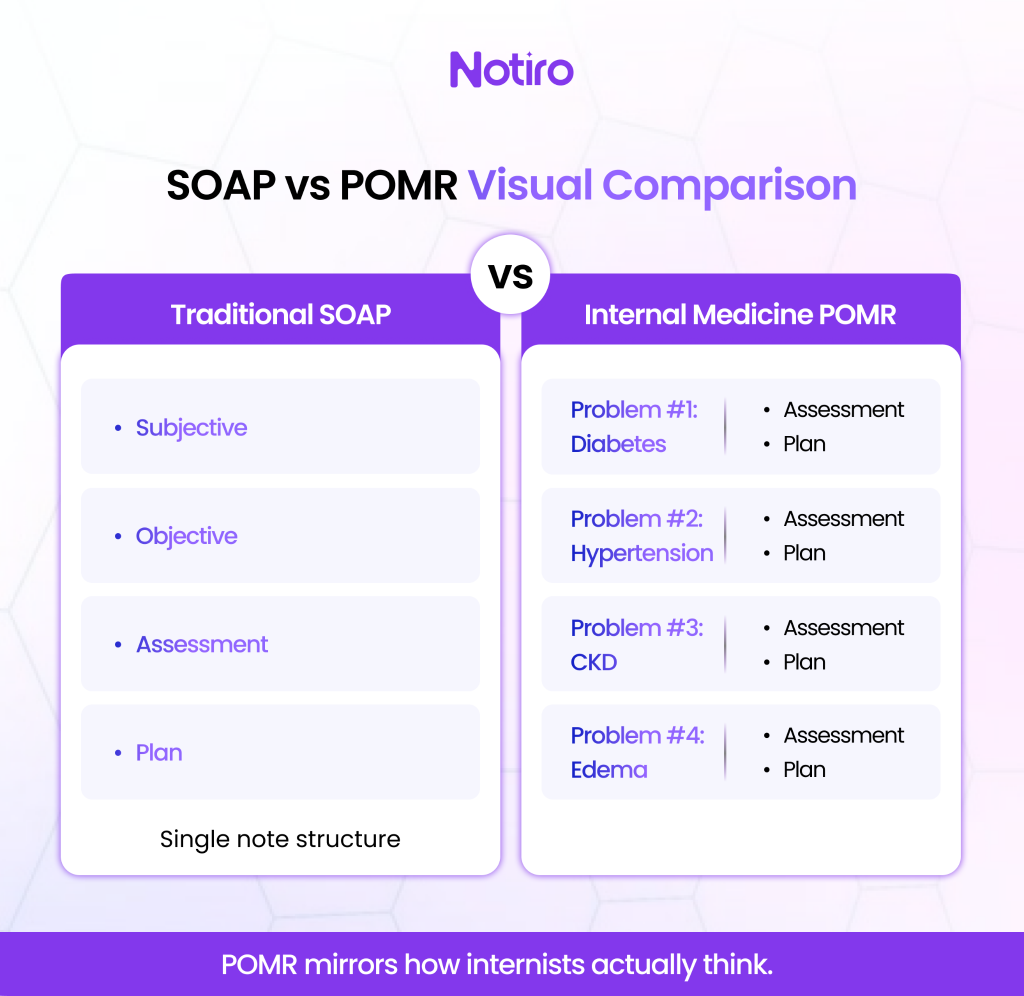
ALT TEXT: SOAP VS POMR Visual Comparison.”
An ambient AI scribe for internal medicine that supports H&P, SOAP, and POMR removes a documentation step that falls back to the physician after every complex visit.
Where Most AI Scribes Fail in Complex Visits
The failure mode is predictable. A patient starts with a primary complaint. The physician addresses it, then pivots to a second active problem. The AI scribe, trained on a cleaner single-problem conversation structure, either folds the second problem into the first or loses it entirely from the note.
Ambient AI documentation tools have a known limitation: omissions are more common than inaccuracies. The transcription is usually correct. The problem is completeness, specifically what the system captured versus what the physician actually discussed. In a multi-problem visit, that gap compounds. A missed problem is a missed diagnosis code. A missed diagnosis code is a missed reimbursement.
The AMA estimates that physicians spend 86 minutes per day on after-hours EHR work. In internal medicine, that number climbs higher because complex visits extend well beyond the schedule when the AI tool cannot handle a multi-problem structure.
The right question before choosing AI charting for internal medicine is not whether the tool writes notes. They all do. The question is whether it writes the right note for a patient with four active problems and codes all four correctly.
The ICD-10 Problem Nobody Talks About
Internal medicine visits generate the highest ICD-10 coding complexity in outpatient practice. A single visit for a patient with diabetes, hypertension, CKD, and a new presenting problem can produce six or more ICD-10 codes, each with specificity requirements that differ by code family.
The April 2026 ICD-10-CM update introduced 288 new CPT codes and changes to instructional notes that affect code pairing rules across multiple diagnostic chapters. Manual post-visit code selection under time pressure produces systematic errors, not from negligence, but from cognitive load and the sheer volume of available codes.
Incorrect ICD-10 coding costs the average practice $30,000 to $150,000 annually through claim denials, undercoding, and missed revenue. It is a documentation problem that begins during the visit and compounds when the physician selects the nearest plausible code rather than the most accurate one.
AI-powered medical note-taking that includes automated ICD-10 and CPT code suggestion drawn from the actual visit conversation catches the specificity that manual selection misses. For internists managing multi-comorbid patients, this is the capability that separates a useful AI scribe for internal medicine from a marginally better dictation tool.
What Notiro Does Differently for Internists
Notiro covers internal medicine AI documentation across three stages of the clinical encounter, not just the visit itself.
Before the visit, Notiro’s Patient Intake AI collects presenting complaints, active medications, and relevant history directly from the patient. The internist walks in already briefed, spending less time gathering history and more time on clinical reasoning.
During the visit, Notiro’s ambient scribe captures the full conversation using medically-tuned AI trained on clinical language. Multi-problem visits do not confuse the system because it tracks multiple clinical threads simultaneously. Notes are generated in SOAP, H&P, or POMR format, depending on the visit.
After the visit, Notiro auto-suggests ICD-10 and CPT codes drawn from the conversation and the generated note. The internist reviews and confirms before EHR sync. Notes reach Athenahealth and Epic in a single click, without a manual transfer step.
Automated ICD-10 and CPT coding is Notiro’s primary differentiator. Freed AI, Heidi Health, and Nabla all produce notes, but none of them auto-code. DeepScribe offers comparable coding depth at $350 to $500 per month per provider, pricing out most solo internists and small group practices. Notiro delivers billing code automation at a price any outpatient practice can access.
UCSF research found that physicians using AI medical scribe tools for internists earn approximately $3,000 more per year and see approximately one more patient per week. Mass General Brigham documented a 21.2% drop in physician burnout scores after 84 days of AI scribe use. In a specialty where nearly half of physicians are already reporting burnout, those are not marginal numbers.
What to Verify Before Choosing a Tool
The comparison that matters for AI scribe software for physicians in internal medicine comes down to four questions.
Does the system generate POMR format natively? Ask any vendor to demonstrate a complex multi-comorbid visit, not a single-complaint demo. Does the tool suggest billing codes from the visit audio, or does it leave code selection to the physician? Does it sync directly to the EHR in one click? And does it cover telehealth, in-person, and walk-in visits without configuration changes between visit types?
A 2025 survey of small primary care practices found 41% less documentation time and 60% less burnout after AI scribe adoption. The gains are real, but only when the tool handles the actual complexity of the specialty, not a simplified version.
Conclusion: The Note Is Table Stakes
Every ambient AI scribe on the market writes a note. That capability is no longer a differentiator. What separates one tool from another in internal medicine is what happens after: whether the system surfaces correct ICD-10 codes for all active problems, whether it syncs to the EHR without a copy-paste step, and whether it handles the full complexity of the visit or just the loudest complaint.
Internal medicine physicians managing multi-comorbid patients cannot afford a scribe who handles simple visits and creates rework on complex ones. The documentation stakes for billing accuracy and complete problem tracking are too high for a tool that only solves half the problem.
See It Work on a Real Internal Medicine Visit
Multi-problem internal medicine AI documentation is where most AI scribes break down, and where Notiro is built to perform. Notiro captures every clinical thread, generates the note format required for the visit, and auto-suggests ICD-10 and CPT codes before the chart closes. Start your free trial at notiro, no IT setup, no enterprise contract.