A family physician finishes a twelve-patient day. Two hours of charting still remain before the note closes. Documentation is still the leading driver of physician burnout in primary care today.
The average physician spends three-plus hours a day on documentation, according to the American Medical Association. Voice dictation software and ambient AI scribes both promise relief, but in different ways. The voice dictation vs ambient AI decision shapes the kind of relief a practice actually gets.
Notiro entered this market to close that gap completely. The platform covers patient intake, ambient scribing, and ICD-10 and CPT coding in one workflow. That distinction matters more than most comparisons of dictation and ambient tools ever admit.
How Voice Dictation Software Works in a Real Exam Room
Voice dictation software converts spoken words into text on command. The physician dictates findings, assessment, and plan, often after the patient has left the room. Dragon Medical One remains the category standard, priced at around $80–$100 per provider per month.
Accuracy is high once the system learns a voice and a specialty vocabulary. But the physician still narrates every line, then edits, formats, and signs the note afterward. Coding still happens manually, which is where undercoding and missed revenue typically begin.
Many practices adopted dictation a decade ago and built real workflow habits around it. Voice commands navigate templates, insert macros, and move between EHR fields without a keyboard. That familiarity is genuine, and it explains why dictation has not disappeared even as ambient AI scribe tools gain attention.
The limitation is structural, not a matter of better training. Dictation requires active narration for every encounter, which adds a step that the visit itself does not need. A clinician still produces the note; the software only changes how the words get typed.
What Changes When a Practice Adopts Ambient AI Documentation
Ambient AI documentation works differently from the moment the visitor arrives. The system listens to the natural conversation between physician and patient, without commands or pauses. It then drafts a structured note in SOAP, H&P, or POMR format before the visit ends.
The physician maintains eye contact with the patient rather than typing or speaking to a screen. Mass General Brigham recorded a 21.2 percent drop in burnout scores after 84 days of ambient scribe use. An ambient AI scribe like Notiro’s removes the narration step that dictation still requires.
Multi-problem visits are where this distinction becomes obvious. An internal medicine appointment covering three chronic conditions results in a single continuous conversation, not three separate dictated summaries. Ambient systems built for clinical language can separate each problem within that conversation without the physician having to organize it out loud.
Noise and overlapping speech used to be the weak point of this category. Modern systems now handle real exam-room acoustics, not just clean studio audio. That progress explains part of why adoption accelerated through 2025 and 2026, including in telehealth visits.
Voice Dictation vs Ambient AI: A Side-by-Side Look
The voice dictation vs. ambient AI comparison becomes clearer when broken down into specific workflow moments. Both reduce typing, but they differ in effort, accuracy conditions, and what happens next. The table below lays out the practical differences.
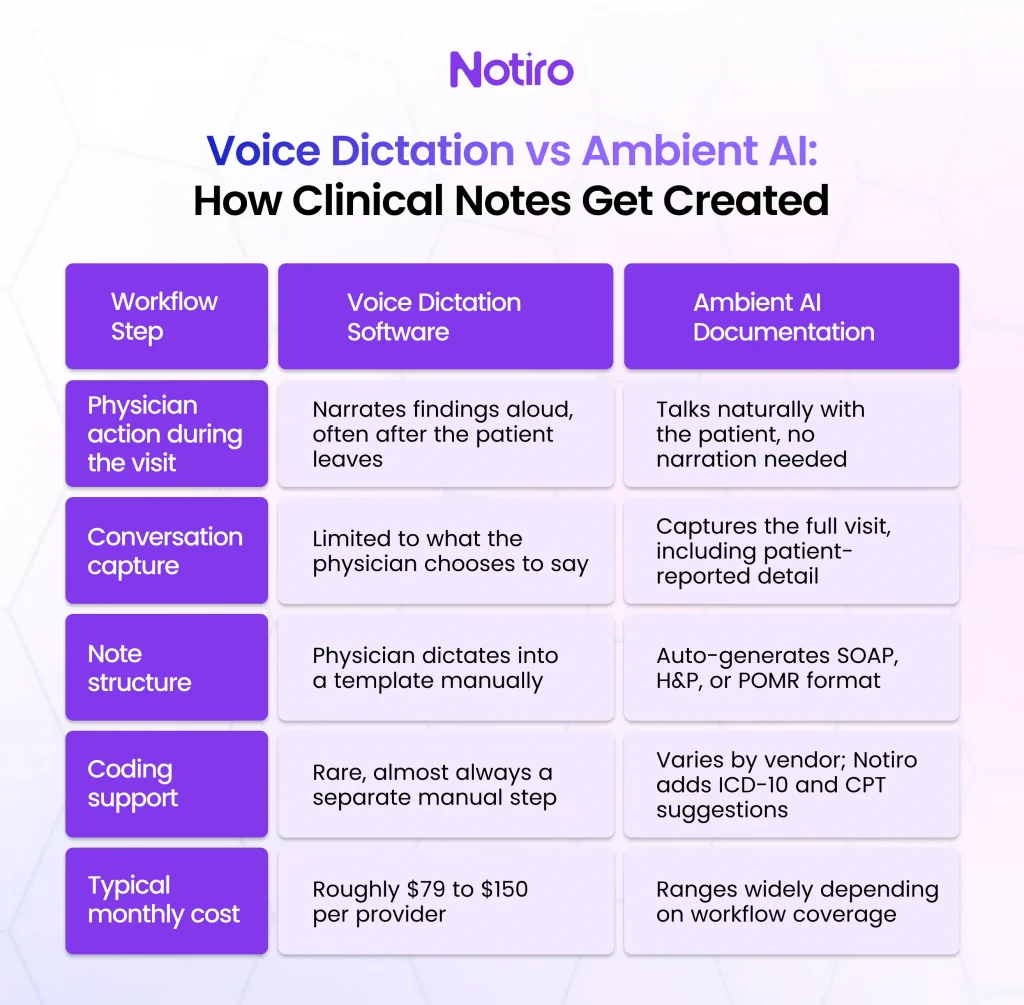
Clinical documentation tools differ most in what happens after the visit ends. Dictation leaves coding and chart closure to the physician, while ambient platforms vary widely on that point. That gap is exactly where the next section matters most.
HIPAA compliance applies to both categories equally, regardless of which method a practice chooses. Any vendor processing patient audio or visit data needs a signed Business Associate Agreement before deployment. Notiro signs a BAA with every practice before any patient data is processed.
Why an AI Medical Scribe Has to Do More Than Write the Note
Most AI medical scribe tools, including Freed and similar platforms, stop at the note. ICD-10 has more than 70,000 codes and CPT adds 10,000, so manual coding under pressure produces errors. Notiro auto-suggests ICD-10 and CPT codes directly from the visit audio, then syncs the chart in one click.
That single workflow step is Notiro’s primary differentiator inside a crowded ambient AI scribe market. Physicians using AI scribes earn about $3,000 more yearly and see one extra patient weekly, per UCSF research. Notiro’s intake, scribing, and coding stages cover the whole clinical day, not only the documentation middle.
Undercoding rarely comes from simple carelessness or inattention. It comes from picking the fastest defensible code at the end of a twenty-patient day. An AI medical scribe that suggests codes from the conversation closes that gap without adding a task.
This is also where healthcare documentation technology earns its budget line. A tool that only writes notes faster still leaves billing exposure untouched. A platform connecting ambient scribing to coding turns time savings into measurable revenue protection as well.
Matching Clinical Documentation Tools to Practice Size, Specialty, and Workflow
Choosing healthcare documentation technology depends on practice size and how visits actually unfold. A solo family physician running twenty visits a day needs documentation finished before the next patient walks in. A psychiatry practice writing long narrative notes needs accuracy on nuance, not just speed.
Internal medicine, with multi-problem elderly patients, benefits most from a scribe that separates each issue clearly. Practice managers weigh a different cost, since losing one physician to burnout can run $500,000 to $1 million. Notiro fits each scenario because intake, ambient scribing, and coding adjust to specialty and visit type.
Nurse practitioners and physician assistants carry the same documentation load as physicians. Scribe marketing often overlooks them, even though Notiro supports any clinician seeing patients, not only MDs. Resident physicians want a tool that works on day one, with no IT setup at all.
Multi-location groups weigh this decision differently again. An administrator overseeing dozens of providers cares less about one feature and more about consistent adoption. Athenahealth and Epic integration, paired with daily physician use, decides that evaluation faster than a comparison sheet.
Dictation software still suits a physician who wants full control over phrasing and already has muscle memory built around it. Ambient AI documentation suits anyone who wants the visit itself to produce the chart. For most practices, the voice dictation vs ambient AI choice still depends on closing the billing loop too.
Switching from dictation to an ambient scribe only solves the listening problem, not the coding one. Notiro listens to the visit, drafts the note, and suggests the ICD-10 and CPT codes before the chart closes. Start a free trial at notiro.ai, no IT setup and no enterprise contract required.