The EHR solved the wrong problem. It digitized clinical records, making them searchable and portable. What it did not do was reduce the work required to produce those records.
Every visit still ends the same way: the physician at a screen, converting memory into structured data, often hours after the clinical event itself.
That gap, between care delivered and care documented, is where physician time disappears. It is also where AI is now doing its most measurable work. Not by replacing the record, but by shifting who fills it in, and when.
What AI Actually Changes: Three Points in the Clinical Day
There are three points in every clinical encounter where documentation burden is concentrated. Each is addressable by AI, though most tools only address one.
Before the Visit: Patient Intake
A physician walking into an exam room without a pre-populated patient summary spends the first several minutes building that picture from scratch.
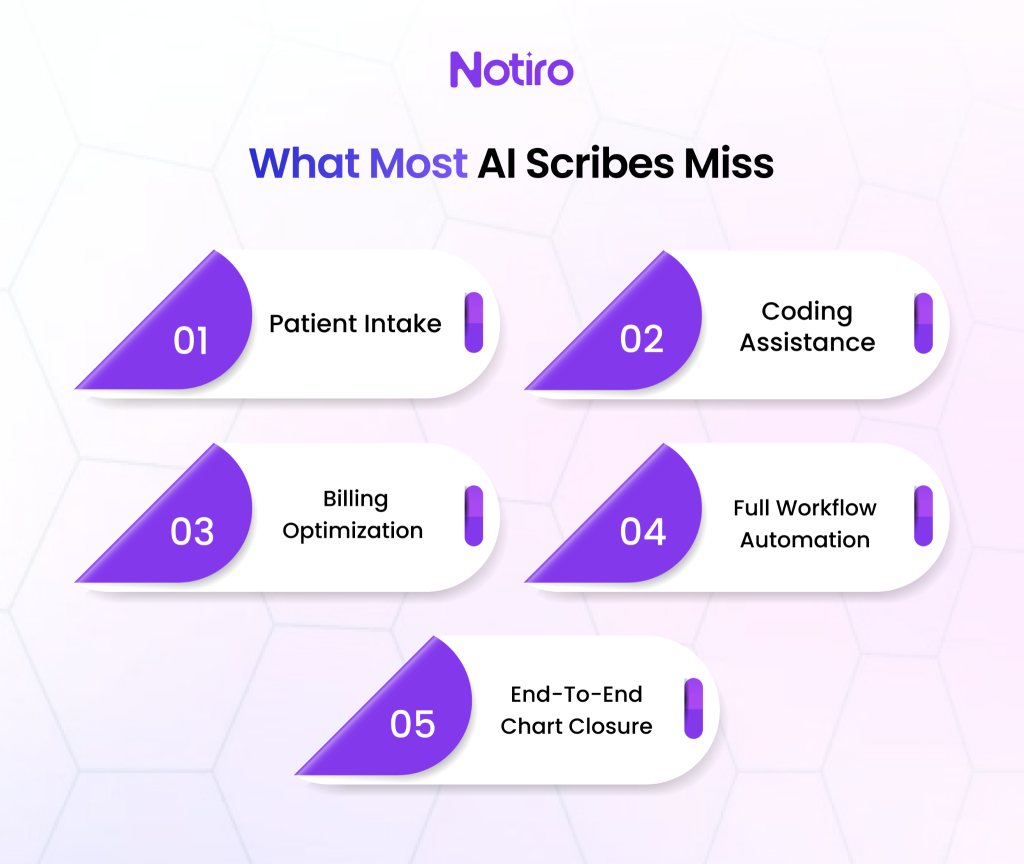
Notiro’s Patient Intake AI collects presenting complaints, symptoms, and medication history before the encounter, so the physician walks in already briefed on a verified baseline, reducing the chance of a clinical detail being missed in a high-volume morning.
The visit starts from a more complete foundation, and the ambient scribe session that follows captures a richer, more accurate note as a result. This capability is unavailable in most Tier 1 AI scribe competitors.
During the Visit: Ambient Scribing
Ambient AI scribing listens to the physician-patient conversation in real time and generates a structured clinical note (SOAP, H&P, or POMR) without the physician dictating or typing. Because the note is captured from the actual conversation, accuracy improves alongside speed.
A JAMA study of 1,800 clinicians across five US academic medical centres found AI scribes reduced documentation time by 16 minutes per 8-hour day, a 10% relative decrease, tripling for clinicians who used AI in more than half of their visits.
A separate Mass General Brigham study found a 21.2% drop in physician burnout after 84 days.
UCSF research found AI scribe adopters earn approximately $3,044 more per year and see 0.8 more patient encounters per week.
Notiro’s scribe is medically tuned, trained in clinical language rather than general speech, handles multi-problem visits without conflating presenting complaints, and runs mobile-first with no additional hardware.
After the Visit: Coding, Billing, and EHR Sync
The note is finished. The physician still needs to select ICD-10 and CPT codes and manually transfer the record into the EHR under time pressure at the end of a high-volume day.
ICD-10-CM contains more than 70,000 codes; CPT contains more than 11,000 codes (AMA). Physicians consistently select lower-complexity codes than the visit supports, not from negligence, but because correct coding under time pressure requires documentation specificity that takes time.
Undercoding occurs in 33 – 45% of outpatient visits, with some physicians losing as much as $100,000 annually from underreported services.
Notiro’s ICD-10/CPT coding automation reads the ambient note and visit audio, surfaces the encounter-supported codes, and presents them for physician review before the chart closes.
This is a decision-support layer, not autocomplete, that addresses the complexity and time pressure that cause physicians to underrepresent. One click syncs everything to the EHR.
The competitive gap is significant. Freed AI, Heidi Health, and Nabla offer no auto-coding. DeepScribe does, at $350–$500 per provider per month, pricing that excludes solo and small-group practices. Notiro delivers the same billing intelligence at a price any practice can access.
EHR Integration: Where the Workflow Closes or Breaks
An AI scribe that requires manual copy-paste into the EHR does not reduce the documentation burden. It relocates it. Manual transfer also doubles the risk of transcription errors, because data entered twice is twice as likely to be entered incorrectly.
This matters beyond efficiency. A note that moves correctly from the ambient session into the EHR is cleaner, more defensible, and less likely to generate a billing query or compliance flag down the line. Accuracy at the point of sync is not a convenience feature; it is a clinical records issue.
Notiro syncs notes, ICD-10/CPT codes, and prescription data to the physician’s EHR in one click, with confirmed integrations including Athenahealth and Epic, which covers more than 30% of US hospital patients.
One-click sync closes the workflow loop where other tools leave it open, and removes the transcription risk entirely.
The Incomplete Adoption Problem
More than 81% of US physicians now use AI professionally, more than double the 2023 rate, with clinical documentation among the top use cases.
Most tools physicians currently use write notes and stop, leaving manual coding and chart closure untouched. That partial adoption captures some time savings and leaves the billing gap, and the revenue it represents, completely untouched.
The distinction matters in practice. A physician saving 16 minutes on documentation but still selecting codes manually at the end of a 20-patient day has improved one step in a three-step problem.
The question for any physician evaluating AI clinical documentation tools is whether the tool closes the full loop or handles only the easiest part.
Final Verdict
The EHR is no longer just a record. For practices using AI across the complete clinical day, it has become an active partner: one that briefs the physician before the encounter, documents during it, and surfaces billing decisions after it.
Notiro is built to close that full loop: AI-powered intake that reduces pre-visit gaps, ambient scribing that captures accurate notes in real time, and ICD-10/CPT coding automation that supports better billing decisions without manual effort. The practices that adopt this complete workflow get the time back and the revenue accuracy, not one or the other.
The note is the easiest part. The coding is where the revenue lives. The intake is where the accuracy starts.
The physician who finishes a 20-patient day still selecting codes by hand has an AI scribe, not an AI workflow. Notiro automates the full clinical day, from patient hello to chart closure, synced to Athenahealth or Epic in one click. Start your free trial at Notiro. No IT setup, no enterprise contract.