Every healthcare interaction, from a flu check‑up to a complex specialist visit, ends with documentation. That final step may seem small on the surface, but it’s the backbone of patient records, continuity of care, billing, quality assurance, and legal compliance.
Historically, clinicians scribbled notes or typed them later, but as digital records became the norm, medical dictation emerged as a faster and a vocal alternative to manual documentation.
One of the physicians made a statement regarding the use of AI technology in documenting patients’ records, stating:
| “AI scribing has allowed me to claw back some time, and having a summarized conversation (as well as an actual transcription) allows me to relax and be more in the moment with my patients, instead of staring at a screen and typing the whole time.” — Dr. Kissi Rosabel Blackwell, Family Physician, Texas. |
This is the transformative power of AI, changing manual clinical documentation into automated medical dictation. It frees up more time for clinicians to engage with their patients rather than being bogged down by administrative tasks.
But wait, what medical dictation really is, how it works today, why it matters, challenges clinicians face, and how modern AI is reshaping this entire landscape.
What is Medical Dictation?
Medical dictation refers to a physician speaking into a device, such as a voice recorder, smartphone app, or specialized software, to record details of a patient visit. Instead of typing, the clinician uses spoken words to capture the information.
That audio is then transformed into written text and stored in the patient’s medical record. Thus, medical dictation isn’t a new idea.
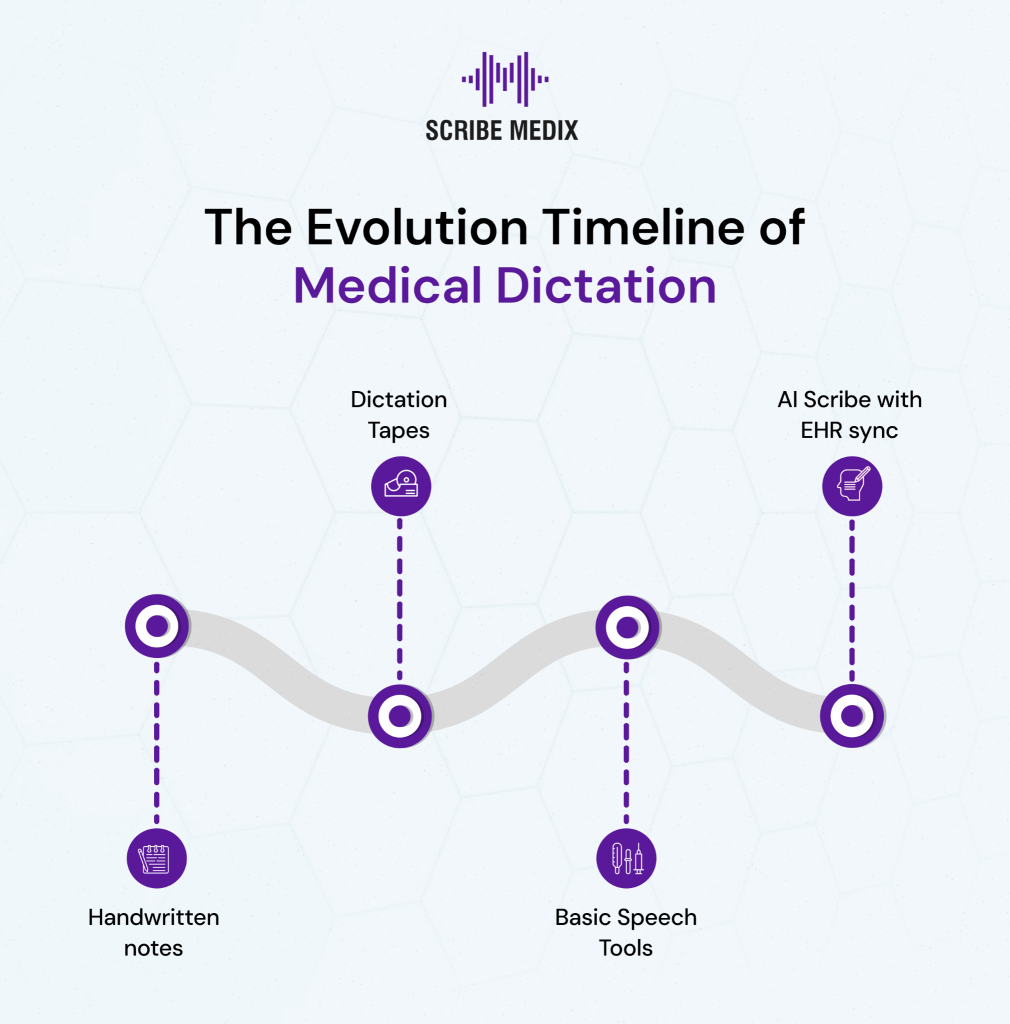
In fact, healthcare documentation has existed since the earliest forms of clinical record‑keeping, evolving from hand‑written notes to shorthand stenography and now digital speech‑based systems.
Why Medical Dictation Matters?
Medical dictation is important because it helps doctors quickly and accurately record patient information. Instead of typing long notes, doctors can speak them.
This reduces mistakes, and as a result, patient records are clear, complete, and up to date. The following are some of the points that explain the importance of medical dictation.
- Saves Time
Traditional note writing is a major time sink. Research shows clinicians can spend 34% to 55% of their workday on documentation, often more than the time they spend with patients.
Physicians in the U.S. frequently report spending two hours on the computer for every hour of patient care, largely due to documentation duties. That’s time pulled directly away from patient engagement or reaching more patients in a day.
Therefore, medical dictation reduces time and helps reduce manual entries.
- Improves Accuracy and Continuity
Dictation allows clinicians to record details while they are still fresh in their minds. This helps ensure that the information is complete and clear.
- Supports Billing, Coding, and Legal Needs
Proper documentation helps ensure that procedures are coded correctly. This protects clinicians and healthcare organizations in audits and legal scenarios.
- Improves Patient Safety
The clear and comprehensive records reduce the risk of medical errors and improve continuity of care between different providers over time.
The Rise of the AI Medical Dictation Tool in Healthcare Sector
AI medical dictation tools are rapidly becoming a standard part of modern healthcare. As documentation demands grow, clinicians are under pressure to spend more time on records than on patients.
AI medical dictation addresses this challenge by converting spoken clinical notes into accurate text within seconds.
These tools use advanced speech recognition and natural language processing(NLP) to understand complex terminology, accents, and clinical context.
Unlike traditional dictation, AI systems work in real time and integrate directly with electronic health records (EHRs), reducing manual entry and administrative workload.
Traditional Medical Dictation Vs. AI Medical Dictation
Here is a quick breakdown of traditional and AI medical dictation:
| Traditional Medical Dictation | AI Medical Dictation |
| Clinicians spend time reviewing and correcting notes. Therefore, the documentation burden is high. | Real-time transcription reduces review time, which minimizes the documentation burden. |
| In traditional methods, manual corrections are often required. | A trained AI understands medical context and improves accuracy. |
| They often do not work well with modern EHRs(Electronic Health Records). | AI medical dictation systems are fully integrated with EHRs, allowing for real-time syncing. |
| This factor contributes to clinician burnout due to excessive documentation work. | It reduces burnout by streamlining documentation and allowing more patient interaction. |
| Traditional methods have high costs and delays due to human transcription. | AI medical dictation systems are cost-effective and minimize delays in automated transcription. |
How AI Medical Dictation Software Works?
Let’s walk through the actual process clinicians use to turn speech into structured clinical documentation:
1. Capture Conversation
During a patient visit, the clinician records important details such as observations, findings, assessments, plans, prescriptions, and follow-ups. AI digital tools are used to capture voices, unlike traditional methods.
2. Speech to Text
This is where the technology steps in. In old systems, audio files are forwarded to human transcriptionists. However, modern systems use speech recognition and AI to turn speech into text. In some cases, they also extract important clinical information and structure.
Speech recognition can be fast, as one of the studies found speech‑to‑text documentation took about 5.1 minutes on average versus 8.9 minutes typing.
3. Review and Approve
The initial text, whether human‑edited or AI‑generated, is reviewed by the clinician. They ensure accuracy, adjust language, and confirm that the final note reflects the visit correctly. This step is the most critical one for both quality and compliance.
4. Sync to Electronic Health Record(EHR)
After the note is reviewed, it syncs with the Electronic Health Record (EHR) system. This makes it available to the rest of the care team for follow-up care, billing, reporting, and analytics.
Therefore, this step ensures that each piece of documentation becomes part of the patient’s complete health history.
How Notiro Redefines Documentation Time and Process
If you’re tired of the endless cycle of manual documentation, transcription errors, and time-consuming reviews, Notiro is the solution for you.
The AI-powered platform automates medical dictation, capturing real-time conversations, generating accurate notes, and seamlessly syncing with your EHR. Clinicians can save time, reduce burnout, and ensure accuracy, all while improving patient care.
Notrio offers a streamlined workflow, cutting out manual processes and reducing administrative stress.
Thus, it’s time to ditch the old methods and embrace the future of healthcare documentation.
Try Notiro today and experience efficiency like never before!