Doctors spend more than 3 hours per day on documentation, according to the American Medical Association. That number has barely moved in a decade, despite the billions poured into health IT. What has changed is where that documentation happens, who produces it, and what happens to it afterward. The traditional model built around certified medical transcriptionists, 24-hour turnaround cycles, and manually keyed chart entries is losing ground fast. This article breaks down what is driving that shift in the medical transcription industry in 2026, what is replacing the old model, and what healthcare teams are actually choosing today.
The Medical Transcription Industry 2026: What the Numbers Show
The U.S. Bureau of Labor Statistics projects a 5% decline in employment for medical transcriptionists between 2024 and 2034. That decline is not a prediction of disruption still to come. It is a count of jobs already lost and not replaced.
The medical transcription market itself is not collapsing. The medical transcription services market was valued at USD 84.52 billion in 2026 and is projected to reach USD 108.5 billion by 2031 at a 5.12% CAGR. What is collapsing is the labor model underneath it. Outsourcing still holds the largest share of procurement, but hybrid captive-outsourced models are now recording the fastest growth, at a 14.34% CAGR.
Technological advances in speech recognition and natural language processing allow physicians to document patient encounters in real time, reducing the need for medical transcriptionists. The market is expanding while the workforce that once powered it contracts. That is what structural displacement looks like.
Why Traditional Medical Transcription Services Are Breaking Down
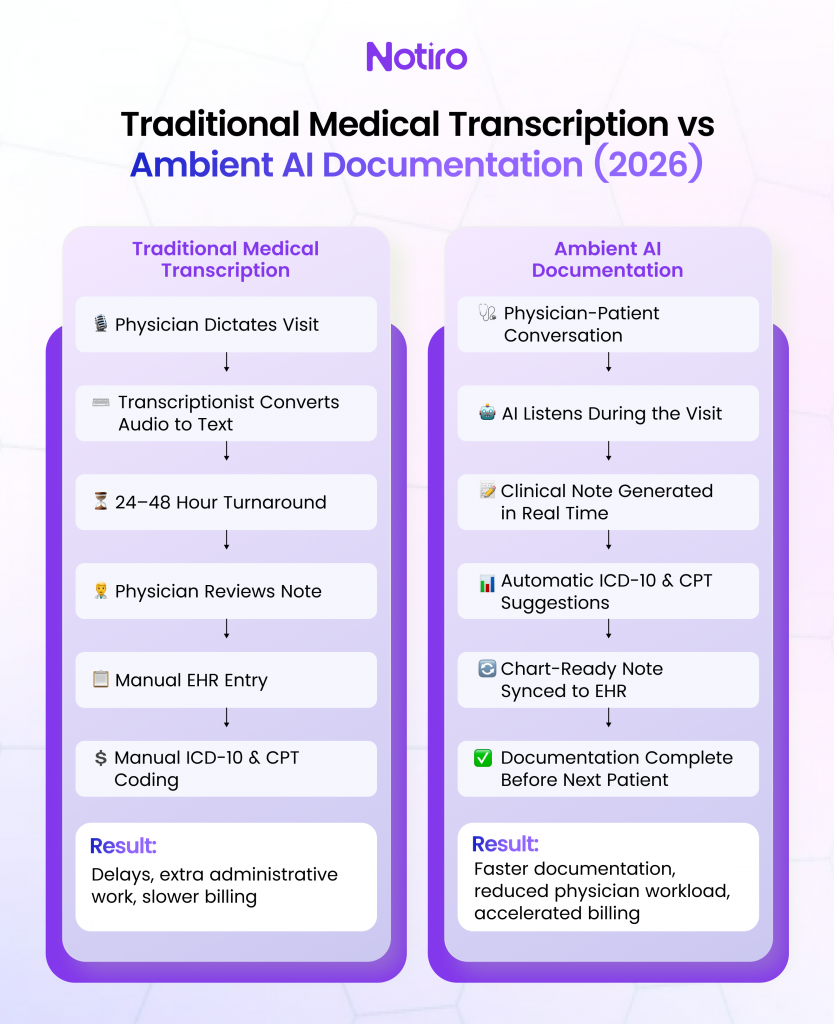
The traditional workflow followed a fixed sequence. A physician dictated into a recorder. A certified transcriptionist converted that audio into a typed document within 24 to 48 hours. The document was returned to the practice, reviewed, and manually entered into the patient chart.
That model cost $8 to $25 per encounter and scaled linearly with patient volume. The deeper problem was never the price. It was the lag. A clinical note sitting outside the EHR for 24 hours cannot support billing, cannot inform the next visit, and cannot be audited. Medical transcription outsourcing companies built efficient pipelines for audio-to-text conversion. They did not solve the delay, the billing code gap, or the EHR integration problem. Those three gaps are precisely what the technology replacing them addresses directly.
Medical Transcription Industry Trends: The Shift to Ambient AI
The medical transcription market is evolving from a service-based industry into a technology-driven ecosystem centered on clinical workflow efficiency. The mechanism driving that shift is ambient clinical intelligence.
Modern AI medical scribes listen to the physician-patient encounter as it happens. The conversation is processed through language models trained specifically on clinical terminology. A structured note in SOAP, H&P, or POMR format is available before the encounter ends, not 24 hours after it. Stanford Health Care reported that 96% of physicians found ambient transcription easy to use after its 2024 DAX Copilot rollout, and 78% said it reduced note-taking time.
The research on outcomes is consistent. Research from RCTs and multi-system studies shows AI scribe users spend measurably less time on documentation, with some studies linking adoption to reduced burnout and increased revenue per physician. UCSF data cited in Notiro’s positioning materials indicate that physicians using AI scribes earn approximately $3,000 more per year and see approximately 1 additional patient per week.
This is the gap that platforms like Notiro are built to close. Notiro covers the full clinical day: patient intake before the visit, ambient scribing during it, and automatic ICD-10 and CPT code suggestions from the visit audio afterward. Most competing healthcare documentation solutions stop at the note. The coding step still requires manual effort or a separate piece of software.
What Medical Transcription Companies Are Getting Wrong in 2026
Many medical transcription companies have pivoted to AI-assisted services rather than fully human transcription. That pivot is the right direction, but it stops short of what clinical documentation actually requires. A tool that converts audio to text faster does not eliminate the three root problems: EHR lag, billing code gaps, and physician post-visit review time.
The AAPC flagged this concern explicitly in 2024, warning against “coding-naive AI scribes,” tools that generate polished clinical notes but produce no billing codes from them. Traditional medical transcription converts dictation into a typed document, returned hours later with no billing codes and no direct EHR delivery. Many AI transcription tools replicate that same gap in a faster, more efficient way.
ICD-10 has over 70,000 codes. CPT has more than 10,000. Selecting the correct codes under time pressure is where revenue is lost and where documentation errors compound. Healthcare teams choosing clinical documentation services in 2026 need to ask one question: Does this platform produce billing codes from the visit, or does it stop at the note?
Healthcare Documentation Solutions: What Leading Practices Are Choosing
Many clinicians report that AI-generated plan and assessment sections feel more complete than notes written under time pressure. That qualitative shift matters because note quality has a direct relationship to billing accuracy. A note that captures the complexity of a visit correctly supports the billing code for that complexity level. Undercoding, the systematic selection of lower-complexity codes than the visit warrants, costs practices thousands of dollars monthly in missed reimbursement.
Platforms that address both the note and the code are where healthcare documentation solutions are heading. Notiro handles all three stages of the clinical day: the pre-visit intake that briefs the physician before walking in, the real-time ambient scribe during the encounter, and the automatic billing code suggestions after it. No manual coding step, no separate billing staff overhead, no documentation delay.
General encounter documentation is the category where AI medical scribe software has the clearest ROI. Specialized and medico-legal documentation is where some human transcription will remain. For most outpatient encounters, ambient AI scribes document faster and require less post-visit effort than traditional transcription.
The Medical Transcription Market in 2026: Where It Goes From Here
The headline numbers will continue to show market growth. Telehealth providers are posting the highest growth rate at 14.63% CAGR to 2030 among end users in the medical transcription services market. That volume will not be handled by the transcription workforce that existed in 2020.
Two-thirds of physicians were using health AI as of the AMA’s 2025 Digital Health Survey, up 78% from 2023. Medical transcription software built on ambient AI is capturing the documentation workload that medical transcription outsourcing used to carry. Mass General Brigham found a 21.2% drop in physician burnout scores after 84 days of AI scribe use.
The trends in the medical transcription industry are clear. The service model built on turnaround windows and per-encounter billing is giving ground to software that runs during the encounter itself, generates the note, and hands the physician a chart-ready document with billing codes before the next patient walks in.
Conclusion
Traditional medical transcription is not disappearing from healthcare. It is being displaced from the center of the clinical documentation workflow. The physician practices seeing the most meaningful change in documentation burden moved past the note-only solution and adopted platforms that cover the full clinical day.
The gap between what most medical transcription services deliver and what modern clinical documentation requires is measurable in hours per day and dollars per month. The AMA has consistently identified documentation as the leading driver of physician burnout, making this more than a technology procurement decision. The choice is no longer between human and AI transcription. It is between a workflow that ends with the note and one that ends with a chart-ready document, coded and synced.
Try Notiro
Traditional transcription leaves the billing step unsolved, and that gap compounds across every patient encounter. Notiro generates clinical notes and suggests ICD-10 and CPT codes from the visit audio, before the chart closes. Start your free trial at notiro, no IT setup, no enterprise contract.