A physician finishes a 14-patient day, opens the EHR, and reviews the AI medical scribe’s output. The note looks clean. But buried in the assessment is a medication the patient never mentioned, and a diagnosis code that does not match what was discussed in the room.
This is not a rare software glitch. It is a structural problem with how most AI scribes are built, and it has a name: hallucination.
Healthcare AI hallucinations occur when a language model generates confident-sounding clinical content that has no basis in the actual conversation. The note looks complete. The language sounds clinical. The information is wrong. For a physician reviewing 20 notes at the end of a shift, that error is easy to miss and costly to ignore.
What Are AI Scribe Hallucinations in Clinical Notes?
AI scribe hallucinations in clinical notes happen when the model fills gaps in the conversation with fabricated but plausible-sounding content. The trigger is usually ambiguity: a patient speaks quickly, a name is mispronounced, a symptom is mentioned in passing, or the acoustic environment introduces noise. Instead of flagging the uncertainty, the model infers, and sometimes incorrectly so.
The most common hallucination patterns in clinical documentation include:
- Medication confabulation: The model generates a drug name similar to what was said but phonetically distinct (e.g., “hydroxyzine” instead of “hydralazine”)
- Diagnosis carries forward errors: Past medical history items bleed into the current assessment
- Plan fabrication: The AI adds follow-up instructions or referrals not discussed during the visit
- Demographic drift: Age, sex, or pronoun substitution when patient identity is not anchored in the transcript
These are not edge cases. They represent the predictable failure modes of general-purpose language models deployed in high-stakes clinical environments without adequate medical tuning.
Why AI Scribe Errors in Clinical Notes Are a Patient Safety Problem
The consequences of AI scribe errors in clinical notes extend beyond chart accuracy. A hallucinogenic medication can cascade into a prescription error. A fabricated referral can delay appropriate care. A misattributed diagnosis code can trigger a billing denial or payer audit.
A 2023 study published in JAMA Internal Medicine found that large language models generated incorrect medical information in a meaningful percentage of clinical Q&A tasks, particularly around drug dosages, contraindications, and diagnostic criteria, exactly where clinical note hallucinations cause the most harm.
A signed note is a legal document. If a hallucinated finding is signed and submitted to a payer, the physician has certified content that they did not generate. A physician seeing 20 patients per day who misses one hallucinated line per note accumulates documentation risk at scale, across a full patient panel, over months.
Which AI Scribes Are Most Vulnerable to Healthcare AI Hallucinations?
Not all AI scribes carry equal hallucination risk. The architecture matters.
General-purpose large language models, trained on broad internet text and applied to clinical transcription, are most prone to healthcare AI hallucinations. They have no reliable mechanism for “I don’t know.” When audio is unclear, they fill the gap with statistically probable medical language. That language may be accurate. It may not be.
Tools built on medically tuned models carry lower hallucination risk because their outputs are constrained to clinically grounded patterns rather than general language prediction. The distinction matters when evaluating AI medical scribe accuracy in real settings. A scribe who performs well in a clean studio environment may hallucinate frequently in a busy outpatient clinic, due to ambient noise, patient crosstalk, non-native speaker accents, and rapid dictation.
Several Tier 1 competitors, Freed AI, Heidi Health, and Nabla, have published minimal clinical accuracy data. The market relies largely on user testimonials rather than independent validation. DeepScribe holds a KLAS score of 98.8/100, the highest ambient AI score recorded by KLAS Research, because it invested in third-party accuracy validation. That score carries weight with enterprise buyers for a reason.
Notiro’s medically-tuned AI scribe is built to handle multi-problem visit complexity and real exam room acoustic conditions, the two environments where general-purpose models are most likely to hallucinate.
How to Prevent AI Scribe Hallucinations: A Practical Framework
Preventing AI scribe hallucinations in clinical notes requires action at three levels: tool selection, workflow design, and physician review practice.
1. Choose a Medically-Tuned Model Over a General-Purpose One
The first prevention step happens before the scribe enters an exam room. A tool trained on clinical language, one that understands the difference between a symptom, a finding, and a plan item, is structurally less likely to confabulate than a general-purpose model applied to medical transcription.
Ask vendors directly: is the underlying model general-purpose or medically-tuned? Ask what clinical datasets it was trained on. Ask whether the tool has been independently evaluated for AI medical scribe accuracy. Vague answers should be treated as a warning sign.
2. Require Uncertainty Flags in the Output
A well-designed AI medical scribe should distinguish between what it heard clearly, what it inferred, and what it could not capture. Notes that present all content with equal confidence provide no signal about where review attention is needed.
Look for tools that surface low-confidence segments or leave explicit placeholders rather than silently filling gaps with fabricated text.
3. Audit High-Hallucination Sections First
The Assessment and Plan sections carry the highest risk of hallucinations; they require the model to synthesize and generate conclusions rather than transcribe. The Subjective section is the second-highest risk when the patient speaks quickly or uses non-standard terminology.
Reviewing these sections first reduces cognitive load and focuses attention where errors are most likely to appear.
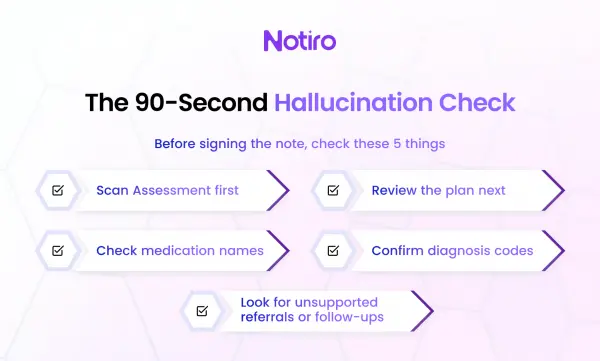
Use this quick review checklist before signing an AI-generated clinical note:
4. Standardize the Pre-Visit Context
One underappreciated hallucination driver is an information-sparse session start. When the ambient scribe begins recording without a patient history baseline, the model fills context gaps from training data rather than the actual patient record.
Patient Intake AI, available in Notiro but absent from every other Tier 1 AI scribe competitor, addresses this directly. When the patient’s presenting complaint, medication list, and history are captured before the visit starts, the scribe begins with a richer context. The note has less to infer and more to transcribe. Hallucination risk drops accordingly.
5. Build a Post-Visit Review Protocol
No AI scribe is error-free, and the review step is not optional. A structured protocol under 90 seconds, scan Assessment/Plan, check medication names, confirm diagnosis codes against what was discussed, catches the majority of hallucinated content before the chart is signed.
The Mass General Brigham AI scribe study documented a 21.2% drop in physician burnout scores after 84 days of AI scribe use, conducted with a structured physician review workflow in place. The tool reduced documentation time. The protocol protected accuracy.
How AI Medical Scribe Accuracy Affects Billing, Not Just Safety
Clinical note: hallucinations create a billing problem alongside the safety problem. A hallucinated finding in the Assessment section can generate an incorrect ICD-10 code suggestion, and an ICD-10 code that does not match the documented encounter is a claim waiting to be rejected.
According to CMS, ICD-10 has over 70,000 codes, and CPT has over 10,000. Manual post-visit code selection under time pressure is already a systematic source of undercoding errors. An AI scribe that introduces inaccuracies into the note content it pulls from compounds. This problem.
Notiro’s ICD-10 and CPT coding pulls codes from the visit audio and the generated note. When the note is accurate, the code suggestions are accurate. When hallucinations corrupt the note, the downstream coding is corrupted too. Clinical note accuracy is not a documentation concern alone; it is a revenue cycle concern.
How Notiro Helps Prevent Clinical Note Hallucinations Before They Reach the Chart
Healthcare AI hallucinations in clinical notes are a predictable consequence of deploying general-purpose language models in environments that demand clinical precision. The physician who uses a tool that fills ambiguity with fabricated text is accumulating liability one signed chart at a time.
Prevention requires the right tool architecture, a structured review protocol, and a pre-visit context baseline that reduces the model’s inference burden. The hallucination problem does not disappear with better AI. It is managed with better AI and a disciplined clinical workflow.
AI scribe hallucinations corrupt more than the note; they corrupt the codes, the billing, and the legal record the physician signs. Notiro’s medically-tuned ambient scribe is built on clinical language, not general-purpose text prediction, and its Patient Intake AI gives the model a verified context baseline before recording starts.
Start your free trial at notiro, no IT setup, no enterprise contract.