Telehealth utilization rose from 5.01% to 5.51% of all medical claim lines between the fourth quarter of 2025 and the first quarter of 2026, a 10.1% national increase. Mental health visits still drive most of that growth, but family medicine, internal medicine, and urgent care practices are all writing more virtual notes than they were a year ago.
The physician who built a documentation habit around an in-person exam room is now charting from a split screen, watching a patient’s face in one window while typing or talking into a microphone in the other.
An AI scribe for telehealth has to solve a different problem than an ambient scribe built for the exam room, and most tools on the market were not designed with that distinction in mind.
Why Telehealth Documentation Breaks the In-Person Playbook
What Disappears Without a Physical Exam Room
A virtual visit removes the physical cues that a scribe tool quietly relies on. There is no nurse calling out a vitals reading, no physical exam finding spoken aloud while the physician palpates an abdomen, no second voice in the room confirming what just happened. The conversation has to carry more of the clinical information because there is nothing else to fall back on.
The Compliance Weight Audio-Only Visits and State Rules Add
Federal rules add their own weight to that conversation. Medicare’s audio-only and home-as-originating-site flexibilities now run through December 31, 2027, extended under the Consolidated Appropriations Act of 2026, but every audio-only visit still has to document why video was not used and confirm the patient agreed to that format.
States layer their own rules on top of the federal baseline. New Jersey law requires a provider to determine and be able to report a patient’s location during a telehealth visit, since that location governs emergency response and which state’s licensing rules apply to the physician on the other end of the call. A scribe that only captures what was said, without flagging the consent, modality, and location detail a payer or licensing board will look for later, is solving half the problem the family physician actually has. Telehealth AI documentation has to carry that extra weight by design, not bolt it on after a claim gets denied.
What an AI Medical Scribe for Telehealth Actually Needs to Handle
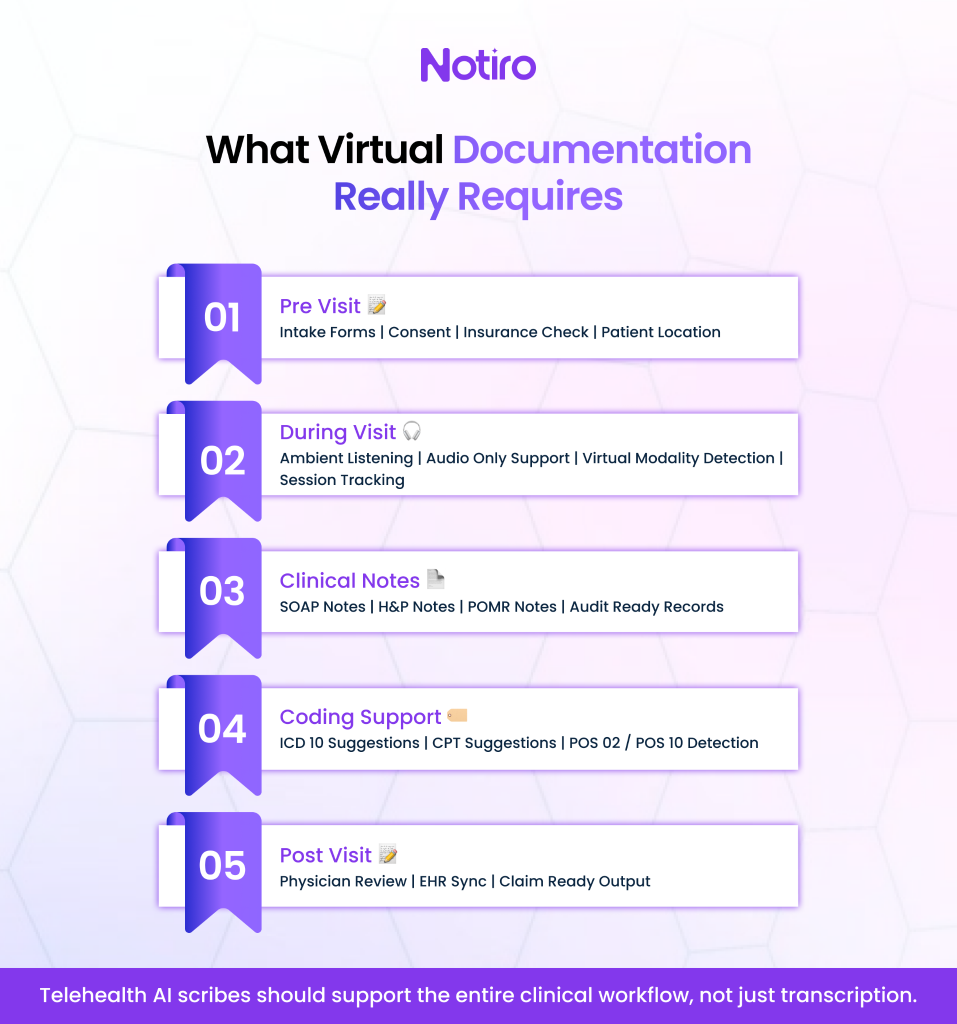
Notiro’s case for the virtual visit is the same case it makes for the in-person one: cover patient intake before the visit, ambient documentation during it, and ICD-10 plus CPT coding after it, not just the piece in the middle.
A useful way to evaluate a telehealth AI scribe is to look at the full documentation path, not just the transcription moment.
- Performing on Compressed, Device-Routed Audio
Visiting audio over a video platform is already compressed and routed through a microphone and speaker rather than captured in an open room. A scribe has to perform on that signal, not just on a quiet studio recording, or the note quality drops exactly when the physician has the least time to fix it.
- Structured Notes That Survive a Telehealth Audit
The note still needs to land in a structured SOAP, H&P, or POMR format that the physician would have written anyway. Telehealth visits are audited at least as often as in-person visits because documentation is the only proof that a virtual visit happened as billed.
- EHR Sync Without the Copy-Paste Tax
The note has to reach the EHR without a copy-paste step. A physician moving from one video call to the next does not have five spare minutes to manually transfer a note between systems. Notiro’s ambient scribe runs on mobile or web across visit types, in-person, telehealth, or walk-in, so the physician is not switching tools depending on how the patient showed up that day.
Patient Consent and HIPAA on a Screen, Not on Paper
“Is it okay if I use an AI scribe today?” is the question physicians are most often afraid to ask, and a telehealth visit makes it harder to avoid. The patient is already looking at a camera, often from their own home, and the request to record that conversation lands differently than it would in an exam room.
What a Signed BAA Actually Covers
Notiro is HIPAA-compliant and signs a Business Associate Agreement with every practice, a contract that allows a vendor to process Protected Health Information. Patient audio is processed without being used to train Notiro’s models. For the nurse practitioner or physician assistant running an independent virtual panel, the BAA is not a website badge. It is the document that determines whether the practice is exposed for the first time when a patient asks where the recording went.
The Coding Problem Most AI Scribes for Telemedicine Tools Ignore
Ambient note-writing is common now. More than 60 vendors offer some version of it, and most perform reasonably well at the transcription layer. What almost none of them do is connect the visit to the correct billing code, and telehealth makes that gap costlier, not less.
- Place-of-Service Codes and Modifiers for Virtual Visits Require
A virtual visit needs the right place-of-service code. CMS designates POS 02 for telehealth delivered outside the patient’s home and POS 10 for telehealth delivered inside it, each tied to a different payment rate. Pair that with an ICD-10 diagnosis code precise enough to survive a payer review, and a physician choosing codes manually at the end of a twelve-visit telehealth day, half audio-only and half video, is working under real-time pressure with one more modality detail to remember.
- Where Freed, Heidi Health, and Nabla Stop Short
Freed, Heidi Health, and Nabla, the tools physicians compare first, generate the note well. None of them auto-suggests the ICD-10 and CPT codes behind it. Notiro does, reviewed and approved by the physician before it syncs to Athenahealth or Epic, closing a step that a busy virtual schedule makes easy to skip and expensive to keep skipping.
Where a Virtual Care AI Scribe Fits a Telehealth-Heavy Practice
Neurology physicians now deliver more than 20% of their weekly visits by telehealth, the highest share of any specialty tracked, with psychiatry close behind. The nurse practitioner or physician assistant running an independent telehealth panel carries the same documentation load as a physician, often with less institutional support and fewer billing staff. Telemedicine documentation software built only with “doctor” in mind misses a growing share of those who are actually seeing patients on screen.
The Burnout Math at High Telehealth Volume
Notiro’s intake-to-coding workflow does not change based on a clinician’s credentials. A Mass General Brigham study recorded a 21.2% drop in physician burnout scores after 84 days of consistent AI scribe use, a figure worth weighing seriously against any practice carrying a heavy virtual caseload.
Documentation does not get lighter because a visit occurred on a screen rather than in an exam room. It gets more specific, with consent language, modality justification, and billing codes. The manual workflow was already missing before telehealth made the schedule busier. Notiro’s AI scribe for telehealth carries the note from intake through ICD-10 and CPT coding to EHR sync, the same as it does for an in-person visit, so the virtual half of the schedule stops being the part that eats into the evening. Start a free trial at notiro, no IT setup and no enterprise contract required.