Cancer care is rarely simple. An oncology visit may involve pathology reports, imaging findings, chemotherapy updates, medication changes, side effects, survivorship planning, and emotionally difficult conversations, all within a single appointment.
Somewhere between those discussions, the oncologist still has to complete detailed clinical notes. That is where oncology clinical documentation becomes challenging.
The note is not just a record. It is the memory of the patient’s cancer journey. It explains what treatment was selected, how the patient responded, what risks were discussed, and what comes next. When documentation is clear, cancer care feels coordinated.
However, when notes become rushed, copied, or incomplete, important clinical context can disappear. Therefore, the goal is not simply to write faster notes. The real goal is reducing documentation burden without losing the patient story.
Why Oncology Documentation Takes So Much Time
Oncology documentation is more complex than many standard clinical workflows because cancer care usually spans months or years and involves multiple specialists.
A patient may move between medical oncology, radiation oncology, surgery, radiology, pathology, genetics, and palliative care. Every provider depends on accurate documentation to understand where the patient stands in treatment.
Thus, oncology notes must capture:
- Cancer type and stage
- Treatment history
- Response to therapy
- Medication adjustments
- Side effects and symptom progression
- Goals of care discussions
- Follow-up plans
That is a significant amount of information for one encounter. Moreover, oncology decisions often change quickly. A scan result, lab value, or adverse reaction can completely alter the treatment plan.
Therefore, documentation must explain not only what changed but also why the decision was made. This is exactly why clinical documentation improvement matters so much in oncology. Better notes improve continuity, communication, patient safety, and treatment coordination.
The Documentation Burden in Oncology Is Growing
The documentation burden in oncology is not just frustrating. It directly affects clinician’s workload and time with patients.
| A 2025 JNCI study found that oncology specialists increased their EHR time from 400.2 minutes per week in 2019 to 465.2 minutes per week in 2022, which represented a 16.2% increase in EHR-related work. |
Another study examining head and neck cancer consultations found that clinicians performed nearly 13 mouse clicks and 40 keystrokes per minute during initial consultations.
However, the issue is not only the number of clicks. Every click competes with attention. Every unfinished note becomes another task waiting after clinic hours. Over time, documentation starts following the clinician’s home.
In oncology, that burden feels even heavier because many patient conversations are already emotionally demanding.
Why Traditional Documentation Struggles in Cancer Care
Traditional documentation workflows were not designed for the complexity of modern oncology.
Templates help standardize notes, but they can become rigid and repetitive. Copy-forward saves time, but outdated information can easily remain inside the chart. Manual typing may be accurate, yet it often interrupts patient interaction.
As a result, clinicians frequently end up reconstructing visits from memory after the appointment ends.
That creates another problem. Important context can disappear.
For example, a note may state that the patient “tolerated treatment well,” but it may fail to explain worsening fatigue, neuropathy symptoms, emotional concerns, or why a dosage adjustment was discussed.
Therefore, oncology documentation does not simply need more words. It needs a better signal and a clearer context.
How AI Documentation Helps Oncology Teams
AI documentation for oncology helps reduce note time by capturing conversations during the patient encounter and organizing them into structured clinical notes.
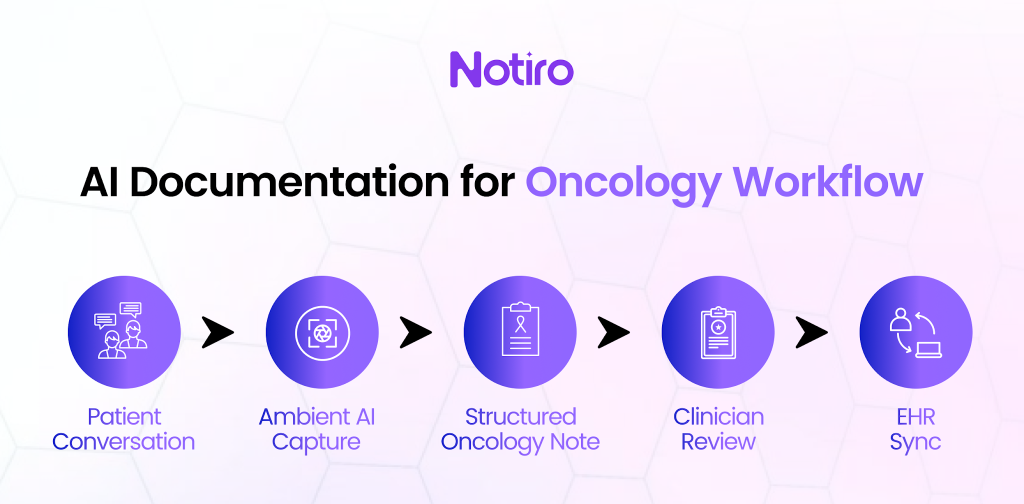
Instead of typing continuously during the visit, clinicians can focus more directly on the patient while the AI drafts documentation in the background. Afterward, the clinician reviews, edits, and approves the final note before syncing it into the EHR.
This workflow is gaining attention across healthcare.
| A 2025 JAMA Network Open study involving 1,430 clinicians across major healthcare systems found that ambient documentation technology was associated with reduced burnout and improved well-being. |
That does not mean AI replaces clinical judgment. However, it does show how reducing documentation friction can improve clinical workflows.
What an AI Scribe for Oncology Should Capture
An AI scribe for oncology should do more than convert speech into text.
Cancer care requires clinical structure and contextual understanding. Therefore, a strong oncology documentation workflow should help organize:
- Diagnosis and staging
- Treatment history
- Imaging and lab discussions
- Symptoms and treatment side effects
- Medication changes
- Goals of care conversations
- Follow-up planning
- Patient instructions
However, the clinician must remain in control. The AI creates the draft, but the oncologist still verifies accuracy, adjusts clinical reasoning, and approves the final documentation.
That review process is essential because oncology decisions are too important to rely on automation alone.
Clinical Documentation Improvement in Oncology
Clinical documentation improvement is often discussed from a billing perspective, but in oncology, it also affects continuity of care.
A strong oncology note should explain:
- Why was a treatment selected
- How the patient responded
- What risks were discussed
- What symptoms require monitoring
- What happens next
Without that context, the next clinician may understand the treatment plan but miss the reasoning behind it.
Therefore, documentation improvement should focus on clarity and continuity rather than simply producing longer notes.
Where AI Documentation Reduces Note Time
AI documentation can reduce note time in several practical ways across oncology workflows.
First, it helps capture long and detailed consultations without forcing clinicians to type constantly during emotionally sensitive discussions.
Second, it organizes follow-up visits by summarizing symptoms, treatment tolerance, medication updates, and next steps into structured documentation.
Third, it improves multidisciplinary communication because cleaner notes are easier for other providers to review quickly.
Finally, it can reduce after-hours charting. That matters because many oncology clinicians spend evenings finishing documentation instead of disconnecting from work. The chart somehow always wants “just one more update.” Very clingy behavior from a software system.
The Future of Oncology Documentation
The future of oncology documentation is not about removing clinicians from the process. It is about reducing friction around the process.
AI captures conversations and drafts notes. The clinician reviews and approves. The EHR remains the system of record. Most importantly, the patient remains the center of the conversation.
As cancer care becomes more personalized through genomic testing, targeted therapies, and immunotherapy, documentation complexity will continue to grow. Therefore, oncology teams do not need less documentation. They need smarter documentation support.
How Notiro Helps Oncology Teams Document Care Without Losing the Conversation
Oncology teams do not need another tool that adds more steps to an already complex workflow. They need documentation support that fits naturally into patient care.
Notiro helps capture patient conversations, turn them into structured clinical notes, and keep clinicians in control through review and approval before EHR sync. This supports cleaner oncology documentation without asking doctors to choose between listening carefully and charting accurately.
With SOAP and HPI templates, smart phrases, AI medical coding, contextual awareness, HIPAA-compliant security, and EHR integration, Notiro helps reduce documentation pressure while preserving the clinical context cancer care depends on.
So, the outcome is simple: less time rebuilding the visit after it ends, and more time focused on the patient while it is happening.