
Clinical documentation affects nearly every physician, but the burden differs by speciality. A radiologist producing reports all day has a different workflow from a psychiatrist writing narrative notes or a primary care physician managing several conditions in one visit.
That is why voice dictation for medical specialities should not be treated as a one-size-fits-all solution. The biggest gains usually appear where clinicians produce large volumes of narrative text, repeat familiar note structures, use specialised terminology, or need to complete documentation quickly between patients and procedures.
The American Medical Association reported in October 2025 that physicians averaged 13 hours per week on indirect patient care, including documentation, order entry, test-result interpretation, and referrals.
For healthcare organisations trying to reduce keyboard work, voice-enabled documentation can improve clinical efficiency.
10 Specialities Where Voice Dictation Saves Time
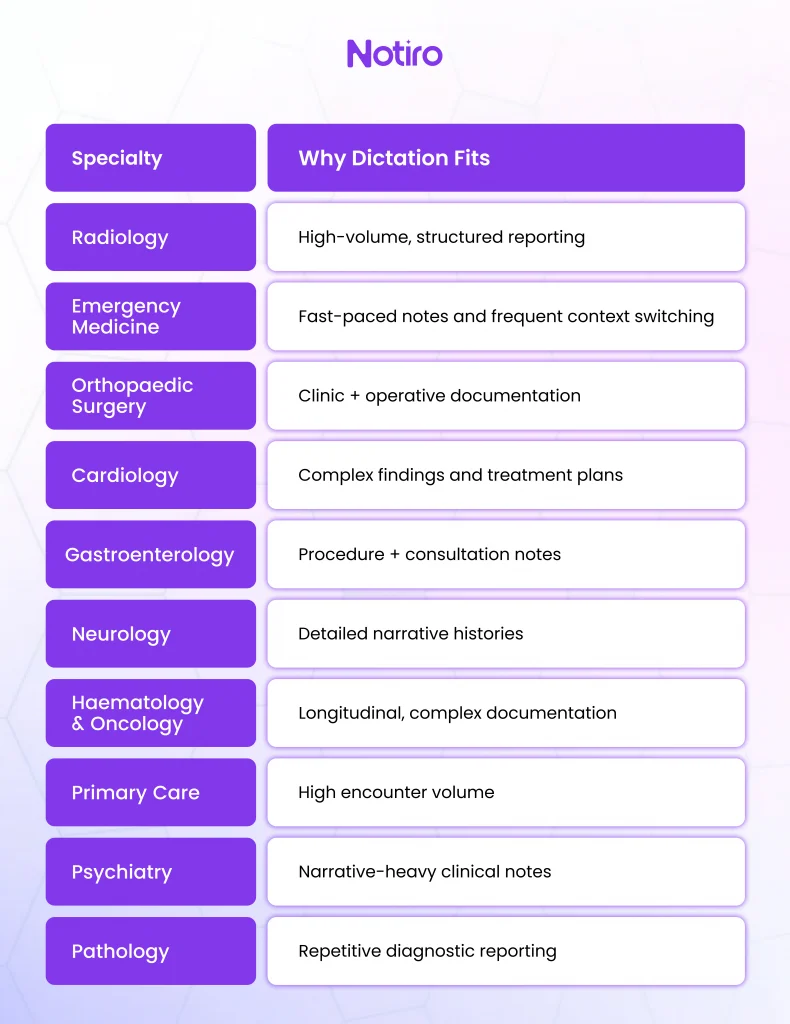
The potential medical voice dictation time savings by speciality depends on note volume, narrative complexity, terminology, and workflow. These specialities are strong use cases.
1. Radiology
Radiology is a natural environment for voice dictation because reporting is central to the speciality. Radiologists interpret images and communicate findings through structured reports throughout the day.
Typing every observation can interrupt concentration. Dictation allows radiologists to describe findings while reviewing the study and then edit the generated text before finalising the report.
Many reports follow predictable sections, including history, comparison, findings, impression, and recommendations. High volume and repeatable structure make radiology one of the best specialities for voice dictation software.
2. Emergency Medicine
Emergency medicine involves constant movement between patients, tests, procedures, consultations, and disposition decisions. Physicians may manage several cases while documenting histories, examinations, procedures, and discharge plans.
Voice dictation can help emergency physicians capture important information while the encounter is fresh, rather than leaving multiple unfinished notes until later.
For emergency departments evaluating clinical dictation efficiency by speciality, the goal is keeping documentation moving during a high-pressure shift without adding unnecessary work afterwards.
3. Orthopaedic Surgery
Orthopaedic surgeons manage clinic visits, imaging reviews, injections, surgical planning, postoperative care, and operative documentation. Much of it combines recurring language with patient-specific findings.
It can also help with operative notes that cover procedural steps, findings, implants, complications, and postoperative plans. This mix of structured information and narrative detail makes orthopaedics a strong use case for healthcare voice dictation.
4. Cardiology
Cardiology documentation can become complex quickly. One encounter may include symptoms, cardiovascular history, medication changes, ECG findings, imaging results, risk factors, diagnostic reasoning, and a detailed treatment plan.
Dictation lets cardiologists express this information naturally rather than breaking their thought process into repeated typing and clicking.
It can support consultations, follow-ups, procedures, and interpretation-heavy encounters. The advantage is strongest when the system recognises speciality terminology and preserves clinical meaning.
5. Gastroenterology
Gastroenterologists often switch between outpatient consultations and procedures during the same day. They may need to complete consultation notes, follow-ups, endoscopy documentation, procedure findings, impressions, and post-procedure recommendations.
This mix of structured and descriptive documentation makes gastroenterology well suited to voice-enabled workflows.
Physicians can dictate findings and recommendations while they remain clear in memory. When considering medical voice dictation time savings by speciality, gastroenterology stands out because dictation can support both cognitive encounters and procedural documentation.
6. Neurology
Neurology relies heavily on detailed clinical narratives. Neurologists often document symptom progression, neurological examination findings, medication responses, functional changes, prior investigations, and complex diagnostic reasoning.
Voice dictation allows neurologists to capture details in a natural sequence without compressing important information, since manual typing is too time-consuming. This can be especially helpful for new consultations, complicated follow-ups, and patients with extensive neurological histories where context matters.
7. Haematology and Oncology
Haematology and oncology documentation is often longitudinal. Physicians may need to reference pathology, previous treatments, imaging, laboratory trends, treatment response, medication toxicity, adverse effects, and future therapeutic plans.
These notes often require context rather than isolated data points.
Voice dictation can make it easier to explain how a patient’s condition has changed while clearly documenting the next stage of care. Among common healthcare voice dictation speciality use cases, oncology is well suited to systems that can handle complex terminology and longer narratives without creating significant cleanup work afterwards.
8. Primary Care and Family Medicine
Primary care physicians may not write the longest notes, but the volume and variety of encounters create substantial documentation work.
A session might include chronic disease management, preventive care, medication reviews, acute complaints, referrals, and follow-up planning. Patients may also present with multiple problems during a single appointment.
Voice dictation can help physicians capture the assessment and plan immediately after an encounter, rather than leaving notes for later. In high-volume practices, reducing repetitive typing across many visits can improve workflow, making primary care an important consideration in any physician dictation software comparison.
9. Psychiatry
Psychiatry is another speciality where narrative documentation plays a major role. Notes may include symptoms, behavioural observations, psychosocial circumstances, mental status examinations, medication responses, risk assessments, and treatment plans.
Much of this information cannot be communicated effectively through checkboxes.
Voice dictation allows psychiatrists to summarise encounters naturally while preserving clinically meaningful context. Because psychiatric documentation can contain sensitive information, organisations should ensure that any voice-enabled system fits privacy, security, consent, and organisational requirements. When implemented appropriately, dictation can reduce typing while maintaining the detail psychiatric notes require.
10. Pathology
Pathology relies heavily on accurate interpretation and reporting. Depending on the case, pathologists may document specimen characteristics, microscopic findings, diagnostic impressions, comments, and recommendations.
Instead of repeatedly switching between visual analysis and keyboard input, pathologists can convert observations into report text via speech and review it before finalising. For organisations conducting a physician dictation software speciality comparison, pathology shows how voice technology can support specialities where repeated report creation is fundamental to daily work.
What Makes a Speciality a Good Fit for Voice Dictation?
Strong voice dictation use cases share several characteristics: high documentation volume, narrative content, repeated note structures, specialised vocabulary, time-sensitive chart completion, and frequent workflow switching.
That is why clinical dictation efficiency by speciality should not be judged only by transcription speed. The better question is whether voice dictation reduces the total effort required to produce an accurate, usable note.
Fast transcription that needs extensive correction provides limited value. A workflow that preserves intended structure and minimises editing can deliver more meaningful improvement.
Healthcare organisations should consider note type, encounter volume, speciality terminology, templates, review requirements, and EHR workflows when evaluating dictation technology.
Why Specialty-Aware Voice Dictation Matters
Medical specialities do not document patients in the same way. Radiologists need efficient reporting; neurologists need detailed narratives; orthopaedic surgeons need clinic and operative documentation; primary care physicians may prioritise rapid completion.
The best approach to voice dictation for medical specialities is therefore one that adapts to clinical workflows instead of forcing every physician into the same process.
Speciality terminology also matters. Physicians should not spend the time they saved dictating correcting medical vocabulary afterwards. If clinicians must copy, paste, reformat, and reorganise everything manually, much of the efficiency benefit disappears.
Choose Voice Dictation Around the Speciality Workflow
No speciality benefits from voice dictation in exactly the same way. Radiology and pathology need efficient reporting, emergency medicine needs speed, and neurology, psychiatry, and oncology benefit from easier narrative capture. Orthopaedics and gastroenterology span clinical and procedural workflows, while primary care can reduce repetitive documentation.
The real value of medical voice dictation time savings by speciality comes from matching technology to the way clinicians work.
Notiro helps healthcare teams streamline documentation with AI-assisted encounter capture, structured clinical notes, speciality-aware workflows, and EHR-connected documentation.
If physicians are spending too much time typing, restructuring notes, or finishing charts after patient care.
Explore Notiro to see how AI-powered clinical documentation can reduce repetitive work, improve note completion, and keep clinicians focused on patient care.