
Physicians started adopting AI scribes to escape hours of nightly charting. A 2026 study in the Annals of Internal Medicine changed that conversation. Researchers at the Veterans Health Administration found AI-generated notes scored lower than human notes on accuracy.
Speed had become the industry’s main selling point. Almost nobody asked whether faster documentation was also accurate. This gap between speed and AI clinical documentation quality is now the question every practice must answer.
Notiro was built on a different premise. A note only saves time if the physician trusts it enough to sign without a rewrite. That trust is the real measure of this article, which works through.
Speed Was Never the Same Thing as Healthcare Documentation Quality
Most AI scribe marketing leads with minutes saved per visit. That number matters to a physician working a full patient day. It says nothing about whether the note holds up under a payer audit.
Healthcare documentation quality asks a different question. Does the note capture the reasoning behind a clinical decision. Does it record what was ruled out, not only what was found? That distinction rarely shows up in a product demo.
A note can be generated in ninety seconds. It can still miss the one detail that changes the next physician’s plan. Speed and accuracy are simply not the same variable.
Physician burnout research explains why speed became the dominant metric first. The average physician spends more than 3 hours a day on documentation, according to the American Medical Association. A tool that cuts that time feels valuable before anyone checks what the note says.
The 2026 VA-led study captured this exact tension. Ambient AI notes were often more thorough on paper than human ones. Reviewers still preferred human notes for accuracy, because thoroughness without precision reads as noise.
Practice managers view this trade-off differently than physicians do. A note that looks complete can still trigger a claim denial weeks later. Speed on the front end does not guarantee fewer headaches on the back end.
Where AI Clinical Documentation Quality Breaks Down
A separate evaluation, published in Frontiers in Artificial Intelligence, compared physician notes with ambient AI drafts. It scored AI clinical documentation across five specialties using a validated instrument. That instrument was not a vendor’s own benchmark.
Results showed AI notes were less succinct than the physician baseline. They were also more prone to hallucination, even where the overall organization scored well. Thoroughness and accuracy are not automatically the same thing.
Hallucination is the sharpest risk to AI medical scribe accuracy. A fabricated finding rarely appears to be an error. It reads as a confident clinical statement, which is exactly why it turns dangerous.
Omission carries a quieter but equally costly risk. Independent research on ambient scribes found hallucination rates near one to three percent. That is lower than manual dictation error rates of seven to eleven percent. It still compounds fast across a full weekly panel.
Notiro’s ambient scribe is medically tuned, not trained on general speech. It is built to handle multi-problem visits without merging separate complaints into one line. Noise-robust processing matters, too, since exam rooms rarely sound like quiet studios.
A family physician managing four chronic conditions in a single visit needs a note that traces each problem. A scribe trained in general conversation tends to blend these threads under time pressure. That is exactly where thoroughness quietly turns into inaccuracy.
Why Medical Documentation Quality Decides Whether Coding Holds Up
Clinical documentation improvement, known in the field as CDI, existed long before AI scribes arrived. Its purpose is to close the gap between what happened in the visit and what the chart states.
A note generated quickly but missing supporting detail creates a coding problem downstream. ICD-10 contains more than 70,000 codes, and CPT contains more than 10,000. Manual code selection under time pressure is a documented source of undercoding.
Medical documentation quality and billing accuracy are really the same problem. UCSF research found that AI scribe adopters earn roughly $3,000 more per year. They also see about 1 additional patient per week, largely because complete notes support the coding of a visit as warranted.
Most ambient scribes stop at the note itself. Notiro’s coding layer auto-suggests ICD-10 and CPT codes directly from the visit audio. That gives the physician a documented reason for each code selected, not a rushed guess.
Undercoding is rarely a deliberate choice. It happens because a physician is choosing between finishing a chart and seeing the next patient. A note built with coding in mind from the start removes that tradeoff.
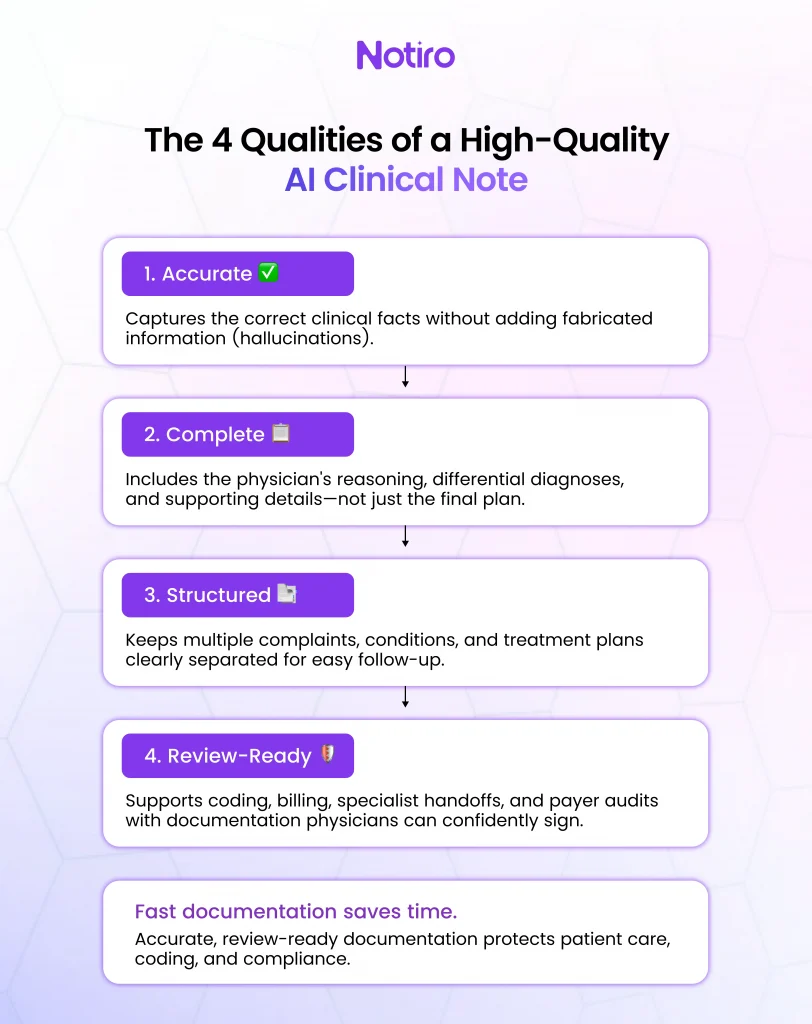
What AI-Powered Clinical Notes Need to Hold Up Under Review
AI-powered clinical notes earn a physician’s trust the same way any clinical document does. A note that survives scrutiny months later tends to do a few things well. It reflects the reasoning behind a plan, not only the plan itself.
It also keeps multiple problems from a single visit distinct, rather than flattening them into a single summary. And it gives the physician a real chance to correct details before anything reaches the permanent chart.
This is where AI clinical note quality becomes an operational decision. It is not a marketing claim that a vendor can simply assert. Mass General Brigham recorded a 21.2 percent drop in burnout scores after eighty-four days of AI scribe use.
That kind of result comes from documentation that actually holds up. It does not come from typing less at night alone. Notiro was built around the full clinical day for exactly this reason.
Patient intake happens before the visit, ambient scribing happens during it, and ICD-10/CPT coding follows right after. The note and the chart are close together instead of drifting apart across separate manual steps.
A practice comparing scribe vendors should ask a harder question than time saved. Ask what happens when a specialist reads that note six months later with no memory of the visit. Ask whether the plan explains why, not just what.
Nurse practitioners and physician assistants face this same test with less margin for error. They often carry larger panels with less coding support. A note that documents reasoning clearly protects them as much as the supervising physician.
Two scribes can save an identical six minutes per visit. They can still produce notes with very different odds of surviving a second read. The number worth tracking is accuracy, not elapsed time.
Faster documentation only matters if the note underneath it can be trusted by whoever reads it next. That remains the real test months after a visit ends. It is the one question physicians are now asking every scribe vendor to answer honestly.
Physicians did not adopt AI scribes to trade one documentation problem for another. Notiro closes that gap, from the words spoken in the room to the chart that survives an audit. Start a free trial at notiro and see what a note built for scrutiny looks like.