
Most healthcare organizations closely monitor denied claims, reimbursement delays, and accounts receivable. However, one of the largest sources of lost revenue often goes unnoticed: undercoding.
Medical undercoding occurs when providers bill for a lower level of service than what was actually documented and delivered. Unlike denied claims, undercoded claims are usually paid without issue, making the resulting revenue loss difficult to identify. Over time, these small reimbursement gaps can add up to substantial financial losses across an entire practice.
The issue is particularly important as healthcare organizations face growing financial pressures. According to Experian Health’s 2025 State of Claims Report, 41% of providers reported denial rates exceeding 10%. While denials remain a major concern, many practices fail to recognize that accepted claims can also contribute to revenue leakage when coding does not accurately reflect patient care.
Addressing undercoding in medical billing is no longer just a coding concern. It is a revenue integrity and practice management priority.
What Is Medical Undercoding?
Medical undercoding occurs when a healthcare service is reported using a lower-paying code than the clinical documentation supports. This can happen during Evaluation and Management (E/M) coding, procedure coding, diagnosis reporting, or chronic care management services.
For example, a provider may document a complex patient encounter involving multiple chronic conditions and extensive medical decision-making. If the submitted code reflects a lower level of complexity than the documentation supports, the practice receives less reimbursement than it has earned.
Unlike overcoding, which is often associated with compliance risk, medical undercoding frequently results from caution, uncertainty, incomplete documentation review, or workload pressures. Some providers intentionally select lower-level codes because they believe it reduces audit exposure. However, coding guidelines require accurate reporting of documented services, not conservative coding.
While a single undercoded claim may seem insignificant, the cumulative financial impact across hundreds or thousands of encounters can be substantial.
The Real Cost of the Medical Undercoding Problem
The medical undercoding problem extends beyond individual claims. It affects profitability, operational performance, and long-term financial planning.
One reason healthcare undercoding issues are so difficult to address is that they rarely generate immediate warning signs. A denied claim demands attention because payment is delayed or rejected. An undercoded claim, however, is paid successfully, making the revenue shortfall largely invisible.
According to AHIMA, accurate coding and clinical documentation play a critical role in reimbursement, compliance, revenue cycle performance, and healthcare data integrity. When services are coded below documented levels, organizations lose revenue and create gaps in the data used for quality reporting and strategic decision-making.
Undercoding can impact:
- Practice profitability
- Provider productivity metrics
- Service line performance evaluations
- Risk adjustment reporting
- Population health management initiatives
- Financial forecasting accuracy
These hidden losses can significantly affect a practice’s ability to invest in staff, technology, and patient care initiatives.
Medical undercoding rarely stems from a single issue. Instead, it often results from several operational and documentation challenges occurring simultaneously.
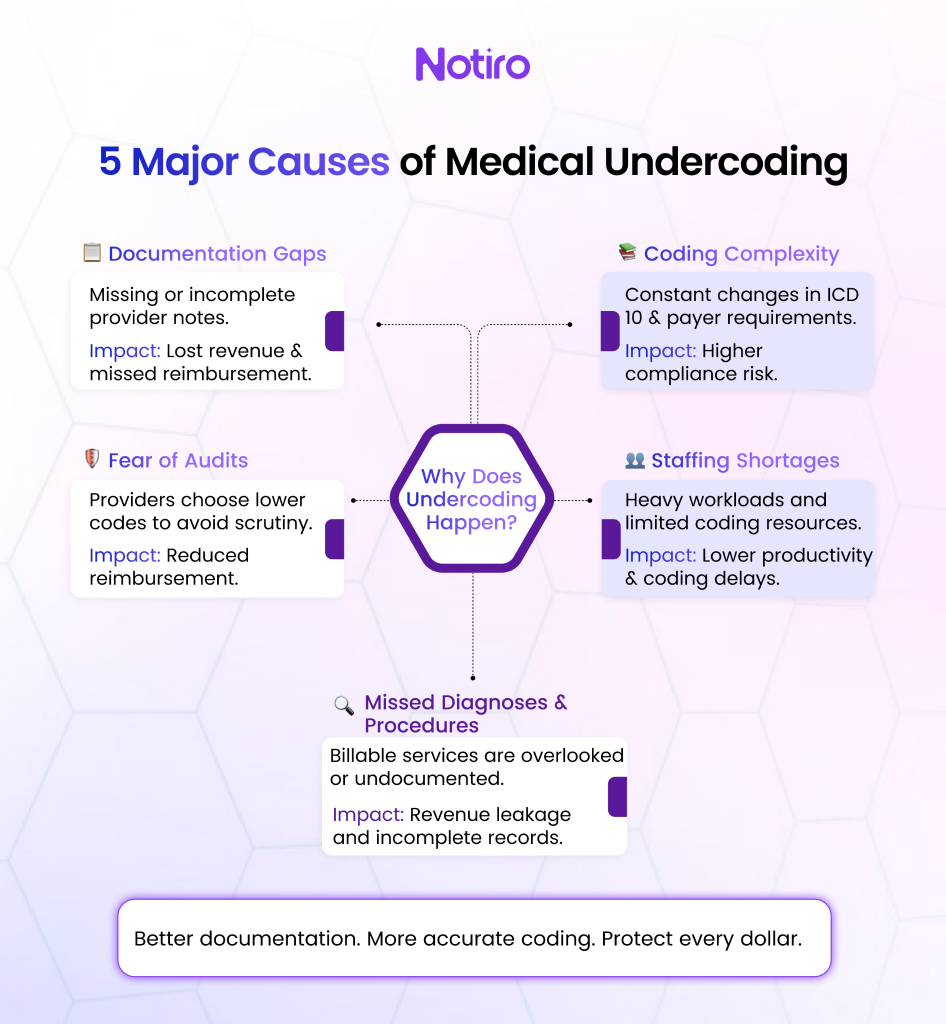
Why Healthcare Organizations Continue to Struggle With Undercoding
- Documentation Gaps
Coding accuracy depends on complete and detailed documentation. When provider notes fail to capture the full complexity of patient care, coders may be forced to assign lower-level codes.
Even experienced coding professionals can only report services that are clearly supported by the medical record.
- Increasing Coding Complexity
Healthcare coding requirements become more complex each year. Updates to CPT, ICD-10-CM, and payer-specific guidelines require continuous education and monitoring.
Specialty practices often face additional challenges because coding requirements vary significantly between clinical disciplines.
- Fear of Audits
Many providers associate coding compliance with avoiding higher-level codes. This mindset often leads to conservative coding practices that contribute directly to undercoding in medical billing.
However, federal oversight agencies emphasize coding accuracy rather than reduced reimbursement. The Office of Inspector General (OIG) continues to review coding and documentation practices as part of broader healthcare compliance efforts.
- Staffing and Workload Pressures
Revenue cycle teams across the country continue to face staffing shortages.
When coders and billing teams manage growing workloads with limited resources, the likelihood of missed diagnoses, omitted procedures, and coding errors in healthcare increases significantly.
How Undercoding Impacts Revenue, Compliance, and Performance
The consequences of healthcare undercoding issues extend far beyond reimbursement.
First, undercoding directly reduces revenue by lowering payments for services already provided. Practices work just as hard to deliver care but receive less compensation for those efforts.
Second, undercoding affects data quality. Healthcare organizations rely on coded information to assess patient complexity, measure outcomes, and support strategic planning. Missing diagnoses or understated service levels can distort important operational insights.
Third, undercoding can affect value-based care programs. Risk adjustment models and quality reporting initiatives depend on accurate coding to reflect patient acuity and care complexity. Incomplete coding may result in lower reimbursement opportunities and inaccurate performance evaluations.
The problem also creates compliance concerns. Medical coding compliance requires claims to accurately reflect documented services. Consistently coding supported service levels below can create discrepancies between clinical documentation and reported data.
How AI Identifies Missed Revenue Opportunities Before Claims Are Submitted
Traditional coding audits typically review only a small sample of encounters. As patient volumes increase and staffing pressures continue, manual reviews alone often fail to identify widespread undercoding patterns.
AI-powered coding review tools help address this challenge by analyzing clinical documentation before claims are submitted.
Real-Time Documentation Review
Modern coding platforms can evaluate provider notes and compare them against coding guidelines. This helps identify situations where documentation may support additional diagnoses, procedures, or higher service levels.
Detection of Missed Coding Opportunities
A common source of lost revenue occurs when documented conditions or billable services are omitted from the final claim. Automated review systems help identify these potential gaps and flag them for coder review.
E/M Coding Validation
Evaluation and Management coding remains one of the most challenging areas in healthcare reimbursement. AI-assisted tools can assess documentation complexity, medical decision-making, and encounter details to support accurate code selection.
Provider-Level Insights
Coding patterns often vary significantly among providers. Automated analytics can identify unusual trends, reveal potential undercoding behaviors, and support targeted education initiatives.
Importantly, the purpose of these systems is not to maximize reimbursement. The goal is to ensure claims accurately reflect documented patient care.
AI and Medical Coding Compliance
Compliance remains essential to any revenue integrity strategy. Accurate coding requires organizations to report services exactly as documented, regardless of reimbursement outcomes.
Interest in technology-driven coding support continues to grow. This gap highlights a significant opportunity for healthcare organizations seeking to improve coding accuracy while maintaining strong medical coding compliance standards.
AI-assisted review supports coders by identifying discrepancies, documentation gaps, and potential undercoding situations. Final coding decisions, however, remain the responsibility of qualified coding and compliance professionals.
Stop Losing Revenue to Undercoding
Every undercoded claim represents reimbursement your practice has already earned but may never collect. As coding requirements become more complex and staffing pressures continue to rise, healthcare organizations need smarter ways to protect revenue without compromising compliance.
Notiro helps providers and coding teams detect undercoding risks, validate documentation, and improve coding accuracy before claims reach payers. The result is stronger revenue integrity, fewer missed opportunities, and greater confidence in every submitted claim.
Schedule a demo today to discover how Notiro can help your organization uncover hidden revenue and strengthen coding performance at scale