
A patient notices a small device in the exam room and pauses before sitting down. “Is that recording me?”
Just a few years ago, that question would have been unusual. In 2026, it is becoming increasingly common as AI scribes find their way into healthcare organizations of every size.
Most discussions about AI documentation focus on accuracy, efficiency, or physician adoption. Yet many healthcare leaders are discovering that the real challenge begins before the note is even created. Patients want to understand what role AI plays during their visit and how their information is handled.
That is where consent becomes important. Whether a practice uses ambient listening technology, AI-assisted note generation, or a full clinical workflow platform such as Notiro, physicians need a clear approach for explaining the technology to patients. They should also obtain patient agreement when appropriate.
Let’s explore what patient consent for AI scribe technology means in 2026, when it may be required, and how practices can build workflows that support transparency, trust, and operational consistency.
Why AI Scribes Have Changed the Consent Conversation
Healthcare providers have always used tools to support clinical documentation. Electronic health records, dictation software, transcription services, and speech recognition platforms all changed how notes were created. AI scribes are the latest evolution in that process.
The difference is visibility. Patients can often see AI documentation technology working during the visit. Some systems listen in real time.
Others generate notes from conversations. Some organizations explain the technology before appointments begin.
As a result, patients naturally want to know what is happening. The consent conversation is not simply about compliance. It is about maintaining trust in an environment where new technologies are becoming part of routine care.
Patients deserve to understand how information is collected, processed, and incorporated into their medical records.
What Is AI Scribe Consent?
AI scribe consent refers to informing patients that AI-assisted documentation technology will be used during their clinical encounter and obtaining their agreement before proceeding.
The exact process varies across healthcare organizations. Some practices rely on verbal consent. Others use written disclosures.
Larger health systems may incorporate AI documentation language into broader patient consent forms. Regardless of the format, effective consent should answer several basic questions:
- What does the AI scribe do?
- Is the conversation recorded?
- Who reviews the documentation?
- How is patient information protected?
- Can patients decline participation?
Patients do not necessarily need a technical explanation. They need a practical one.
When Is Patient Consent Required?
One of the most common questions physicians ask is whether separate consent is legally required before using an AI scribe.
The answer depends on several factors, including organizational policies, state regulations, privacy requirements, and the way the technology functions.
For example, considerations may differ when:
- Audio recordings are stored
- Conversations are processed in real time
- Third-party vendors are involved
- Additional data retention practices exist
- Local regulations impose specific requirements
Rather than relying on assumptions, healthcare organizations should work with legal, compliance, and privacy teams to establish clear policies.
What remains consistent across nearly every environment is the value of transparency. Even when separate written authorization is not mandatory, informing patients about AI-assisted documentation is often considered a best practice.
AI Scribe Verbal Consent Versus Written Consent
Many healthcare organizations are evaluating whether verbal or written consent is the better approach. In reality, both methods have advantages.
- AI Scribe Verbal Consent
AI scribe verbal consent is often the simplest option. A physician may briefly explain the technology at the start of the encounter and confirm that the patient is comfortable proceeding.
For example:
“I use an AI documentation assistant that helps create my clinical notes so I can focus more on our conversation. I review everything before it becomes part of your chart. Is that okay with you?”
The discussion is quick, clear, and easy for patients to understand. Many organizations appreciate verbal consent because it creates minimal disruption while still promoting transparency.
- AI Scribe Consent Forms
Some healthcare organizations prefer a more formal process through an AI scribe consent form. Written consent may be useful when:
- Organizational policy requires documentation
- Audio recordings are retained
- Legal teams recommend additional disclosures
- Regulatory guidance supports written authorization
The benefit of a written process is consistency. Every patient receives the same information, and organizations have documented records of consent practices.
The most effective approach depends on the clinical setting, risk profile, and organizational requirements.
What Patients Actually Want to Know
Healthcare professionals often assume patients have concerns about artificial intelligence itself. In practice, most questions are much simpler. Patients frequently ask:
- Who Can Access My Information?
Patients want reassurance that their medical information remains protected and accessible only to authorized individuals involved in their care.
- Is Someone Listening Later?
Many patients are more concerned about storage and access than the technology itself. Explaining whether conversations are stored, processed, or reviewed helps eliminate uncertainty.
- Can the AI Change My Medical Record?
Patients should understand that physicians remain responsible for reviewing and approving documentation before it becomes part of the official record.
- Can I Decline?
Patients appreciate knowing they have a choice. Even when most patients agree to AI-assisted documentation, offering transparency reinforces trust.
Successful consent conversations focus on answering patient questions in plain language rather than overwhelming them with technical details.
Common Consent Mistakes Practices Make
As AI adoption grows, healthcare organizations are discovering several recurring mistakes.
- Using Technical Language
Patients rarely benefit from explanations involving machine learning models or complex system architecture. Simple language is more effective.
- Rushing the Conversation
Patients should have an opportunity to ask questions before agreeing to AI-assisted documentation.
- Assuming Everyone Understands AI
Public familiarity with AI continues to grow, but understanding remains inconsistent. Never assume patients know how AI scribes work.
- Inconsistent Staff Messaging
Patients may receive different explanations from reception staff, nurses, and physicians. Organizations should establish standardized talking points.
- Failing to Document the Process
Even when verbal consent is used, practices should have clear policies on documentation and workflow consistency.
Building a Practical AI Scribe Consent Workflow
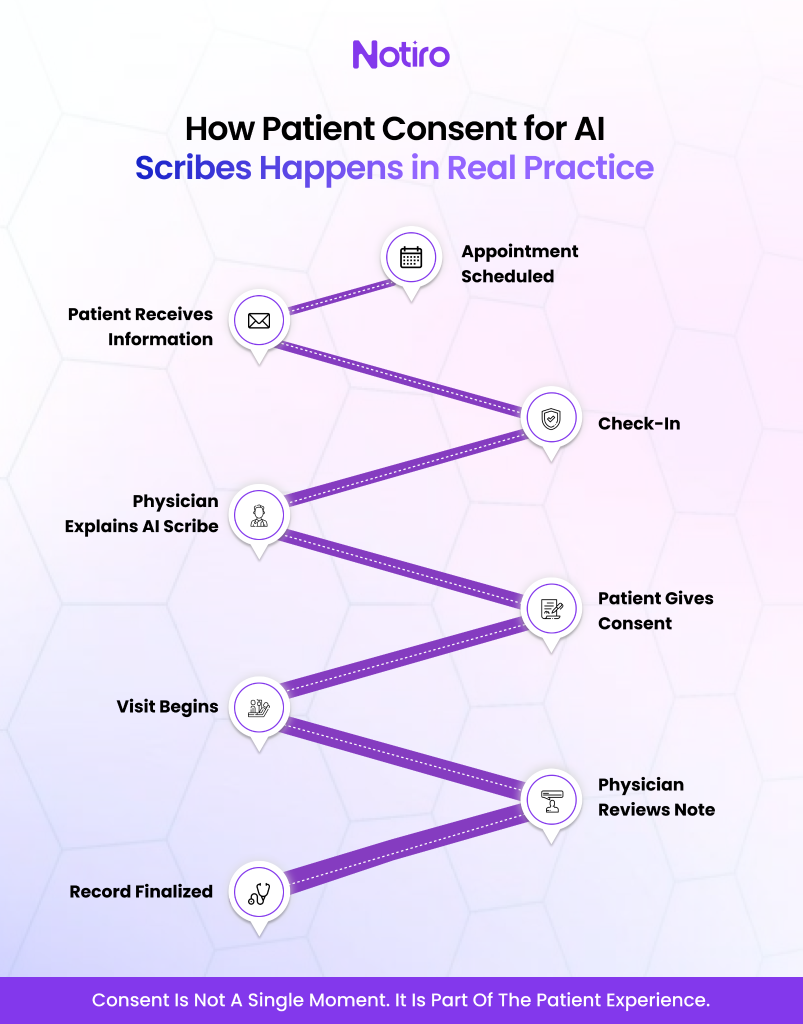
The most successful healthcare organizations treat consent as part of the patient experience rather than a compliance checkbox. A practical workflow often includes the following steps.
| Before the Appointment | Patients receive information about AI-assisted documentation through appointment reminders, intake materials, or patient portals. |
| During Check-In | Staff members can answer common questions and provide educational resources when needed. |
| During the Clinical Encounter | The physician explains the AI scribe process and obtains consent according to organizational policy. |
| Documentation | Consent discussions are documented consistently when required. |
| Continuous Improvement | Organizations regularly review patient feedback and update workflows as regulations and technologies evolve. |
This approach creates consistency without adding unnecessary complexity.
How Notiro Supports Transparent and Efficient AI Documentation
Consent is only one part of successful AI adoption. Healthcare organizations also need technology designed specifically for clinical environments.
Notiro helps providers streamline documentation workflows while maintaining physician oversight at every stage of the process. Its AI-powered platform supports conversation capture, structured note generation, coding assistance, and EHR synchronization, helping healthcare teams reduce manual work while improving consistency.
By automating time-consuming documentation tasks, Notiro enables clinicians to focus on patient interactions rather than administrative processes. At the same time, physicians remain in control of reviewing and approving clinical records before finalization.
The result is a workflow that supports efficiency, reduces documentation errors, and creates a better experience for both providers and patients.
Notiro Helps Healthcare Teams Build Trust Around AI Documentation
As AI scribes become increasingly common across healthcare, patient trust will remain just as important as technological performance.
Organizations that communicate clearly, establish consistent consent workflows, and prioritize transparency will be better positioned to adopt AI successfully.
Notiro is a leading AI clinical workflow platform built to support that transition. From conversation capture and note creation to coding support and EHR integration, Notiro helps healthcare organizations modernize documentation while keeping clinicians firmly in control.
Want to see how AI-powered documentation can fit into your practice? Book a demo with Notiro and discover how smarter clinical workflows can improve efficiency, accuracy, and patient confidence.