
A clinic invests in an AI medical scribe to reduce burnout and speed up documentation. The promise sounds simple enough: less typing, faster charting, and more attention to patients instead of screens.
Then someone from the compliance team asks a question that changes the entire discussion. Where does the patient conversation actually go? That is where things become more serious. An AI medical scribe does far more than generate notes.
It listens to patient encounters, processes protected health information, drafts documentation, and often connects directly with Electronic Health Records(EHRs). In plain terms, it becomes part of one of the most sensitive workflows in healthcare.
Therefore, choosing an AI scribe is not just a productivity decision. It is also a compliance and risk decision.
Many healthcare organizations focus heavily on features during vendor demos. They evaluate note quality, turnaround time, specialty templates, and EHR integrations. However, the bigger question is often overlooked.
Is the workflow actually secure and HIPAA compliant? That is exactly why clinics need to verify how AI clinical documentation tools handle patient data before signing a contract.
Why HIPAA Compliance Matters for AI Medical Scribes
Healthcare documentation contains some of the most sensitive information within a healthcare organization. Patient symptoms, diagnoses, medications, treatment plans, insurance details, and medical history all fall under protected health information(PHI).
Now imagine an AI medical scribe processing hundreds of those conversations every day. Suddenly, documentation is no longer just a workflow issue. It becomes a security and compliance responsibility.
Under HIPAA, healthcare organizations must protect electronic protected health information(ePHI) using administrative, technical, and physical safeguards. That responsibility does not disappear simply because an AI vendor is involved.
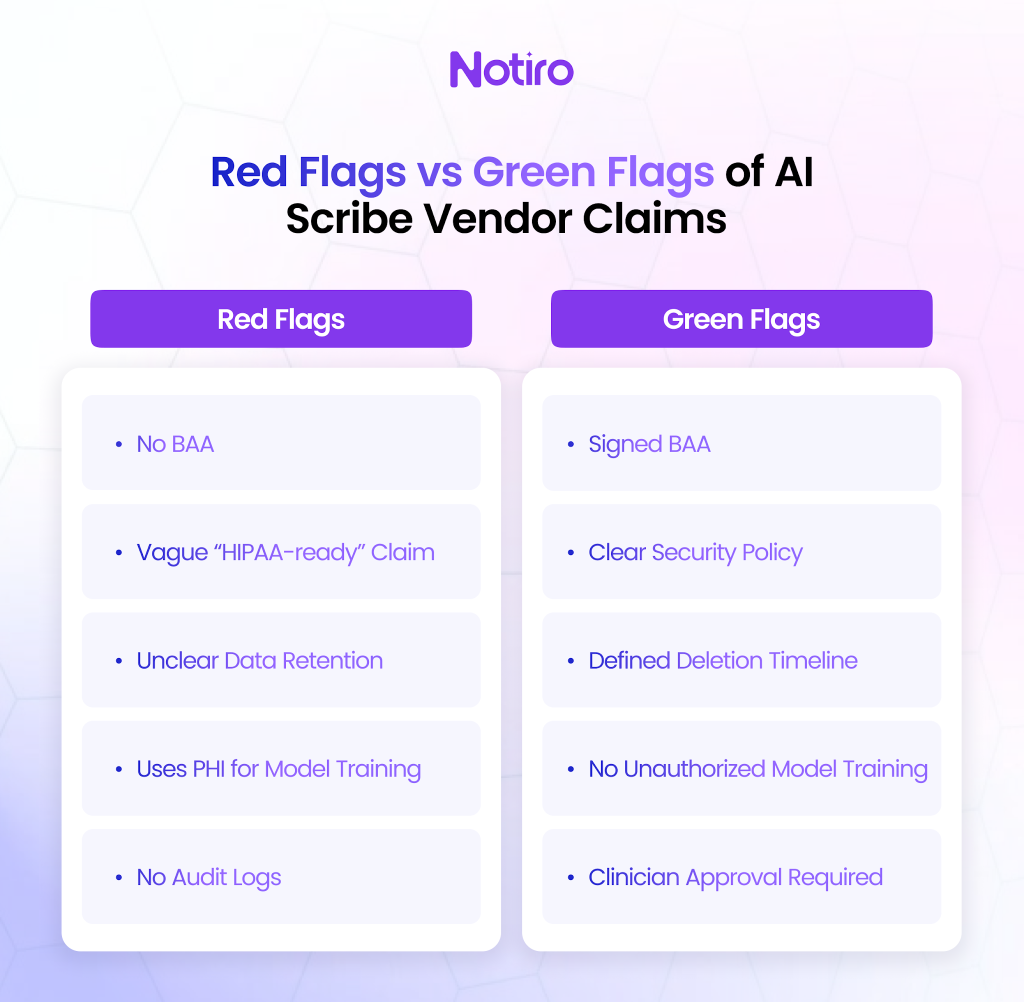
Therefore, a clinic cannot rely on marketing claims like “HIPAA-ready” or “secure AI documentation.” Those phrases sound reassuring, but they do not explain how the system actually handles patient data.
A HIPAA compliant AI scribe should protect patient information across the entire documentation journey, from audio capture to note approval and EHR syncing.
The Biggest Misconception About Medical Scribe HIPAA Compliance
Many clinics assume HIPAA compliance begins and ends with encryption and a signed Business Associate Agreement(BAA).
However, compliance is much broader than that. The real risk often exists inside the workflow itself:
- Where is the audio stored?
- Who can access transcripts?
- Is patient data used to train AI models?
- Are subcontractors involved?
- How long is data retained?
- Does the clinician review notes before approval?
These operational questions matter because AI clinical documentation tools interact with PHI continuously. Therefore, healthcare organizations need to evaluate the entire lifecycle of patient information rather than focusing only on surface-level security claims.
What Clinics Must Verify Before Buying an AI Medical Scribe
Here are some factors that clinics should look for:
Verify Whether the Vendor Signs a BAA
A Business Associate Agreement is one of the first things a clinic should verify before purchasing any AI medical scribe.
Under HIPAA, vendors that handle protected health information on behalf of healthcare providers are generally considered business associates. Therefore, they are expected to sign a BAA outlining how patient information will be protected and managed.
However, the agreement itself is not enough. Clinics should also understand:
- How the vendor handles breaches
- Whether subcontractors are involved
- How data is stored and deleted
- What security responsibilities belong to the vendor
If a vendor refuses to sign a BAA, that is not a minor concern. It is usually a major warning sign.
Verify Where Patient Conversations Are Stored
AI medical scribes begin with audio capture. That means patient conversations may be temporarily stored, processed in real time, converted into transcripts, or synced into clinical records.
Therefore, clinics should clearly verify:
- Is the audio stored?
- Where is it stored?
- Is it encrypted?
- How long is it retained?
- Who has access?
- Can it be deleted on request?
This step matters more than many organizations realize. Audio recordings can contain highly sensitive details beyond the final medical note. Side conversations, emotional responses, and additional personal information may all exist inside raw recordings.
Thus, medical scribe HIPAA compliance must include strict controls around audio handling and retention.
Verify Whether Patient Data Trains the AI Model
This is one of the most important questions in modern AI healthcare workflows.
Some AI systems improve their models using customer interactions and uploaded content. In healthcare, that creates obvious compliance and privacy concerns.
Therefore, clinics should directly ask vendors:
- Is patient data used for AI training?
- Are transcripts reviewed by humans?
- Are third-party AI providers involved?
- Are conversations retained for product improvement?
- Does the system follow zero-retention policies?
Vague answers should not be accepted. Terms like “de-identified” or “anonymous” often sound safe, but clinics should still understand the technical and contractual safeguards that underpin those claims.
Why Human Review Still Matters in AI Clinical Documentation
AI can generate clinical notes quickly. However, speed alone does not guarantee accuracy. Clinical context can easily be misunderstood. A symptom might be summarized incorrectly. Medication details can be missed.
A sentence spoken casually during a consultation may appear more significant inside the generated note.
That is exactly why human review remains essential. A reliable AI clinical documentation workflow should allow clinicians to:
- Review notes before approval
- Edit sections easily
- Verify medications and diagnoses
- Correct inaccuracies
- Approve the final version before EHR sync
In other words, AI should support, rather than replace, clinical reasoning. The best systems keep clinicians in control while reducing documentation fatigue.
Verify Security Controls and Access Permissions
Encryption is important, but encryption alone is not enough. Healthcare organizations should also verify whether the AI medical scribe includes:
- Role-based access controls
- Multi-factor authentication
- Audit logs
- Secure login systems
- Session timeout controls
- User permission management
These safeguards help reduce unnecessary exposure to protected health information. Moreover, strong access controls also support HIPAA’s “minimum necessary” principle, which limits access to only the information required for a specific purpose.
In plain terms, not everyone inside a clinic should see everything.
Verify How the AI Scribe Integrates With EHR Systems
EHR integration is another major factor clinics should evaluate before buying. Some AI scribes only generate text that clinicians manually copy into the EHR. Others integrate directly into healthcare workflows using APIs and automated syncing.
However, deeper integration also means deeper security responsibility. Therefore, clinics should verify:
- How data moves into the EHR
- Whether syncing is encrypted
- What permissions are required
- Whether audit trails exist
- How errors are handled
- Whether clinicians can control final approval
A good integration should reduce friction without reducing visibility or control.
Verify Data Retention and Deletion Policies
Many healthcare organizations focus heavily on note quality during product evaluations. However, data retention policies are equally important. Clinics should understand:
- How long audio is stored
- Whether transcripts remain after note completion
- How deleted information is removed
- Whether backups retain patient data
- What happens after contract termination
The key point is simple. Patient information should not remain in systems longer than necessary.
Clear retention and deletion policies reduce long-term compliance exposure while improving trust between healthcare providers and technology vendors.
What a HIPAA Compliant AI Scribe Should Actually Look Like
A reliable AI medical scribe should improve documentation efficiency without creating additional compliance risk. Therefore, a strong solution should include:
- Signed BAA
- Encrypted workflows
- Human review before approval
- Secure EHR integration
- Clear retention policies
- Role-based access controls
- Audit logging
- Limited data exposure
- Transparent subcontractor policies
Most importantly, the workflow should feel secure without slowing clinicians down. Healthcare teams are already overwhelmed by administrative burden. The purpose of AI clinical documentation is to reduce friction, not create new operational uncertainty.
How Notiro Supports Secure AI Clinical Documentation
Healthcare organizations do not need less documentation. They need smarter documentation workflows that protect both clinicians and patient information.
That is where Notiro fits into the process. Notiro helps clinics capture patient conversations, generate structured clinical notes, support clinician review, and sync approved documentation into EHR systems.
Instead of removing clinicians from the workflow, it keeps them in control while reducing the burden of manual charting.
Moreover, Notiro supports HIPAA compliant security, encrypted conversations, SOAP and HPI templates, smart phrases, AI medical coding support, and EHR integration workflows designed for real clinical environments.
Therefore, clinics can improve documentation efficiency without sacrificing compliance visibility or patient trust. Less typing. Better documentation. More time focused on patient care.