
Physicians did not enter medicine to spend their evenings buried in charts, inboxes, and administrative clicks. Yet in 2026, documentation overload remains one of the biggest contributors to clinician fatigue, staffing instability, and declining job satisfaction across healthcare systems.
Recent physician burnout statistics show the problem is still widespread despite years of workflow optimization efforts. According to the American Medical Association (AMA), 41.9% of physicians reported at least one symptom of burnout in 2025, with the highest rates seen in emergency medicine, oncology, radiology, and family medicine.
At the center of this crisis is a familiar issue: excessive documentation.
The healthcare industry is now turning toward AI clinical documentation tools to reduce after-hours charting, improve note accuracy, and give physicians more time for patient care. The shift is not simply about automation. It is about restoring clinical focus in a healthcare environment increasingly dominated by administrative work.
Physician Burnout Statistics Show Documentation Is Still the Breaking Point
The latest physician burnout statistics reveal a pattern that healthcare leaders can no longer ignore. Burnout rates may be slowly declining overall, but administrative burden continues to drive dissatisfaction across specialties.
Research from the AMA also shows that EHR complexity, inbox overload, and workflow interruptions directly contribute to physician stress.
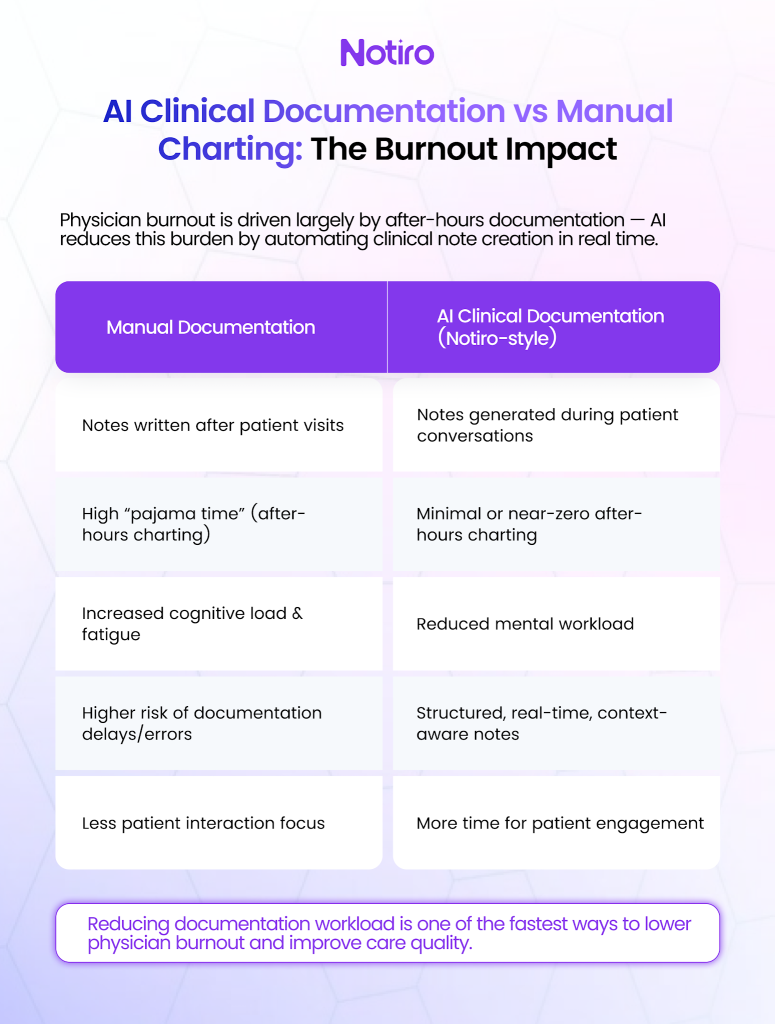
For many clinicians, the workday no longer ends after the last patient encounter. “Pajama time” charting has become routine, with physicians completing notes and documentation late into the evening just to keep pace with operational demands.
This burden affects more than individual well-being. Burnout is closely tied to:
- Reduced patient engagement
- Higher turnover rates
- Staffing shortages
- Increased risk of documentation errors
- Lower productivity across care teams
Healthcare organizations are increasingly recognizing that burnout is not a resilience issue. It is a workflow issue.
Why Clinical Documentation Improvement Has Become a Strategic Priority
Healthcare systems spent years focusing on EHR adoption and digital recordkeeping. However, many organizations underestimated the long-term documentation burden created by these systems.
Today, clinical documentation improvement is no longer viewed only as a billing or compliance initiative. It has become a workforce sustainability strategy.
The problem is not merely the existence of documentation. Physicians understand the importance of accurate records, continuity of care, and coding requirements. The issue is the amount of manual effort required to produce compliant notes while maintaining patient interaction and clinical efficiency.
Modern clinicians manage:
- Detailed encounter documentation
- Prior authorizations
- Coding requirements
- Follow-up communication
- EHR navigation
- Regulatory reporting obligations
When these responsibilities accumulate across dozens of patients daily, documentation consumes a significant portion of clinical time.
Industry discussions across healthcare technology forums increasingly point to AI-assisted workflows as one of the few scalable ways to reduce this burden without compromising documentation quality.
Regulatory Expectations Are Increasing Documentation Pressure
The operational strain on physicians is also shaped by evolving regulatory and compliance requirements.
In the United States, organizations must comply with privacy and security standards set forth by the Health Insurance Portability and Accountability Act (HIPAA). Healthcare providers are expected to maintain secure patient records, accurate documentation, and reliable audit trails.
At the same time, healthcare systems face increasing scrutiny around:
- Coding accuracy
- Clinical quality reporting
- Patient data governance
- Information blocking rules
- AI transparency and oversight
Regulatory agencies and healthcare organizations are also paying closer attention to how AI is implemented within clinical environments. The AMA has emphasized that healthcare AI tools should remain transparent, clinically validated, and physician-controlled.
This creates a difficult balancing act for providers. Physicians are expected to produce increasingly detailed documentation while maintaining productivity targets and patient satisfaction scores.
Without workflow automation, the administrative load continues to expand.
AI Clinical Documentation Is Reshaping Physician Workflows
This is why AI clinical documentation tools are gaining rapid adoption across healthcare organizations.
According to recent AMA survey data, more than 80% of physicians now use AI professionally in some capacity, including medical documentation, chart summarization, and care note generation.
Unlike earlier healthcare automation systems that added complexity, modern AI documentation platforms are designed to work passively within clinical conversations.
Ambient AI scribes can:
- Capture physician-patient conversations
- Generate structured clinical notes
- Reduce manual typing
- Support coding workflows
- Decrease after-hours documentation
The most effective systems do not attempt to replace physicians. Instead, they reduce repetitive administrative tasks that contribute to cognitive overload.
This distinction matters.
Healthcare providers remain cautious about AI systems that interfere with clinical judgment. However, adoption rises significantly when AI is positioned as a documentation assistant rather than a diagnostic authority.
Recent studies also support the operational impact of these tools. Research on ambient AI scribes found meaningful reductions in cognitive load and documentation burden among clinicians using AI-assisted note generation.
The Operational Cost of Manual Charting Is No Longer Sustainable
The financial and operational consequences of burnout extend beyond physician well-being.
Healthcare organizations facing chronic documentation inefficiencies often experience:
- Lower physician retention
- Increased recruitment costs
- Delayed patient throughput
- Reduced appointment capacity
- Growing administrative overhead
Even small workflow inefficiencies multiply quickly across large provider networks.
In many practices, physicians spend nearly as much time documenting care as delivering it. Industry conversations increasingly describe documentation as the hidden operational bottleneck limiting scalability in healthcare delivery.
The challenge becomes even more severe in high-volume specialties such as emergency medicine, oncology, and primary care, where charting requirements are extensive and patient demand continues to grow.
AI-assisted documentation changes the equation because it reduces the friction between patient interaction and record completion.
Instead of reconstructing conversations after appointments, clinicians can review and finalize structured notes generated during the encounter itself.
The result is not only faster chart completion but also improved focus during patient interactions.
Why Healthcare Organizations Are Investing in Smarter Documentation Systems
The conversation around physician burnout statistics is increasingly shifting from awareness to measurable intervention.
Healthcare leaders are no longer asking whether documentation burden contributes to burnout. They are asking which technologies can realistically reduce it without disrupting care delivery.
This is where AI-enabled clinical documentation improvement becomes strategically important.
Successful platforms share several characteristics:
- Seamless EHR integration
- HIPAA-compliant infrastructure
- Minimal workflow disruption
- Accurate medical transcription
- Specialty-aware note generation
- Fast clinician review processes
Adoption also depends heavily on usability. Physicians are unlikely to embrace tools that create additional clicks, require complex onboarding, or interrupt patient communication.
The goal is not to add another layer of software. It is to remove operational friction from the clinical day.
How Notiro Supports More Sustainable Clinical Documentation
Notiro helps healthcare providers reduce documentation burden through AI-powered clinical transcription and workflow support designed around real clinical environments.
Using ambient AI documentation, Notiro transforms physician-patient conversations into structured, context-aware clinical notes that reduce manual charting demands while supporting documentation accuracy.
The platform is built with HIPAA-compliant security standards and an encrypted infrastructure to help organizations maintain patient privacy and regulatory confidence.
Notiro also integrates directly into clinical workflows, including embedded experiences within AthenaOne, allowing providers to document care without constantly switching systems or tabs.
Most importantly, the technology is designed to give clinicians something increasingly difficult to reclaim: time.
As healthcare organizations continue responding to physician burnout statistics in 2026, reducing documentation fatigue will remain one of the clearest opportunities for operational improvement.
AI clinical documentation is no longer a future concept. It is becoming part of the modern care workflow.
If your organization is exploring ways to reduce charting fatigue, improve clinical documentation, and support physician efficiency without disrupting patient care, now is the time to see how Notiro can help.
To explore how AI-powered documentation can support more sustainable clinical workflows.