
Claim denials do not just delay payments. They drain revenue, overload billing teams, and turn small documentation gaps into expensive workflow problems. According to Experian Health’s 2025 State of Claims Report, 41% of providers now report denial rates of 10% or higher, showing that denials remain a serious and growing revenue cycle challenge.
For medical practices, every denied claim means delayed payment, extra staff time, and more pressure on billing teams that are already stretched thin. Often, the problem starts before the claim reaches the payer. A missing code, incomplete documentation, unsupported medical necessity, or incorrect modifier can create avoidable friction.
In this blog, we will explore how AI medical coding works, why claim denials continue to rise, and how medical coding automation helps healthcare organizations improve coding accuracy, reduce administrative burden, and speed up reimbursement. We will also look at how automated medical coding software is helping providers create cleaner claims and build more efficient revenue cycle workflows.
What Is AI Medical Coding?
AI medical coding uses artificial intelligence to review clinical documentation and suggest accurate billing codes. These may include ICD-10 diagnosis codes, CPT procedure codes, and other billing details needed for claim submission.
Instead of relying only on manual review, medical coding automation helps identify relevant information inside physician notes, encounter summaries, assessments, and treatment plans.
The software does not replace coders. It gives them a stronger starting point.
A coder can review the AI-suggested codes, validate them, make adjustments, and approve the final claim. This keeps human oversight in place while reducing repetitive manual work.
Why Claim Denials Happen
Most claim denials do not result from a single big mistake. They usually come from small gaps that build up across the documentation and billing process.
Common reasons include:
- Missing or inaccurate patient information
- Incorrect ICD-10 or CPT codes
- Lack of documentation to support medical necessity
- Missing modifiers
- Payer-specific rule changes
- Incomplete provider notes
These issues slow reimbursement because the claim must be corrected, reviewed, and resubmitted. In some cases, billing teams spend more time fixing old claims than preparing new ones.
That is not a workflow. That is a treadmill with invoices.
How Medical Coding Automation Reduces Denials
1. It Improves Coding Accuracy
Accurate coding is one of the strongest defenses against claim denials. When codes match the clinical documentation, payers have fewer reasons to reject or delay the claim.
Automated medical coding software reviews the encounter and helps identify codes that reflect the actual care provided. It can catch details that may be missed during a rushed manual review, especially in long or complex notes.
This helps billing teams submit cleaner claims the first time.
2. It Finds Documentation Gaps Earlier
A claim can still be denied even when the care was appropriate. If the note does not clearly support the billed service, the payer may question medical necessity.
AI medical coding tools can flag missing or weak documentation before the claim is submitted. This gives providers and coders a chance to correct the issue while the encounter is still fresh.
That early correction matters. Fixing a note today is much easier than defending it three weeks later.
3. It Speeds Up the Coding Workflow
Manual coding takes time, especially when teams are reviewing high volumes of charts every day.
Medical coding automation helps shorten the time between patient visits, documentation, coding, and claim submission. Coders do not have to start from a blank screen. They can begin with AI-generated suggestions and focus on reviews rather than basic code discovery.
Faster coding leads to faster claim submission. Faster claim submission leads to faster reimbursement.
Simple math. Less dramatic than payer portals.
4. It Supports Cleaner Claims
Clean claims are claims that can be processed without additional corrections or requests for information.
AI medical coding supports cleaner claims by helping align three important pieces:
- The clinical note
- The diagnosis and procedure codes
- The payer’s billing requirements
When these elements match, claims are less likely to bounce back. This reduces rework for billing teams and helps practices maintain healthier cash flow.
Why Speed Matters in Reimbursement
Revenue cycle performance depends heavily on timing. The longer claims sit uncoded or incomplete, the longer providers wait to get paid.
Delayed reimbursement can affect staffing, operations, growth plans, and patient service quality. For smaller practices, even a few weeks of payment delay can create real pressure.
A 2025 Fierce Healthcare report, citing MDaudit vendor data, found that the average dollar amount of denied hospital inpatient and outpatient claims increased by 12% and 14%, respectively. That makes denial prevention more important than ever.
AI medical coding helps move claims forward by reducing coding delays and improving first-pass accuracy. It does not solve every revenue cycle problem, but it strengthens one of the most important points in the process.
The Role of Human Coders Still Matters
Medical coding is not just matching words to codes. It requires judgment, compliance knowledge, specialty awareness, and payer experience.
That is why AI should support coders, not replace them.
The best workflow is a partnership. AI handles the repetitive scanning and code suggestion process. Human coders review, validate, and make final decisions.
This approach improves productivity without removing clinical and compliance oversight.
It also helps coding teams focus their time where it matters most: complex cases, exceptions, denials, audits, and revenue integrity.
What to Look for in Automated Medical Coding Software
The right automated medical coding software should make the workflow easier, not heavier.
Healthcare organizations should look for a system that offers:
- ICD-10 and CPT code suggestions
- Real-time documentation review
- EHR integration
- Specialty-specific coding support
- HIPAA-compliant data handling
- Easy review and approval workflows
- Customizable templates
- Clear audit support
Ease of use is important. If the system adds too many clicks, providers and coders will avoid it. The best tools work naturally inside the clinical workflow and help teams move from documentation to reimbursement without unnecessary friction.
AI Medical Coding and Revenue Cycle Efficiency
Medical coding automation is not only about faster coding. It improves the connection between clinical care and financial performance.
When documentation is clearer, coding becomes more accurate. When coding is more accurate, claims become cleaner. When claims are cleaner, reimbursement moves faster.
Here’s how AI supported by human coder review creates a revenue cycle flywheel: clearer documentation leads to accurate coding, cleaner claims, fewer denials, and faster reimbursement.
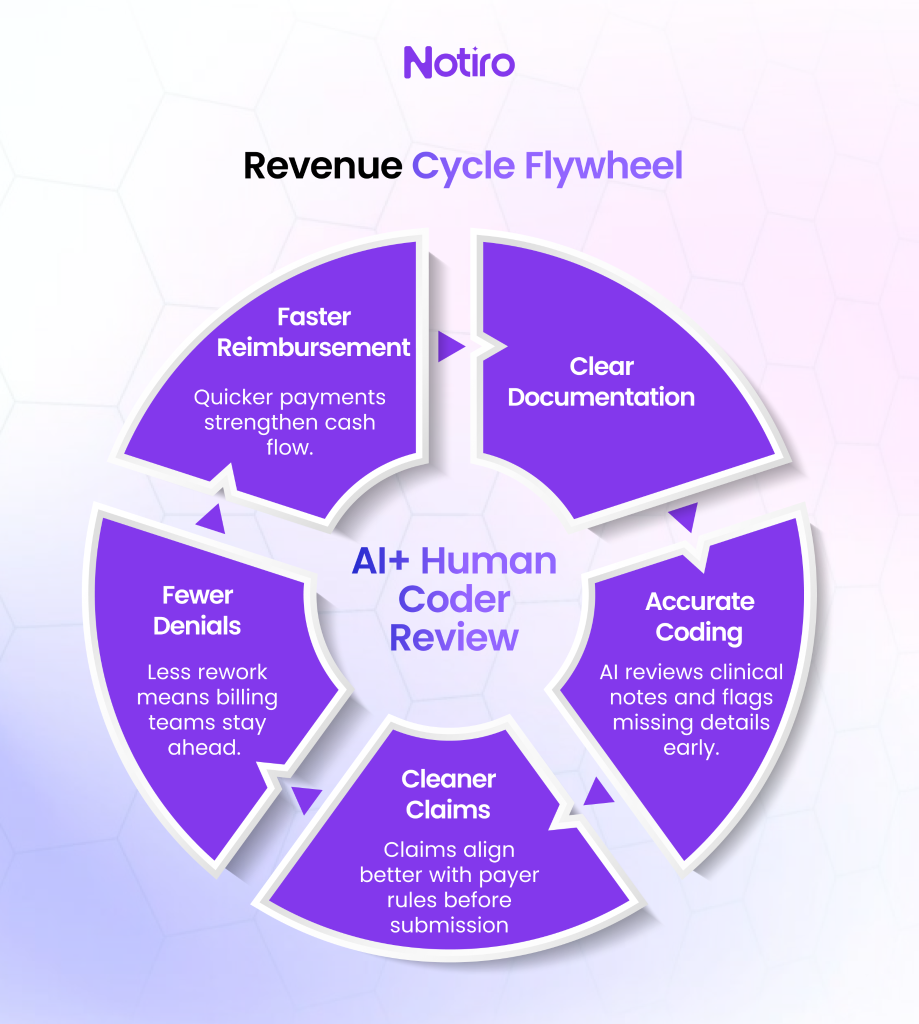
This creates a healthier revenue cycle from the first patient note to the final payment.
For providers, the value is practical. Less rework. Fewer avoidable denials. Faster claims. Better visibility. More time for patient care.
For billing teams, it means fewer repetitive corrections and more time for higher-value revenue cycle work.
How Notiro’s AI Medical Coding Software Helps Reduce Claim Denials
Claim denials are often the result of small issues that happen early in the documentation and coding process. A missing detail, weak documentation, incorrect code, or delayed review can slow payment and create unnecessary administrative work for already busy healthcare teams.
AI medical coding gives practices a smarter way to manage that pressure. By improving coding accuracy, identifying documentation gaps, and helping claims move faster, automation can reduce preventable denials and support stronger reimbursement performance.
For practices looking to bring documentation and coding into one smoother workflow, Notiro offers AI clinical order with intelligent coding support. It helps providers create cleaner notes, prepare coding-ready documentation, and reduce the manual burden tied to reimbursement.
In a healthcare environment where time, accuracy, and cash flow all matter, automated medical coding software is becoming less of a future idea and more of a practical advantage for practices that want fewer denials, faster payments, and healthier operations.