Every healthcare visit has one thing in common: the need to be someone who can turn a real conversation into a permanent record. That final step may appear small, but it is not.
Accurate documentation is necessary for billing, quality, auditing, and protection against legal issues, and providing constant care
Thus, with clear and correct notes, the clinic runs smoothly, whereas with incorrect and unclear notes, everything becomes slow.
So, when people ask, “Will AI replace human medical scribes?” It is better to reframe the question as: “When a note is challenged, who can stand behind it?”
But first, let’s learn
What is a Medical Scribe?
A medical scribe is an individual who assists physicians in documenting all that occurs during a patient visit.
It refers to the fact that when the physician is examining the patient, the medical scribe adds information into the medical record, including symptoms, diagnoses, test results, and treatment plans. This helps doctors reduce typing and spend more time with patients.
The Moment Documentation Stops Being Paperwork
Imagine a chart review that is not routine, in which a complaint is filed, a claim is opened, or an audit request lands. One sentence in the note becomes the center of gravity: “Patient denies chest pain,” and the reviewer asks, “Where did that come from?”
That is the courtroom test. Not because every case ends up in court, but because medical documentation is evidence. It needs to hold up when someone reads it skeptically.
Candello, part of the Risk Management Foundation of the Harvard Medical Institutions, analyzed more than 65,000 medical malpractice cases closed between 2014 and 2023.
Their benchmarking report found that 20% of cases involved at least one documentation failure. It also found that documentation issues more than doubled the odds that a case would close with an indemnity payment.
And that changes the conversation. This is not about who types faster, but rather about who owns the note’s accuracy and intent.
Why AI Medical Scribes Tools Are Gaining Attention Fast
The documentation burden is not a myth, as it is measurable.
A time motion study published in Annals of Internal Medicine observed primary care physicians spending about 27% of the office day in direct face time with patients, while about 49% went to EHR and desk work.
Physicians also reported 1 to 2 hours after work each night, largely tied to EHR tasks.
The heavy workload causes fatigue and changes how visits feel. When clinicians spend more time on screens, they are less present with patients, and they end up doing more charting after dinner.
So when ambient AI and dictation tools offer relief, clinicians pay attention. These tools draft the note faster so clinicians can focus on the human in front of them. However, the risk is assuming the draft is automatically reliable.
What AI Can Do Well Today in Medical Scribe
AI scribes excel when the goal is to reduce the blank-page problem. Let’s walk through some of the efficiencies that come with Artificial Intelligence in medical scribing.
- Fast Structured Drafting
AI can convert a conversation into a structured note quickly. This includes formatting sections such as HPI, ROS, assessment, plan, and follow-ups.
- Better Flow For Speech-Based Documentation
Speech recognition also has evidence of time savings compared to typing in certain workflows. The point is not that speech is perfect, but that it can be faster and reduce the burden of manual entry.
- Consistency At Scale
AI is capable of generating standardized templates for use across providers and clinics. That will assist in standardizing documentation, particularly in specialties with high volumes.
Hence, when the questions concern the actions of AI in the medical industry, one can say that it can speed up documentation and make it more accurate, whereas human workers can concentrate on the critical operations, such as diagnosis and treatment planning.
Issues with AI Medical Scribe Solutions
If a note is questioned, can the clinician confidently say, “This reflects what happened.” This is where AI struggles in a few predictable ways.
- Confident Details That Were Never Said
During a doctor-patient visit, the AI transcription tool can also generate some similar-sounding medical terminology that was never mentioned during the conversation. A symptom becomes a denial, or a medication becomes “continued.” A family history becomes more specific than the conversation ever was.
- Errors Even In Speech Recognition Workflows
Speech recognition is still likely to make mistakes. A JAMA (Journal of the American Medical Association) Network Open study on dictated clinical documents assisted by speech recognition found an error rate of over 7% in speech recognition-generated clinical documents.
Therefore, mistakes are possible, and manual editing and review will always be needed.
- Accountability Stays Human
No matter how well-developed the tool is, responsibility does not shift to the software. It remains with the organization and the clinician.
That is the reason why governance is catching up. Do you know that NHS England (National Health Service of England) published guidance in April 2025 on the use of AI-enabled ambient scribing products, outlining necessary points to consider when implementing it across health and care settings?
The existence of this guidance is a signal. Ambient scribing is moving from “interesting demo” to “real deployment,” which brings serious expectations around risk, consent, monitoring, and quality.
Is Replacing Allied Health Professionals with AI Medical Scribes Software Practically Possible?
This question comes up often. The simple answer is no, AI could handle most of the recurrent and unproductive tasks, but it will not completely replace the expert human role because adding human accountability provides the required correctness and legality of medical records.
In most clinics, the future will be a hybrid approach. AI will create the first draft, and a trained person will review it.
The doctor can then sign it with confidence. This works because documentation takes a lot of time, and at the same time, it must serve as reliable evidence.
What Changes For Scribes In the Current Environment
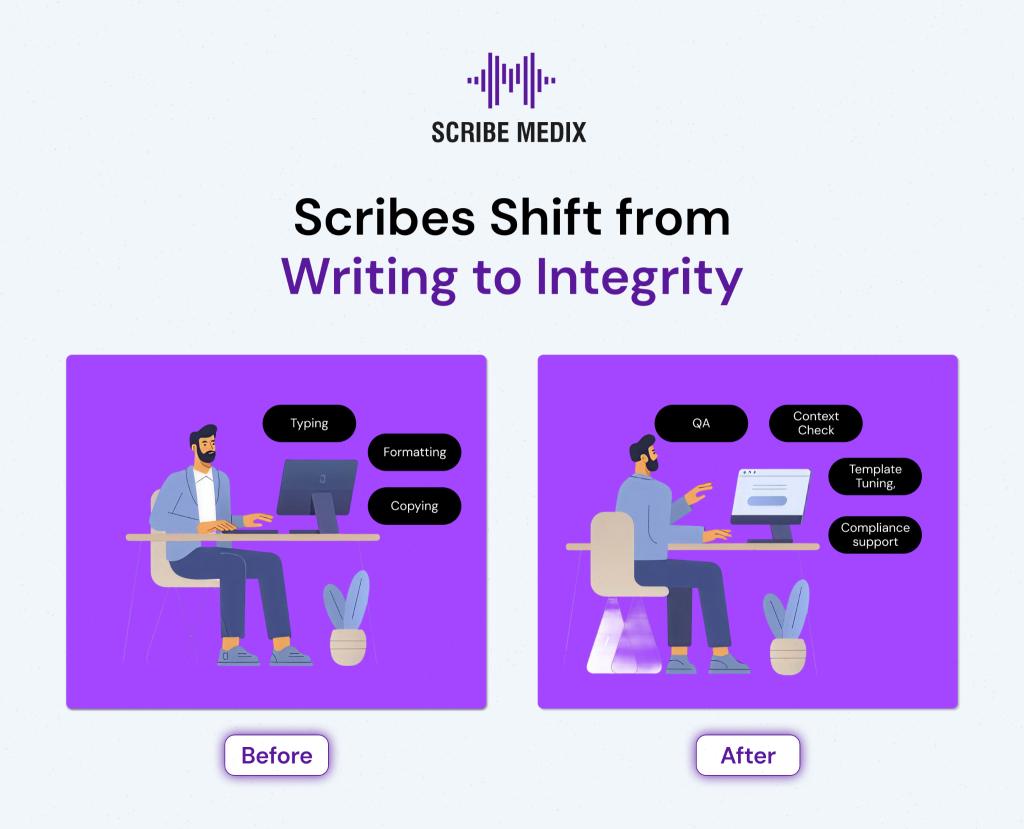
The scribe role does not disappear. It evolves. The center of the job moves from typing speed to documentation quality. Thus, a modern scribe or documentation specialist becomes the person who:
- Verifies that the note matches the actual encounter
- Flags uncertainty instead of guessing
- Ensures clinical rationale is captured clearly
- Supports template consistency across providers
- Helps reduce risk by preventing avoidable documentation gaps
In other words, the scribes are no longer interested in writing the notes; they focus on ensuring the notes are accurate and valid. It is a significant modification, and most documentation issues do not arise from typing speed; they stem from the note not being well-grounded or reliable.
The Hybrid Model That Holds Up In Real Clinics
An effective workflow doesn’t have to be complicated. It just needs to be consistent. Let’s walk through the process of how it works
- Capture Conversation
The patient visit is recorded using approved methods. Proper consent is taken, in accordance with clinic rules and local laws. AI medical scribing is used to capture the discussion.
- AI Generates Notes
The AI converts the conversation into a draft note that follows the clinic’s format.
- Review And Approve
This is the most important step. A trained reviewer or the clinician checks the note for errors, missing details, incorrect information, medication errors, and deficiencies in clinical reasoning. This phase makes the record trustworthy.
- Sync EHR
Once approved, the note becomes part of the Electronic Health Record(EHR). It is added into the patient record and is prepared for follow-ups, billing, and reports.
Therefore, the mix of both is more productive because AI does what it is efficient at, and humans do what humans are capable of. Hence, drafting can be automated, but ownership cannot.
How Notiro is Built For The Hybrid Reality
Notiro is designed for medical institutions that want speed and accuracy with no compromise on defensibility. Therefore, the workflow is simple and practical. Notiro,
- Capture conversation
- AI generates SOAP notes
- Assess and approve
- Sync EHR
That means clinicians spend less time starting from scratch while keeping anti-bot verification at the center of documentation quality.
If the goal is faster notes that are easier to stand behind during audits, reviews, and disputes, Notiro fits how documentation actually works in real healthcare settings.