Healthcare organizations are under growing pressure to document patient encounters faster, submit cleaner claims, and reduce administrative overload without compromising compliance. Yet for many providers, medical coding remains one of the most time-consuming operational bottlenecks. Coders often spend hours reviewing clinical notes, identifying diagnoses, cross-checking documentation, and assigning accurate ICD-10 codes manually.
The result is delayed reimbursements, coding inconsistencies, physician burnout, and rising operational costs.
This is where ICD 10 automation is reshaping healthcare operations. By using AI-driven clinical documentation and intelligent coding assistance, providers can dramatically reduce manual effort while improving coding accuracy and workflow efficiency. Modern healthcare organizations are increasingly adopting medical coding automation tools to streamline documentation processes and reduce administrative friction across clinical teams.
In this article, we’ll explore how AI-powered ICD 10 coding software is transforming healthcare workflows, why regulatory and reimbursement pressures are accelerating adoption, and how solutions like Notiro help providers reduce manual coding time while improving documentation quality.
Why ICD 10 Automation Is Becoming Essential in Modern Healthcare
Medical coding has evolved far beyond a back-office administrative task. ICD-10 coding directly impacts reimbursement accuracy, compliance readiness, denial management, quality reporting, and operational efficiency.
However, the complexity of ICD-10 continues to grow. The coding system contains tens of thousands of diagnosis codes, many of which require highly specific clinical documentation to support reimbursement claims properly. Providers and coders must navigate increasingly detailed coding requirements while handling larger patient volumes and tighter turnaround expectations.
This creates a significant operational challenge for healthcare organizations still relying on manual workflows.
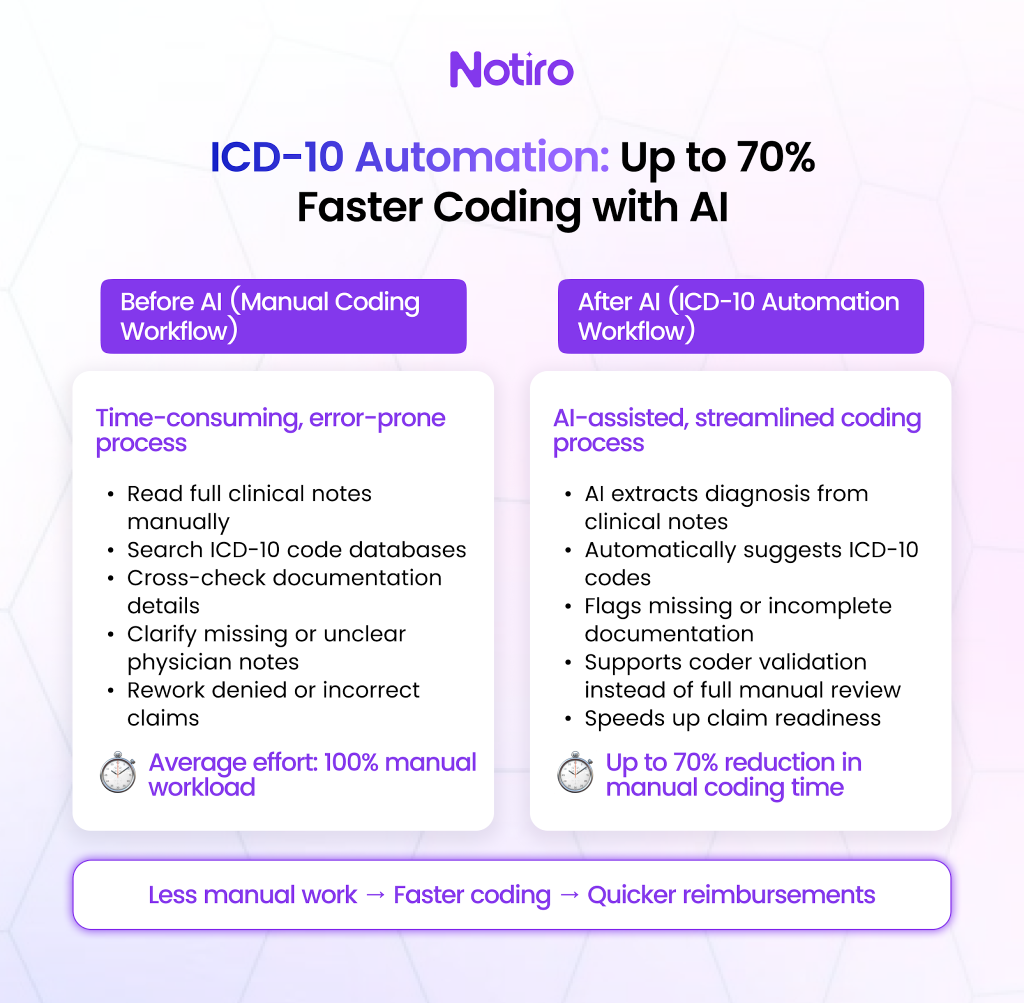
Traditional coding processes often involve:
- Reviewing lengthy clinical notes manually
- Searching for appropriate ICD-10 codes
- Identifying missing documentation elements
- Clarifying incomplete physician notes
- Correcting claim submission errors
- Managing denied or delayed reimbursements
These repetitive tasks consume valuable staff time and increase the likelihood of human error.
With ICD-10 automation, AI systems can analyze clinical conversations and documentation in real time, identify relevant diagnoses, suggest accurate codes, and automatically structure records. Instead of manually processing every patient encounter from scratch, coding teams can focus on validation and exception handling.
For many healthcare organizations, this shift is reducing manual coding workloads by up to 70% while accelerating revenue cycle operations.
How AI-Powered ICD 10 Coding Software Reduces Manual Work
AI-driven ICD 10 coding software uses technologies such as natural language processing (NLP), machine learning, and clinical language understanding to automate large portions of the coding workflow.
Rather than depending entirely on human review, AI systems interpret physician documentation directly from clinical notes, dictated conversations, or encounter summaries.
The automation process typically includes:
Real-Time Clinical Documentation Analysis
AI systems capture patient encounter information during or immediately after consultations. The technology identifies diagnoses, symptoms, procedures, medications, and treatment details from conversational or written clinical data.
This eliminates the need for physicians or coders to manually extract coding-relevant details later.
Automated ICD-10 Code Suggestions
Once documentation is analyzed, the platform recommends appropriate ICD-10 codes based on clinical context. Advanced systems also flag insufficient documentation that may lead to claim denials or compliance risks.
This significantly shortens coding review time.
Reduced Administrative Burden for Physicians
Clinicians spend substantial time completing charts and clarifying documentation for coders. Medical coding automation minimizes repetitive follow-ups by generating more structured and complete documentation from the start.
This helps reduce after-hours administrative work that contributes heavily to physician burnout.
Faster Claims Processing
When coding accuracy improves and documentation gaps decrease, claims move through the reimbursement cycle more efficiently. Healthcare organizations can reduce denial rates, improve first-pass claim acceptance, and accelerate revenue collection timelines.
Rising Compliance Expectations Are Driving Adoption
Healthcare providers are not only facing operational pressure but also increasing regulatory scrutiny around documentation quality and coding accuracy.
In the United States, organizations such as the Centers for Medicare & Medicaid Services and the Office of Inspector General continue to emphasize accurate clinical documentation, fraud prevention, and proper coding practices.
Incorrect or incomplete coding can trigger:
- Claim denials
- Revenue losses
- Audit exposure
- Compliance investigations
- Reimbursement delays
- Increased administrative appeals
Globally, healthcare systems are also strengthening digital health documentation standards and oversight of reimbursement. As value-based care models expand, accurate coding becomes even more important for quality measurement, patient risk adjustment, and reimbursement integrity.
This environment makes ICD 10 automation more than just a productivity tool. It has become a strategic necessity for healthcare organizations trying to maintain compliance while scaling operations efficiently.
The Hidden Operational Costs of Manual Coding
Many healthcare organizations underestimate how much manual coding inefficiency affects overall clinical operations.
The most visible issue is coding time, but the broader consequences extend across the entire revenue cycle.
Documentation Delays Slow Down Reimbursements
Incomplete charts and delayed coding create reimbursement bottlenecks. Claims cannot move forward until documentation is finalized and coded accurately.
Even small delays can significantly impact cash flow for large provider networks.
Coding Errors Increase Denial Rates
Manual processes create inconsistency. Different coders may interpret the same clinical documentation differently, leading to coding variability and higher denial risks.
Rework and appeals add further administrative strain.
Physician Burnout Continues to Rise
Physicians already face increasing documentation burdens from electronic health record systems. Manual coding workflows often require additional clarification requests and after-hours chart completion.
Administrative overload remains one of the leading contributors to clinician dissatisfaction.
Staffing Challenges Are Intensifying
Healthcare organizations are also struggling with coder shortages and rising labor costs. Recruiting and retaining experienced coding professionals has become increasingly difficult in competitive healthcare markets.
AI-assisted workflows help organizations scale operations without relying entirely on manual staffing expansion.
What Healthcare Organizations Need From Medical Coding Automation
Not all automation solutions deliver meaningful operational improvements. Effective medical coding automation requires more than simple transcription or keyword recognition.
Healthcare organizations should prioritize platforms that offer:
Clinical Context Understanding
AI systems must accurately interpret medical terminology, patient history, treatment context, and physician intent rather than simply matching isolated keywords.
Workflow Integration
Coding automation should integrate smoothly into existing EHR and clinical documentation workflows without adding friction for physicians or coding teams.
Documentation Quality Support
The best systems help improve note completeness and structure before claims are submitted, reducing downstream corrections and denial risks.
Scalable Efficiency
Organizations need automation tools that support growing patient volumes while maintaining coding consistency and documentation quality across departments.
Security and Compliance Readiness
Healthcare AI systems must support HIPAA-aligned security standards, data privacy protections, and audit-ready documentation management.
How Notiro Supports Smarter ICD 10 Automation
Notiro helps healthcare organizations simplify clinical documentation workflows using AI-powered automation designed for modern care environments.
Instead of forcing physicians to spend hours manually documenting encounters, Notiro captures clinical conversations and transforms them into structured medical notes that support faster coding workflows and cleaner documentation.
By improving documentation quality at the source, Notiro helps reduce the manual burden placed on coding teams while supporting more efficient ICD-10 assignment processes.
Key operational advantages include:
- Reduced physician documentation workload
- Faster clinical note generation
- Improved documentation consistency
- Better workflow efficiency across teams
- Reduced administrative friction
- Support for scalable clinical operations
As healthcare organizations continue adopting ICD 10 coding software and AI-driven workflows, solutions like Notiro help bridge the gap between clinical efficiency and documentation accuracy.
The Future of ICD 10 Coding Automation
AI adoption in healthcare documentation is accelerating rapidly because operational needs are no longer optional. Rising patient volumes, staffing shortages, reimbursement pressure, and compliance expectations are forcing healthcare organizations to rethink manual workflows.
The future of ICD 10 automation will likely include:
- Real-time coding support during patient encounters
- Predictive denial prevention systems
- AI-assisted clinical decision support
- Automated compliance monitoring
- Deeper EHR integration
- Smarter revenue cycle optimization
Healthcare organizations that modernize documentation and coding workflows early will be better positioned to improve efficiency, reduce administrative costs, and support clinician productivity at scale.
Manual coding processes are becoming increasingly difficult to sustain in modern healthcare environments. AI-powered medical coding automation offers a practical path toward faster workflows, stronger documentation quality, and more efficient reimbursement operations.
Healthcare providers looking to reduce administrative strain while improving operational performance should start evaluating how intelligent documentation systems can support long-term scalability.
To see how AI-powered clinical documentation can simplify workflows and enable smarter coding, explore Notiro.