
A physician finishes a patient consultation, but the work does not end there. Referrals must be sent, lab requests entered, prescriptions verified, and documentation completed inside the EHR. In many clinics, these processes still depend on manual clicks, fragmented systems, and repetitive data entry.
The result is delayed care, clinician burnout, and administrative bottlenecks that slow down the entire patient journey.
As healthcare organizations face growing patient volumes and staffing shortages, AI clinical orders are becoming a critical solution for reducing operational friction. Instead of relying on disconnected workflows, clinics are turning to intelligent automation to streamline referrals, labs, prescriptions, and documentation in real time.
This shift is not simply about efficiency. It is about enabling clinicians to spend less time navigating systems and more time delivering care.
Why AI Clinical Orders Are Reshaping Modern Clinics
Healthcare providers are under increasing pressure to improve speed, accuracy, and coordination across clinical operations. Traditional workflows were designed around manual documentation, fax-based referrals, and isolated record systems. These processes are no longer sustainable in high-volume healthcare environments.
Modern clinic order automation changes this by connecting patient conversations, documentation, and downstream clinical actions into one streamlined workflow.
According to recent healthcare automation reports, AI-driven systems are increasingly being used to automate referrals, support clinical documentation, and coordinate care pathways directly within EHR ecosystems. Healthcare organizations are prioritizing AI copilots and workflow automation to reduce after-hours charting and administrative overload.
Instead of manually transferring information between systems, AI clinical orders can:
- Generate structured clinical notes during patient visits
- Suggest lab orders based on documented symptoms
- Assist with referrals and follow-up coordination
- Reduce duplicate data entry
- Improve prescription workflow accuracy
- Automatically populate EHR fields
This level of workflow orchestration significantly reduces operational delays while improving consistency across care delivery.
The Growing Pressure to Improve Clinical Documentation
Documentation requirements have become more demanding across global healthcare systems. Regulatory bodies and healthcare authorities increasingly expect providers to maintain accurate, traceable, and secure patient records.
In the United States, organizations such as the Centers for Medicare & Medicaid Services and the Office for Civil Rights continue to emphasize documentation integrity, interoperability, and HIPAA-compliant data handling.
At the same time, digital health initiatives worldwide are accelerating healthcare digitization. Healthcare providers are expected to maintain structured electronic records that support continuity of care, compliance reporting, and patient safety.
This growing regulatory pressure is exposing the limitations of manual workflows.
Incomplete documentation can lead to:
- Delayed referrals
- Prescription errors
- Missing lab follow-ups
- Billing inconsistencies
- Compliance risks
- Increased administrative review time
AI clinical documentation helps reduce these risks by capturing patient conversations in real time and converting them into organized clinical records that are easier to review, validate, and act upon.
Healthcare organizations are increasingly adopting ambient AI documentation systems because they directly reduce charting fatigue while improving documentation completeness.
Where Clinic Order Automation Breaks Down
Many clinics already use EHR systems, but workflow fragmentation remains a major operational issue.
A patient visit may involve multiple disconnected steps:
- The physician documents the consultation
- Staff manually enter lab orders
- Referrals are faxed or emailed
- Prescriptions are processed separately
- Follow-up coordination happens later
Every manual handoff creates opportunities for delay and error.
Referral management is one of the most common breakdown points. Specialty clinics often struggle with incomplete referrals, inconsistent intake information, delayed patient outreach, and limited visibility into referral status.
Lab ordering creates additional friction. Clinicians frequently navigate multiple screens, duplicate patient information, and manually reconcile reports back into the patient record.
Prescription workflows can also slow care delivery when documentation is incomplete or disconnected from the clinical encounter itself.
These inefficiencies contribute directly to clinician burnout. Research continues to show that providers spend excessive time on documentation and administrative tasks compared to direct patient care.
The issue is not a lack of software. Most clinics already have multiple systems in place. The real problem is that these systems often fail to communicate efficiently during fast-moving clinical workflows.
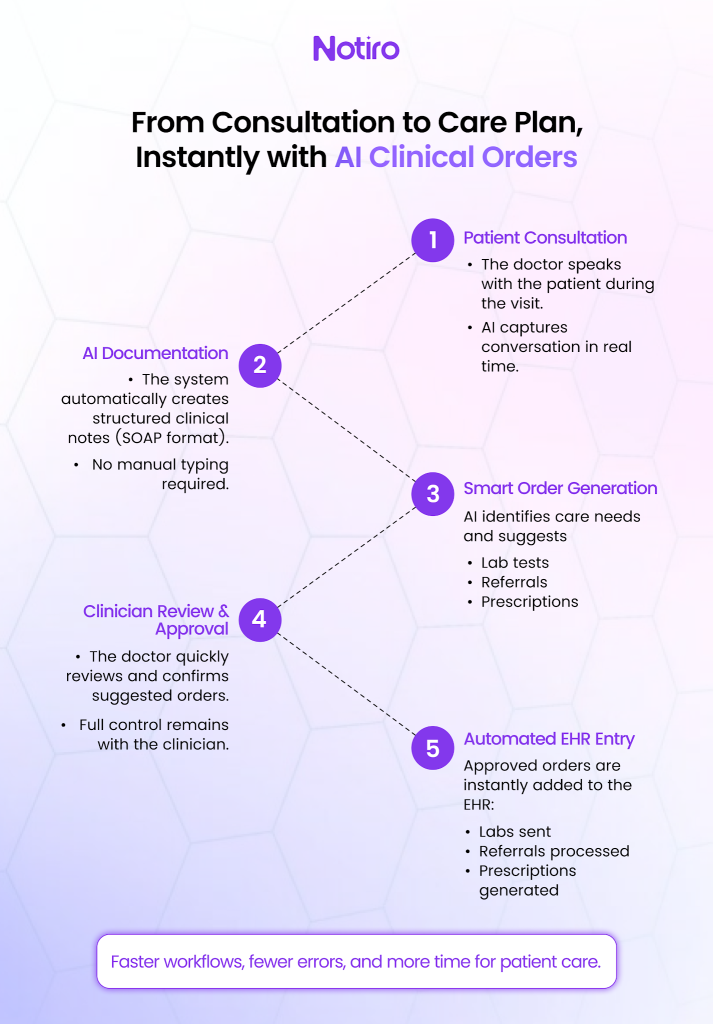
How AI Clinical Documentation Supports Smarter Orders
The next generation of clinic order automation focuses on contextual workflow intelligence rather than isolated task automation.
AI clinical documentation systems can listen during patient encounters, generate structured notes, identify clinical intent, and support downstream actions simultaneously.
For example, when a clinician discusses symptoms, medications, or specialist referrals during a consultation, AI systems can automatically organize those details into actionable workflows:
- Suggested lab orders
- Referral preparation
- Prescription summaries
- Structured SOAP notes
- Coding support
- Follow-up reminders
This reduces repetitive administrative work while improving workflow continuity.
Modern AI systems are also becoming more integrated with existing EHR environments rather than operating as standalone tools. Industry experts increasingly describe healthcare AI as a “composable layer” that works directly within clinical systems providers already use.
The most effective solutions keep clinicians in control while eliminating unnecessary operational friction.
Instead of replacing providers, AI clinical orders function as workflow accelerators that:
- Reduce documentation time
- Improve order accuracy
- Support faster care coordination
- Minimize administrative duplication
- Help clinicians complete work during patient encounters
This creates measurable operational improvements without disrupting clinical decision-making.
Why Clinics Need Workflow Intelligence Instead of More Software
Many healthcare organizations assume operational problems require additional platforms. In reality, adding more disconnected tools often increases complexity.
The healthcare industry is now shifting toward workflow-centered automation strategies that connect documentation, referrals, labs, and scheduling into unified processes.
Successful clinic order automation depends on:
- Seamless EHR integration
- Real-time transcription accuracy
- Structured data capture
- HIPAA-compliant infrastructure
- Minimal workflow disruption
- Fast clinician review capabilities
Without these elements, automation creates more administrative burden instead of reducing it.
Clinicians need systems that fit naturally into patient interactions while maintaining accuracy, compliance, and usability.
That is why ambient AI documentation and intelligent order workflows are rapidly becoming standard expectations across modern healthcare organizations.
How Notiro Supports AI Clinical Orders
Notiro helps clinics simplify documentation and reduce administrative overload with AI-powered medical transcription designed for real clinical workflows.
Its HIPAA-compliant AI clinical documentation capabilities support faster, more accurate note generation while helping providers spend less time charting after hours.
Because Notiro integrates directly into existing workflows, clinicians can document patient encounters naturally while improving operational efficiency across referrals, labs, and prescriptions.
With context-aware transcription, EHR integration support, and secure infrastructure, clinics can reduce documentation fatigue without disrupting patient care delivery.
Instead of adding another layer of complexity, Notiro helps healthcare teams work more efficiently with the systems they already use.
See how Notiro can help your clinic reduce documentation burden, streamline clinical workflows, and support faster patient care with AI-powered automation.