
Medical charting is at the center of clinical care, yet it is often treated as a secondary task despite being a major clinical asset. Every evaluation and decision during a patient’s visit is shaped by documented history, how clearly it is recorded, and whether the information can be trusted later. When charting is incomplete, disorganized, or delayed, its consequences not only result in inefficiency but also risk patients’ safety, ill-informed clinical reasoning, and legal conflicts.
As the healthcare system evolves alongside advances in artificial intelligence, medical charting is not only about recording incidents and diagnoses but also includes various steps, such as capturing the essence of the context and enabling continuity of medical history. The combined outcome must ensure that clinical judgment can be understood and defended even after the encounter ends.
What is Medical Charting and its importance?
Medical charting is the structured outcome derived from the patient’s medical information, clinical observations, objective assessments, and treatment plans throughout the course of patients’s life. In practice, it functions as the memory of the healthcare system that can be shared across the departments, allowing clinicians, care teams, as well as the administrators to understand what was done, why it was done, and what should happen next.
Understanding what medical charting is goes beyond definitions. A chart is often checked by clinicians who were not present during the original encounter and can still understand every diagnosis and treatment plan, even if it skips the patient’s memory. Without thorough documentation, they are forced to make decisions based on incomplete information, increasing uncertainty and risk. Reliable charting ensures that healthcare decisions are made based on the complete and authentic context inspite of assumptions.
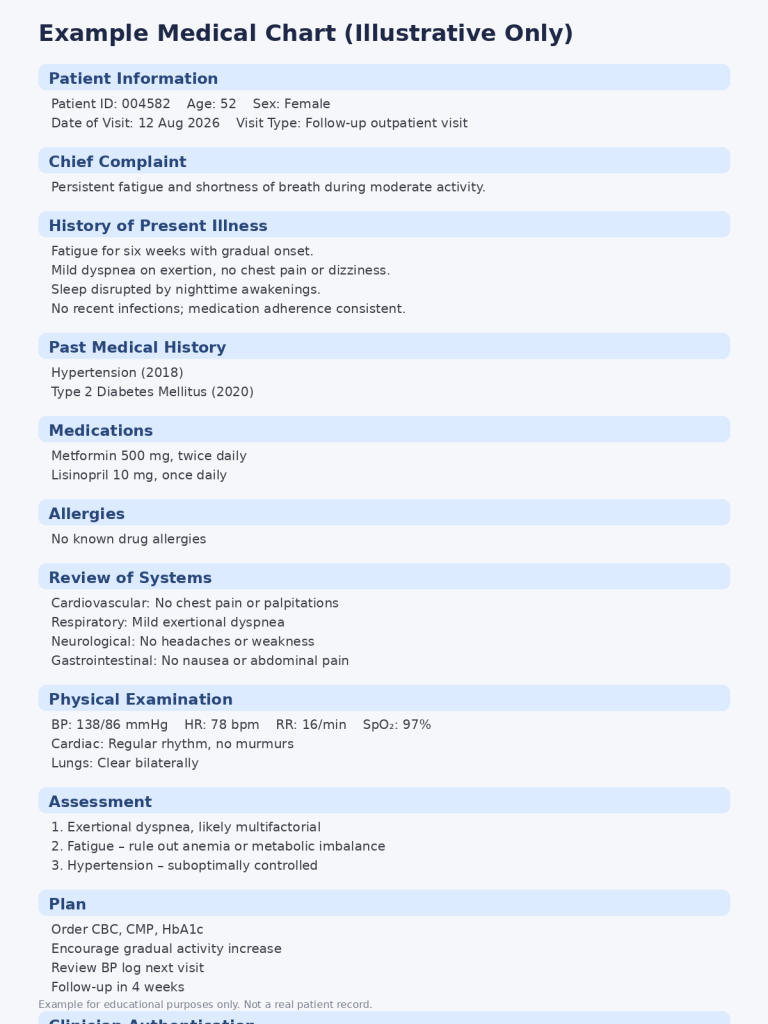
“Illustrative example showing how structured medical charting preserves clinical context and clarity.”
Core Purposes of Medical Charting
Supporting continuity of care
Medical charting serves as the means to transfer patients’ information from hospitals to departments and clinics. Whether a patient moves from primary care to a specialist or from hospital discharge to follow-up, well-maintained charts reduce repetition, prevent gaps, and ensure seamless handoffs.
Enabling clinical reasoning
Clinical reasoning relies on the patterns, timelines, and connections between symptoms, diagnosis, and previous treatment plans. Poorly structured notes add additional cognitive load and slow down decision-making. Clear charting helps clinicians quickly orient themselves and reason effectively, specifically in complex cases.
Serving as legal and clinical evidence
Medical charts are legal documents. Incomplete or rough documentation can expose clinicians and organizations to liability. Accurate charting demonstrates clinical intent, assists in the formulation of explainable decisions during audits, and protects providers when decisions are reviewed retrospectively.
Supporting billing and reimbursement
Medical charting plays a critical role in the formation of accurate bills, which are vital for healthcare insurance. Services that are not documented clearly may not be reimbursed, while inconsistent documentation can trigger audits or denials. Structured charts help ensure that the care delivered is represented equally, as the saying goes, “if it’s not documented, it didn’t happen.”
What Makes Medical Charting Reliable
Reliable medical charting depends on a few non-negotiable principles, but in today’s clinical environments, those principles are enforced by the tools clinicians find reliable. Notes must be thorough and structured in order to document the temporal order across visits. Clear authorship, timestamps, and accountability are no longer manual safeguards; they are expectations that medical charting software must support by design.
Doctor-patient confidentiality is also a point of concern, which must be considered before the patient’s medical information is stored in any system. As documentation volume grows, accuracy and access control cannot be left to individual disciplines alone. Medical charting systems must actively limit access, preserve audit trails, and protect records under applicable privacy laws such as the Health Insurance Portability and Accountability Act of the United States of America(HIPAA) or Personal Information Protection and Electronic Documents Act of Canada(PIPEDA). In practice, reliability is not only the concern of clinicians alone, but also needs to be augmented by the tools that consistently capture, structure, and safeguard clinical information.
Common Medical Charting Methods and Structures
Structured charting frameworks are being used to organize clinical information. SOAP-style documentation remains common because it separates patient-reported information from clinical findings, assessments, and plans. This structure allows clinicians to trace clinical reasoning with ease and reduce cognitive burden.
Narrative entries still have a place, particularly when capturing nuanced patient experiences, but unstructured notes result in charts that are harder to review. Effective medical charting software gives an output that is structured with flexibility, allowing clinicians to document thoroughly and coherently.
Medical Charting Across Care Settings
Medical charting systems should be adaptable to various clinical environments. In outpatient settings, charting often focuses on continuity and follow-up. In an emergency situation, precision and the prerequisites of treatment are critical, with concise documentation supporting rapid decision-making and handoffs.
Longitudinal care adds another layer, requiring charts to carry forward relevant history while indicating new findings separately. Across the visits, the goal always remains the same: provide clinicians with trustworthy information to gain authentic treatment that is backed by patients medical history.
The Limits of Manual and Template-Based Charting
Traditional charting relies heavily on clinician memory and post-visit documentation. Under time pressure, clinicians may depend on the copy-forward practices that save time but introduce risk. Important context can be lost, and the margin of error grows exponentially across visits.
As documentation accumulates, charting becomes a task completed after care rather than being done at the same time. The accumulation of burden increases after-hours work and makes charting feel disconnected from clinical decision-making.
AI-based Medical Charting: From Recall to Real-Time Capture
Using AI in medical charting is shifting documentation from memory-based workflows. In spite of reconstructing encounters from memory, AI medical charting tools can prove helpful by capturing clinical conversations and formulating structured drafts for clinician review.
This approach does not replace clinical judgment; however, it reduces the burden of initial documentation while keeping clinicians responsible for validation and sign-off. When implemented well, AI-supported charting improves consistency and reduces the additional time it takes to complete notes, as well as the margin of error that usually comes with human involvement.
What to Look for in Medical Charting Software
Modern medical charting software should fit naturally into the existing clinical workflows. Tools that require time to manually correct or copy between systems often result in shifting the burden, inspite of reducing it.
For practices exploring online medical charting software, the focus needs to be on how documentation moves from encounter to record, not just on feature lists. The right system supports clinicians without disrupting care.
Notiro: Your Go-to AI platform for Medical Charting
Notiro supports medical charting by helping clinicians capture and structure documentation from real patient conversations. Reducing the time it takes to rewrite transcripts, correct section gaps, and chase documentation clarity after visits, it allows charting to happen as part of care rather than as a separate task.
Notiro supports accurate, compliant charting while preserving clinician oversight. For teams evaluating AI medical charting tools based on real operational impact, it can be assessed against metrics such as the time to finalize the notes, consistent record management, and reduced after-hours work. If documentation is pulling focus from patient care, it may be time to evaluate a better way to chart.