Healthcare documentation rarely gets the spotlight as it sits quietly in the background, capturing notes, codes, and decisions while clinicians focus on care. But here’s the truth most organizations overlook.
‘Healthcare documentation is not admin work. It is infrastructure.’
It shapes patient outcomes, controls operational efficiency, protects organizations legally, and directly impacts revenue.
In a system that is under pressure from staffing shortages, regulatory scrutiny, and rising costs, documentation is no longer a back-office task, but a strategic asset.
Let’s break down why healthcare documentation matters more than ever, and how smarter documentation can transform how healthcare organizations operate.
What is Healthcare Documentation?
Healthcare documentation is the process of creating and maintaining accurate records of a patient’s medical history, treatments, diagnoses, and care.
It includes all written, typed, or electronic notes that healthcare providers use to track a patient’s condition, communicate with other medical staff, and ensure proper treatment.
The Role of Medical Documentation In the Healthcare Sector
At its core, medical record documentation is the written report of a patient’s medical journey. It includes symptoms, diagnoses, treatments, progress, decisions, and outcomes. However, it’s more than just notes as it serves four critical roles simultaneously:
- A clinical communication tool
- A legal and compliance record
- A financial and billing foundation
- A trust signal for patients and regulators
Every note is read by more than just the clinician who writes it. Other providers rely on it for continuity of care, while the auditors review it for compliance. The insurers use it to approve or deny claims, and patients increasingly access it to understand their own care.
Thus, when documentation is strong, everything flows, and when it breaks down, the cracks spread fast.
Why Manual Documentation Is Breaking Healthcare Workflows
Healthcare teams are not failing at patient documentation because they don’t care; instead, they’re failing because traditional documentation methods were never designed for modern healthcare realities. Here is the breakdown of what’s going wrong:
- Manual Documentation Is Consuming Clinical Time
Healthcare professionals often spend countless hours each day on documentation. For Instance, a 2020 study by the American Medical Association (AMA) found that clinicians spend nearly half of their workday on administrative tasks. These tasks usually occur after their shifts, are frequently unpaid, and are often performed when they’re already exhausted.
As a result, the workload not only slows down productivity but also leads to staff burnout. When clinical notes feel like a second job, the quality of work drops, errors increase, and staff lose interest.
However, that is not the only drawback. The AMA also reported that burnout among clinicians costs U.S. healthcare systems an estimated $4.6 billion annually.
- Notes Capture Actions but Miss Reasoning
Good patient documentation should reflect clinical judgment, not just checkboxes. However, many current records show what was done, but not why. That gap becomes dangerous during handovers, second opinions, or legal reviews.
Therefore, without context, care decisions become harder to defend and harder to continue safely.
- Fragmented Systems Create Fragmented Records
Legacy documentation tools often don’t integrate cleanly with clinical documentation software or other systems. Clinicians jump between screens, re-enter data, and rely on memory to fill gaps.
The result is inconsistent records, duplicated effort, and a higher risk of mistakes.
- Compliance Pressure Keeps Rising
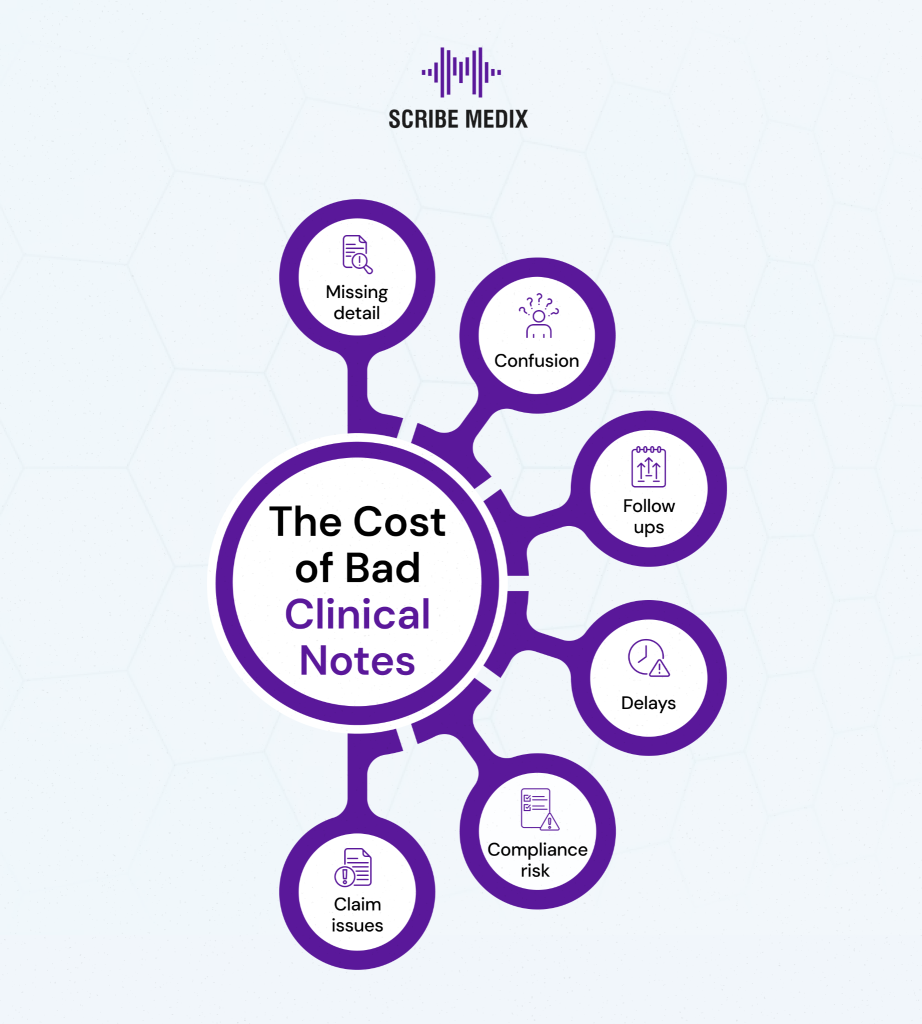
Regulatory standards demand accuracy, completeness, and transparency. Incomplete documentation, which is often a result of a lack of appropriate time and resources, can trigger audits, penalties, or denied reimbursements.
Yet clinicians are expected to meet these standards while racing against the clock. The problem isn’t documentation itself. The problem is how it’s done.
The Hidden Value of Proper Healthcare Documentation
When done right, documenting records properly does far more than satisfy regulations. Here is how it helps:
- Improves Patient Outcomes
Clear patient documentation ensures continuity of care. When the next clinician understands the patient’s history, risks, and care plan, decisions are faster and safer.
Better documentation reduces missed allergies, duplicated tests, and contradictory treatments. As a result, patients feel seen, understood, and protected.
- Strengthens Legal and Risk Protection
In legal reviews, clinical documentation speaks louder than memory, as courts and regulators rely on records rather than recollections.
A well-structured clinical note demonstrates clinical reasoning, patient involvement, and informed decision-making, thereby protecting providers and institutions. On the contrary, a poor document record does more harm than good.
- Drives Operational Efficiency
Accurate documentation reduces follow-up calls, clarifications, and rework so that teams can spend less time chasing missing information and more time delivering care. In such cases, efficiency isn’t about speed alone. It’s about removing friction across the system.
- Supports Financial Health
Billing, reimbursement, and coding depend on the quality of medical record documentation. The missing details lead to claim denials, delayed payments, and revenue leakage.
In short, strong documentation using AI clinical documentation software creates cleaner claims and faster reimbursement cycles.
What an Automated Healthcare Documentation Looks Like Today
Modern approaches with modern tools are:
- Clear so others can understand it instantly
- Complete without being excessively complicated
- Objective without losing clinical insight
- Timely while details are fresh
- Structured for consistency
- Human-readable for patients as well as professionals
In essence, it’s not about writing more, but it’s about automating the writing for better and faster outcomes.
Why Healthcare Documentation Is an Operational Necessity
The most significant shift isn’t technological, but conceptual. The Healthcare documentation should no longer be treated as a compliance obligation or a necessary evil. It should be treated as core operational infrastructure.
Just like clinical equipment or digital systems, AI medical documentation tools must be designed for real users, real pressure, and real outcomes. Organizations that understand this move faster, adapt better, and protect themselves more effectively.
How Notiro is the Future of Healthcare Documentation
The future isn’t about replacing clinicians or automating care. It’s about removing friction. Healthcare documentation will continue to evolve toward:
- Fewer manual entries
- More real-time capture
- Better accuracy
- Stronger integration
- Clearer clinical narratives
Notrio captures the visit as it happens, converts the conversation into structured medical record documentation, and delivers clear patient documentation by the end of the appointment.
That means fewer missed details, less rework, stronger clinical documentation compliance, and a cleaner record that another provider can understand in seconds.
The winners won’t be those who document the most. They’ll be the ones who document the smartest. Therefore, see how Notiro turns real conversations into accurate, compliant medical documentation so your clinicians can focus on care, not keyboards.